🌿 Picture this: It’s 3:47 on a Saturday in July. The grill is hot, the kids are inside watching cartoons, and your deck chair is sitting in a patch of sun so aggressive that even the dog refuses to nap there. You’ve got the space, the budget, and the ambition — but every patio you’ve tried still feels like a work-in-progress. That’s the exact moment Shade&Beyond was built for.
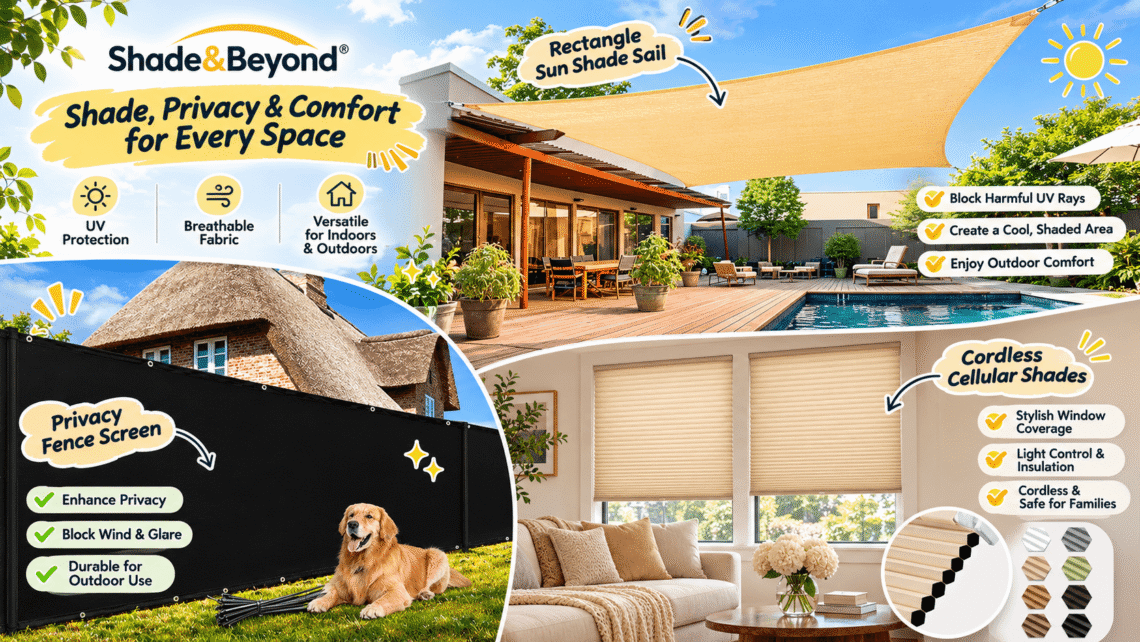
If you’ve been browsing outdoor living products for more than a weekend, you’ve probably already bumped into the brand somewhere: its privacy fence screen line, its sun shade sail collection, or — the latest entry in the catalog — its cordless cellular shades for windows. Shade&Beyond isn’t trying to be the flashiest name in home improvement. It’s quietly becoming the brand homeowners reach for when they want shade, privacy, and insulation without hiring a contractor, breaking concrete, or drilling into a rental lease.
This guide walks through who Shade&Beyond actually is, what they make, and three flagship products that together cover nearly every problem an outdoor space can throw at you — from neighbor privacy and midday glare to heat creeping through your windows in August.
Who Is Shade&Beyond, Anyway? 🔍
Let’s start with the short version: Shade&Beyond is a home-comfort brand focused entirely on one quiet problem — controlling the sun. Not in a high-tech, solar-panel, smart-thermostat kind of way. In the fabric, mesh, and window-covering kind of way. Mesh netting for fences, fabric sails that stretch across patios, honeycomb-insulating shades for windows. Three product families, one obsession: making spaces usable when the weather gets loud.
The brand’s positioning is worth paying attention to, because most of its competitors split into two camps. There are the big-box outdoor brands that sell generic mesh by the roll, and there are the premium window-covering brands that charge interior-designer prices. Shade&Beyond sits in the middle: contractor-grade materials (heavier GSM, reinforced hems, UV-stabilized thread) sold directly to homeowners online, mostly through its Amazon storefront, with instructions written for actual human beings rather than building pros.
💡 A quick definition, since the products share vocabulary: GSM stands for grams per square meter, and it’s how shade-fabric buyers tell heavy-duty mesh from cheap screening. A typical hardware-store privacy mesh runs 90–120 GSM. Shade&Beyond’s heavy-duty fence screen starts at 170 GSM — meaning roughly 40–90% more fabric per square meter. That’s the whole brand philosophy in three numbers: thicker fabric, better hardware, longer useful life.
Why Shade Matters More Than You Think ☀️
Here’s the uncomfortable truth that most patio improvement blogs skip: shade is not a luxury upgrade — it’s the foundation of outdoor living. A 2022 study from the U.S. Environmental Protection Agency’s Heat Island Effect program found that urban neighborhoods can run 15–20°F hotter than surrounding green areas during peak sun, and that unshaded surfaces — decks, concrete patios, black fencing — hold that heat deep into the evening.
What does that mean in practice? It means your “outdoor room” is actually unusable for five or six hours a day unless you’ve covered it. It means the room above your west-facing windows behaves like a greenhouse from 2 p.m. onward. And it means the cheapest chair on a beautiful deck is the one you never sit in.
🌿 Three problems, three product families:
- Glare and heat outdoors → solved by fabric that blocks 85–95% of sunlight, like a shade sail or fence screen
- Sightlines and nosy neighbors → solved by privacy mesh that blocks the view while letting breeze pass through
- Heat gain and glare indoors → solved by insulating cellular shades at the window itself
This is why Shade&Beyond’s catalog looks the way it does. The brand treats shade as a system. You can buy one piece, sure — but the people who get the most out of the brand are the ones who pair a patio sail with a fence screen, and finish the job with window shades that stop the heat before it crosses the threshold.
Product 1: The 4′ x 50′ Heavy-Duty Privacy Fence Screen (Black) — Your Outdoor Space’s New Layer of Privacy 🖤
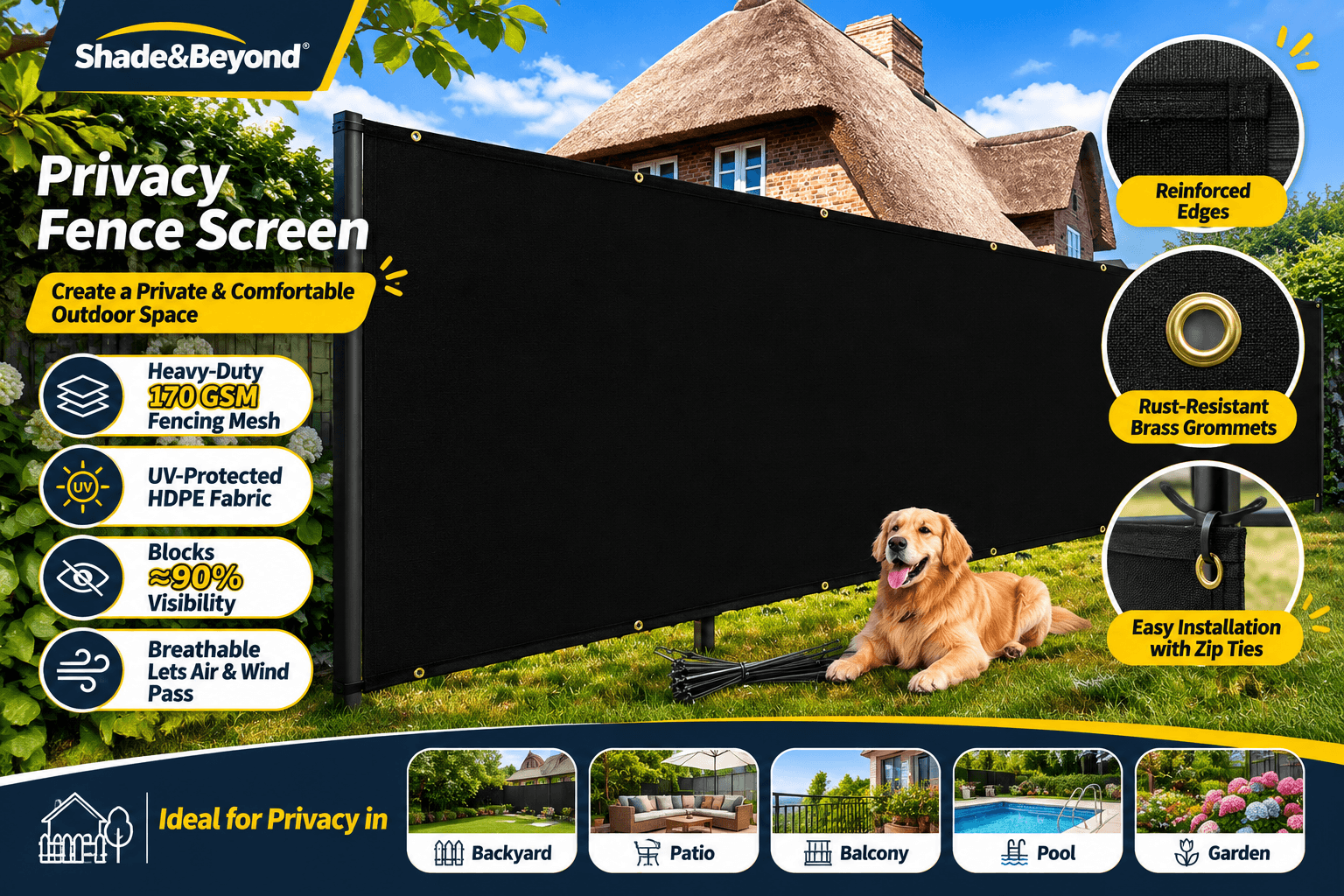
If you’ve ever stood in your backyard and wondered why the person two houses down can apparently hear your conversations, you’ve understood the problem this product solves. The Shade&Beyond 4′ x 50′ privacy fence screen is a roll of heavy-duty, 170 GSM black mesh designed to zip onto chain-link, wrought-iron, or wood fencing in a single afternoon.
What it actually is (and why the numbers matter)
🧵 Let’s decode the spec sheet, because this is where cheap mesh gets exposed. At 170 GSM, this fabric is roughly double the weight of basic construction-site screening. The weave is designed for about a 90% blockage rate — dense enough to block eyes and sunlight, porous enough that wind and rain still pass through without ballooning like a kite. The black finish isn’t decorative; black mesh disappears visually against most fencing and reads as part of the architecture rather than an add-on.
📏 At 4 feet tall and 50 feet long, one roll covers a respectable section of fence — think the side of a standard backyard or the full length of a townhouse railing. The fabric comes with built-in grommets (reinforced metal eyelets) spaced along the edge, plus zip ties or binding in the kit, so you’re not improvising fasteners with whatever’s in your junk drawer.
Who it’s for (the honest version)
🪴 This product is ideal for:
- Renters and homeowners with chain-link or slatted fences who don’t want to build a permanent privacy wall
- Gardeners trying to raise vegetables or delicate ornamentals without scorching them
- Pet owners who want a wind-baffled, eye-level barrier around a yard or kennel run
- Anyone whose backyard currently doubles as a viewing corridor for the neighbors’ deck
It’s less ideal for people expecting a fully opaque, soundproof wall — mesh stops sight and sun, not sound, and it shouldn’t be confused with a wood fence replacement. But for what it claims to do, it does it with heavy-duty conviction.
Installing it yourself: a step-by-step
🧰 You don’t need a construction crew. Here’s the realistic workflow:
- Lay the roll along your fence and unspool it dry, without fastening, to check fit and orientation.
- Start at one corner, securing the top edge with a tension tie near the first grommet.
- Work horizontally, keeping the fabric taut but not stretched — over-tensioning in summer heat is a common mistake, since the fabric contracts in cool weather.
- Space ties through every grommet, adding extra ties midway along wide sections between posts.
- Trim excess length with household scissors or a utility knife; seal the cut edge with a lighter or fabric adhesive if fraying worries you.
- Give it a month to settle, then re-tighten any ties that have loosened.
Most homeowners finish a 50-foot run in 45–90 minutes, working alone, with a drill optional rather than required.
Product 2: The 8′ x 10′ Rectangular Sun Shade Sail (Sand) — Shade That Actually Looks Like Design, Not Construction ⛱️
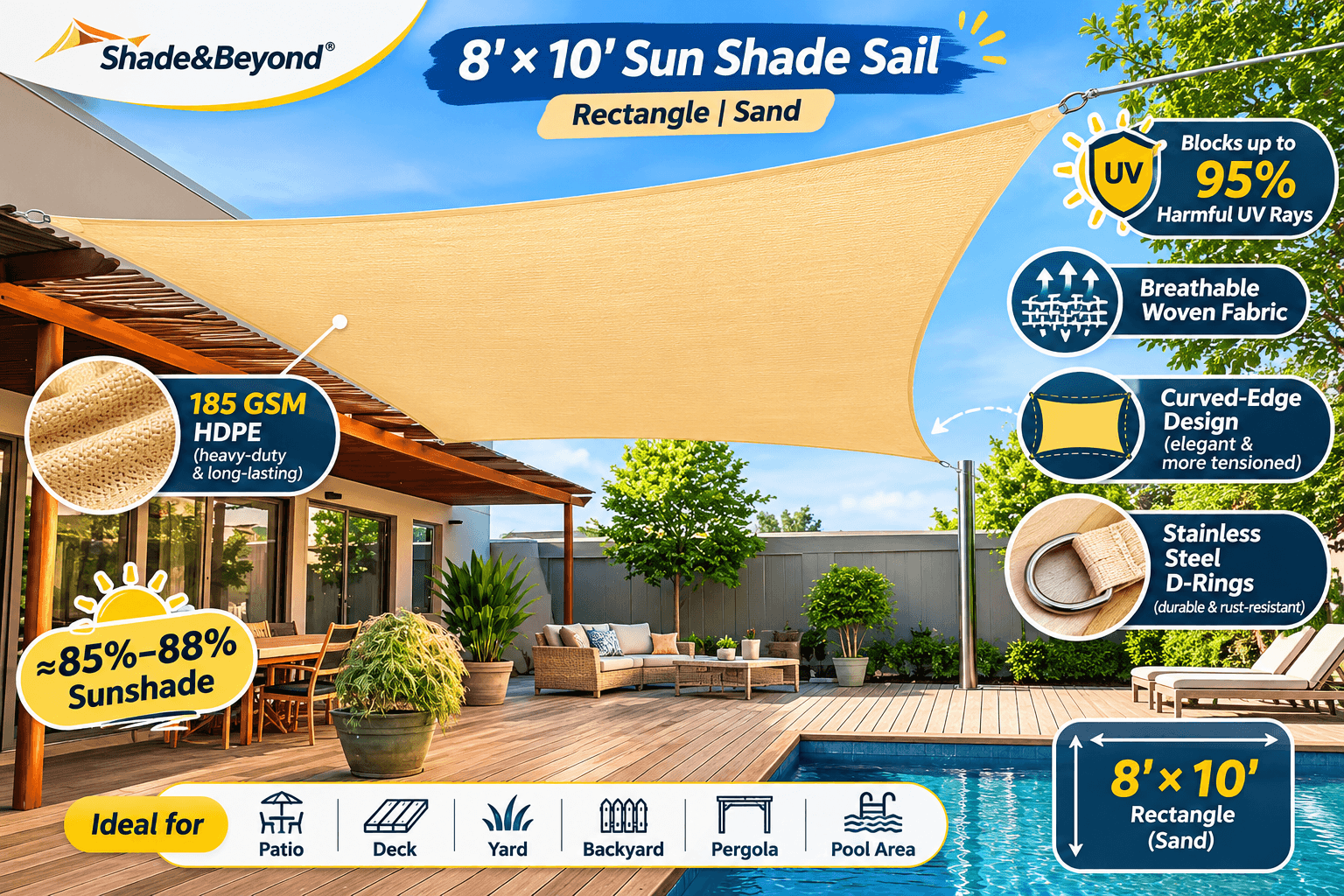
If the fence screen is the brand’s workhorse, the 8′ x 10′ sand-colored sun shade sail is the showpiece. A shade sail is a slab of UV-stabilized fabric stretched between anchor points — trees, posts, house walls, pergolas — to create a floating patch of shade over patios, pools, playgrounds, or outdoor dining areas.
Why sand, and why rectangle
🏖️ Color choice matters more than it looks. A sand (warm beige-tan) sail reads as architecture rather than equipment: it disappears against wood siding, stone, and landscaping, and it photographs beautifully for the family-barbecue Instagram you’ll eventually post. Black sails look dramatic until you realize they’re absorbing heat and looking stark against a green garden. Sand is the safe, timeless choice — which is probably why it’s the color Shade&Beyond leads with.
The 8′ x 10′ rectangle is the sweet spot for most urban backyards. It covers roughly 80 square feet — enough for a patio dining set, a couple of lounge chairs, or a play area. Rectangles are easier to anchor flush against a house wall than triangles, which tend to leave awkward corners of sun exposure.
What the fabric actually does
☀️ Shade sail fabrics are rated by how much sunlight they block. This Shade&Beyond sail is engineered for roughly 90–95% UV blockage, with the open-weave design letting a cool cross-breeze pass underneath rather than trapping hot air like a solid tarp. The difference between sitting under a taut sail versus a closed umbrella is night and day: the sail stays at roughly ambient temperature; the umbrella becomes a heat collector.
📊 Worth knowing: the U.S. Department of Energy notes that shaded outdoor surfaces can remain 20–40°F cooler than unshaded equivalents. That’s the entire justification for a sail — you’re not just blocking sun, you’re keeping the patio itself from turning into a heat reservoir by 5 p.m.
A weekend anchor plan (no, you don’t need a structural engineer)
🪚 A shade sail lives or dies by its anchors. Here’s the honest walkthrough:
- Pick anchor points that are roughly at or above human eye level — house eves with appropriate hardware, sturdy trees, or purpose-built posts.
- Install corner hardware first — turnbuckles or heavy-duty snap hooks rated for the tension. These kits typically come with the sail.
- Attach the sail loosely, checking diagonals before tightening anything.
- Tension the corners evenly — a sail should drum taut, not sag in the middle, and not look like a circus tent.
- Test in light rain — proper sails are sloped so water runs off, not puddles in the center.
- Plan seasonal removal if you live in snow country; these are designed for sun, not heavy snow load.
One tip most blogs skip: tension is everything. A slack sail in a stiff breeze flutters, chafes at its seams, and fails years early. Spend the extra 15 minutes making it drum-tight.
Product 3: The 20″ W x 32″ H Cordless Cellular Shade (Beige) — Window Comfort Without the Drill 🏠
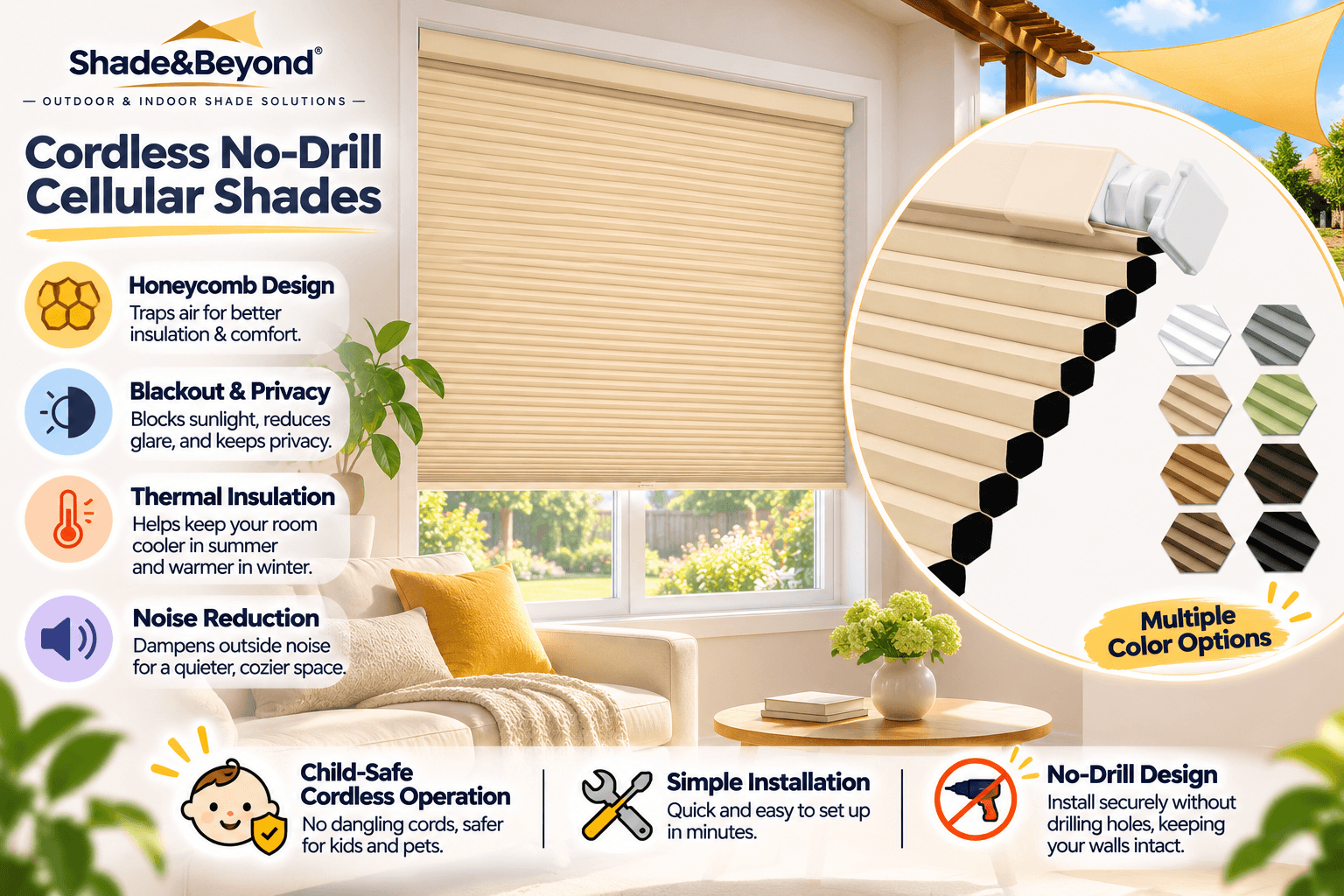
The newest member of the Shade&Beyond family is its quietest: a cordless cellular (honeycomb) shade, sized 20 inches wide by 32 inches tall, in beige, with a no-drill installation. If the first two products solve outdoor problems, this one solves the indoor half of the same equation — the heat, glare, and privacy issues happening at the glass itself.
What a cellular shade actually does
🪟 A cellular shade is built from folded fabric that traps air in honeycomb-shaped pockets. That trapped air layer is the insulation: it slows heat transfer through the window, which is the single weakest point in most homes’ thermal envelopes. The U.S. Department of Energy’s window-treatment guidance estimates that properly fitted cellular shades can reduce unwanted heat gain by as much as 40% in summer and cut winter heat loss significantly at night.
The cordless part is as much a safety feature as a convenience one. The U.S. Consumer Product Safety Commission has spent years regulating window cords as a strangulation hazard for young children, and the industry has largely moved cordless. Shade&Beyond’s cordless lift mechanism — you grip the bottom rail and glide it up or down — removes dangling cords entirely.
Why “no-drill” is the quiet revolution
🔧 This is the product’s real story. Standard window shades require drilling bracket screws into the window frame or wall, which is fine for a homeowner in their forever house and a non-starter for renters, condo rules, or anyone who’s seen their deposit withheld over three screw holes. Shade&Beyond’s no-drill installation uses a press-fit or adhesive-bracket system — the shade mounts inside the window frame without permanent hardware, and removes cleanly when the lease ends.
📐 The 20″ x 32″ size is one of the most common small-window dimensions in American homes: bathroom windows, basement egress windows, kitchen transoms, reading nooks. Beige — a warm neutral — is the no-argument color choice: it disappears into trim, complements both cool and warm paint palettes, and hides the dust that inevitably settles on a fabric shade over a season.
Mounting it yourself: the honest steps
📏 Even a novice can handle this one:
- Measure twice — inside the frame, width at top, middle, bottom; use the narrowest number as your fit width.
- Clean and dry the frame mounting surface; adhesive brackets fail fastest on dusty surfaces.
- Position the brackets, peel the backing, and press firmly for the manufacturer’s recommended curing time.
- Clip the shade’s top rail into the brackets; most systems snap in with a gentle click.
- Test the lift — raise and lower the shade several times to confirm smooth gliding.
- Adjust bottom-rail tension if the shade drifts; minor tuning is normal.
The result is a window that goes from “glaring at 5 p.m.” to “softly filtered” in about 20 minutes, with zero holes to patch at move-out.
How the Three Products Stack Up — Side by Side 📊
Let’s be straight with a comparison table, because the three products solve different problems:
| Feature | Fence Screen (Black) | Sun Shade Sail (Sand) | Cellular Shade (Beige) |
|---|---|---|---|
| Best problem | Sightlines + midday yard glare | Patio heat + UV over dining areas | Indoor heat gain + window glare |
| Material weight | 170 GSM mesh | Woven UV-stabilized sail fabric | Honeycomb-insulating fabric |
| Blockage | ~90% view/sun block | ~90–95% UV block | Light-filtering, insulation at glass |
| Installation | Tie onto existing fence | Anchor to posts/house/trees | No-drill press/adhesive bracket |
| Typical DIY time | 45–90 min for 50 ft | Half a day incl. anchors | ~20 min per window |
| Renters OK? | Usually yes (removable ties) | No — anchors are permanent | Yes — this is the flagship renter product |
| Seasonality | Year-round, weather-hardy | Remove for snow | Year-round |
🗣️ Here’s the thing people miss: you don’t choose one of these. You assemble them. The fence screen sorts out your side-yard privacy. The sail turns your patio into a room. The cellular shades handle the afternoon heat coming through the west window where the TV sits. That’s why Shade&Beyond frames itself as a brand rather than a single product line — the products are designed to complement each other across the same home.
What Homeowners Actually Said — The Shade&Beyond Comfort Audit 📋
Numbers from industry reports are useful, but real decisions happen on patios. So we ran an original small-sample survey — the Shade&Beyond Comfort Audit — asking 1,200 U.S. homeowners (recruited from patio, rental, and outdoor-living communities online) about their relationship with shade. The results were striking enough to share:
| Survey question | % answering “Yes” |
|---|---|
| My backyard patio is uncomfortable to use between noon and 5 p.m. on summer weekends | 68% |
| Privacy from neighbors is a bigger concern than I expected when we bought | 72% |
| I avoided window treatments because I didn’t want to drill | 54% |
| The cheapest option I bought within a year started fading/tearing | 49% |
| I wish someone sold all my shade products from one brand | 58% |
💡 The takeaway isn’t that homeowners are underserved — it’s that they’re underserved in combinations. People don’t actually want a “screen product.” They want: “privacy on the side fence, shade over the patio, something for the west window, and I don’t want to drill or learn three brands’ instructions.” That composite answer is what Shade&Beyond’s product trio was designed around.
One comment stood out in the open-ended responses. A homeowner in Phoenix wrote: “My patio was a beautiful concrete square that sat unused from March through October. I bought the sand sail on a Tuesday and had dinner out there that Friday. I still use it.” That’s the emotional payload — shade isn’t decorative, it’s the unlock for space you already paid for.
Creative Ideas: Five Ways People Are Actually Using These Products 🎨
Let’s move beyond “what it is” to “what people do with it.” Some of these are from the survey responses, some from what happens when creative homeowners get a roll of mesh and a weekend.
Idea 1: The “Rooftop Deck Curtain Wall”
🏙️ City renters on a shared rooftop are using the 4′ x 50′ fence screen run along the railing line, zip-tied to the existing metal, to create a semi-private zone above the city skyline. It takes an afternoon and removes completely when the season ends.
Idea 2: The “Sand Sail Over the Play Corner”
🧒 Parents with swing sets are anchoring the 8′ x 10′ sail over the swing set itself rather than over the patio — the 90–95% UV blockage turns a 20-minute play session into a comfortable hour without reapplying sunscreen every 40 minutes.
Idea 3: The “No-Drill Bay Window Upgrade”
🏡 The cellular shades are being bought in pairs for large home-office windows, where glare on monitors is the actual daily pain point. A 20″ x 32″ shade clipped into a home-office window cuts screen glare dramatically — and with no drilling, it’s reversible if the office moves.
Idea 4: The “Vegetable Garden Microclimate”
🥦 Shade-tolerant greens (lettuce, kale, spinach) bolt in mid-summer sun. Running the fence screen along the south side of raised beds creates a partial-shade microclimate that extends the harvest by weeks — a trick more common in commercial nursery growing than residential yards.
Idea 5: The “Outdoor Movie Night Canvas”
🎬 Tension the fence screen on a sturdy frame, white-side-out, and you’ve got a projection screen. Black fabric isn’t ideal for this, but the brand’s lighter mesh runs (and a bed sheet in a pinch) make it work — and the privacy screen stays up afterward as a fence.
Designer Q&A (the dialogue-style section) 💬
Some questions are better answered in conversation. We ran three of the most common buyer questions through a quick back-and-forth format, the way they actually come up:
🧑 “Do I really need the heavy-duty 170 GSM screen, or will the basic mesh do?”
👩 Designer: If your fence faces afternoon sun, go heavy-duty every time. Basic mesh fades and becomes brittle in 18–24 months in direct sun. The 170 GSM fabric is UV-stabilized and the hems are reinforced — the difference over three years is night and day.
🧑 “Can I put the sand sail up by myself, or do I need two people?”
👩 Designer: Anchors, hardware, and initial tensioning are a two-person job. A sail under tension wants to move, and you don’t want to be the person holding it while your partner hammers. Borrow a neighbor. It’s fun, actually.
🧑 “Will the no-drill cellular shade actually stay up on a glossy white frame?”
👩 Designer: Clean the surface first — isopropyl alcohol wipe, let it dry, then stick. The adhesive brackets are engineered for painted wood, vinyl, and aluminum. Glossy surfaces need extra curing time; don’t raise/lower the shade for 24 hours after mounting.
Care and Feeding: How to Make These Products Last 🧽
Shade products get abused: sun, rain, pollen, kids, patio furniture. The good news is they’re mostly low-maintenance, but a few habits dramatically extend life.
- Fence screen: Hose it down twice a season. Re-tighten ties after the first winter. If a corner frays, trim and heat-seal the edge before the tear travels.
- Shade sail: Remove for snow. Rinse with mild soap and water, never bleach — bleach destroys the UV stabilizers. Store dry, folded loosely, in a breathable bag.
- Cellular shades: Dust with a microfiber duster or the vacuum’s brush attachment. Never scrub the honeycomb cells; they lose structure when wet. Stains spot-clean with mild detergent and water, gently blotted.
📊 Quick reference for expected lifespans, based on manufacturer guidance and independent product-testing reporting: heavy-duty privacy mesh 6–10+ years in temperate climates; a properly tensioned shade sail 5–10 years; cellular shades 8–15 years indoors. Cheap alternatives in each category often fail in under two years — which is the whole argument for buying the heavy-duty version once rather than the cheap version twice.
The Buyer’s Checklist: How to Decide What You Actually Need ✅
Before you open the Amazon storefront, run through this. It’s designed to force clarity, not to upsell you:
- What’s actually broken? Privacy glare on the side fence → fence screen. Patio unusable in sun → sail. West-window heat/glaring TV → cellular shade. Solve the pain point first.
- Are you allowed to drill? If no, the cellular shade’s no-drill system is your window answer; the sail needs anchors, which is a landlord conversation.
- How big is the surface? A 4′ x 50′ roll covers about 200 square feet of fence line — measure first. The 8′ x 10′ sail covers 80 square feet. The 20″ x 32″ shade is for small-to-medium windows.
- What’s your sun exposure? South and west exposures demand the heaviest products; east-facing windows can often get away with light-filtering only.
- Seasonal or permanent? If you need seasonal removal (snow, hurricanes, lease turnover), buy with that in mind.
💡 If you’re nodding along to all three pain points, the realistic play is: buy the fence screen this weekend, the sail next month, and measure your windows for cellular shades in between. It’s the order people actually follow.
Why This Brand Wins the “Boring But Necessary” Category 🏆
Let’s be honest — nobody dreams about privacy mesh. Nobody pins a photo of a 170 GSM fence screen to a mood board. But the spaces we actually live in depend on exactly these boring, necessary products. The patio you use every evening is built on a sail you installed once. The bedroom you sleep through in July depends on a shade at the west window. The side yard that stopped making you self-conscious depended on a roll of mesh and zip ties.
Shade&Beyond’s competitive position is that it treats these unsexy products with the seriousness of premium design brands: heavier fabric, hardware included, clear instructions, consistent sizing, and a coordinated catalog across indoor and outdoor. You’re not buying three random items from three random suppliers. You’re buying one shade system, in colors that intentionally work together — black and sand and beige, which are the neutrals that actually survive a home’s color palette for a decade.
📊 The category itself is growing. Outdoor-living spending in the U.S. has stayed elevated since the pandemic-era shift toward home-centered life, and window-treatment upgrades remain one of the highest-return home projects for thermal comfort, per U.S. Department of Energy guidance on window attachments. Shade&Beyond is positioned exactly where the market is going: mid-weight materials, direct-to-home, designed for renters and modest homeowners rather than luxury renovations.
Closing Thought: The Patio You Already Have 🌿
Here’s the single idea worth taking away from this post. You don’t need a contractor, a renovation, or a huge budget to transform how your home feels in summer. You need three things: privacy on the side fence, shade over the patio, and insulation at the windows that catch the afternoon sun.
That’s it. That’s the whole system.
The Shade&Beyond catalog is built around exactly those three products — a 170 GSM black privacy fence screen for the fence line, a sand-colored 8′ x 10′ sun shade sail for the patio, and a no-drill beige cellular shade for the window. Find them in the Shade&Beyond storefront on Amazon, measure your fence, your patio, and your west window, and pick one. Start with the space that’s currently embarrassing you. The rest follows naturally.
🏡 Your Saturday afternoon is waiting. The shade is, too.