Why a Countertop Garden Has Become a Daily Ritual Instead of a Hobby
Walk into any kitchen these days and you will notice something quietly occupying the corner near the window: a compact, softly glowing unit with rows of leafy greens reaching upward under a purple-white halo. Countertop hydroponic gardens have moved out of the early-adopter gadget phase and into everyday domestic life, and the shift is easier to explain than it sounds. People want fresh herbs without paying three dollars per clamshell at the grocery store. They want to know where their food came from without committing to a backyard plot they have to water in July heat. They want something that looks good on the counter, runs without constant attention, and produces something edible inside ten days.
That combination of appetite, aesthetics, and automation is what the indoor growing category now competes on, and it is also where brands get defined. A countertop planter is no longer judged just by how many pods it holds. It is judged by how loud the pump is at night, how easy the reservoir is to clean, how clearly the light cycles behave when the power blinks, how forgiving the nutrients are for a first-time grower, and whether replacement parts are actually available six months later. Those details are boring until you own one, and once you own one, they are everything.
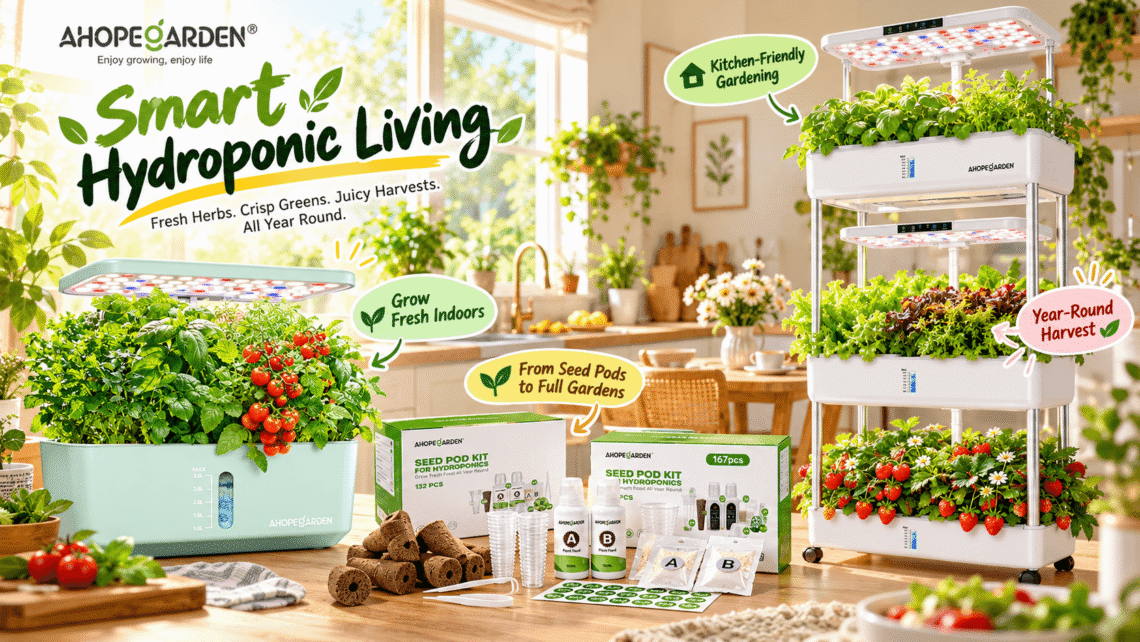
Ahopegarden is one of the brands that has been quietly building a reputation around exactly those details. It is not the oldest name in the category, and it is not the loudest in advertising. What it has done is put together a coherent product family ranging from small 10-pod countertop units to large 66-pod kitchen systems, paired with refill pods and accessory bundles that are deliberately designed to work across competing hardware. This article walks through what the brand is, why its lineup has caught on, and which of its four core products makes sense for which kind of grower.
Who Ahopegarden Actually Is
Ahopegarden positions itself as an indoor gardening company built around a single sentence: the joy of growing, shared every day. That tagline matters because it hints at the brand’s actual positioning, which is not industrial farming, not experimental urban-agriculture theatre, and not the ultra-luxury smart-home niche. It is a consumer brand for ordinary kitchens, apartments, office desks, and windowsills. The products are designed to be plugged in, filled with water, loaded with a few seed pods, and left mostly alone while doing their job.
The brand’s product history tells a fairly clear story. It started with compact countertop systems — four-pod and eight-pod units aimed at people who wanted basil and mint on the kitchen counter — and then expanded outward in three directions at once. First, it added larger multi-pod systems so that a household could grow actual vegetables, not just garnishes. Second, it introduced a transparent smart garden line, which answered a quiet demand from growers who wanted to see the root system developing instead of imagining it inside an opaque box. Third, and probably most strategically, it built a full ecosystem of refill accessories — grow sponges, baskets, domes, labels, and liquid nutrients — sized so that they work not only in Ahopegarden units but also in other popular countertop hydroponic brands.
That third move is the one that separates a device company from a real consumables business. Most indoor growing hardware has razor-thin margins, and the long-term revenue sits in the recurring pods and nutrients. Ahopegarden’s decision to make those consumables cross-compatible with AeroGarden, iDOO, LetPot, GardenCube, and similar platforms means it is competing in the refill market, not just the hardware market. For the customer, the practical effect is simple: you are not locked into buying a single brand’s expensive proprietary pods every month.
The brand also claims a scale milestone that is worth mentioning because it shapes product decisions: global unit sales have passed the one-million mark. That is relevant less as a bragging number and more as a signal that the kinks in the product design have been worked out over real-world usage. Countertop hydroponics is a category where a small engineering slip — a pump that clogs, a light post that cannot adjust, a tank that is hard to reach — gets exposed by tens of thousands of users within weeks. A million units means the basic reliability questions have been addressed.
The Design Philosophy: Automation Without the Complexity
Every brand in this category says it makes indoor growing easy. Ahopegarden’s version of that claim rests on a few specific engineering choices that are worth understanding before comparing products.
The first is the lighting system. Rather than offering a single fixed spectrum, the brand’s higher-end units use a full-spectrum LED panel with two clearly defined modes — a vegetable/leafy mode and a fruit-and-flower mode. That distinction sounds minor, but it is the difference between a lettuce plant that bolts early and a strawberry plant that actually sets fruit. Leafy greens want a cooler, bluer spectrum and a shorter photoperiod. Fruiting plants want a warmer, redder shift and longer daily light. Toggling between those two modes on the unit itself, rather than guessing at bulb colors or buying separate lamps, is one of the things people new to hydroponics consistently appreciate.
The second is the water system. Ahopegarden units use a recirculating pump on a timed cycle rather than running continuously. A cycle of roughly thirty minutes of pump-on time per hour keeps the root zone oxygenated, prevents stagnant water from developing odor, and cuts power use compared with an always-on pump. It also keeps the noise profile low enough that the unit is acceptable in a bedroom or a quiet office. Owners of competing units frequently mention that pump noise is the single most common complaint in reviews, and it is one of the quieter design choices Ahopegarden made that pays off daily.
The third is the height-adjustable grow light post. A basil plant and a dwarf tomato plant are not the same height two weeks after sprouting. A lamp that is fixed too close will scorch tender leaves; one that is fixed too far will produce spindly, weak stems. The adjustable post on Ahopegarden units — reaching up to roughly fourteen to seventeen inches depending on the model — lets the light track the plant as it grows, which is the single biggest lever for preventing leggy growth.
The fourth is the consumables strategy already mentioned. The brand sells nutrient solutions in A-and-B bottles, which is the professional standard. Mixing a single “plant food” liquid for every growth stage is a shortcut, and it shows up in deficiencies within a few weeks. A-and-B nutrients separate the calcium source from the phosphorus-and-micronutrient source so they do not precipitate in the bottle before reaching the plant. That is a detail that most casual growers never asked for, and once they see brown tip burn on a neighbor’s unit and not on theirs, they understand.
The Four Core Products: A Closer Look
Product 1 — The 10-Pod Indoor Garden Hydroponics Growing System with LED
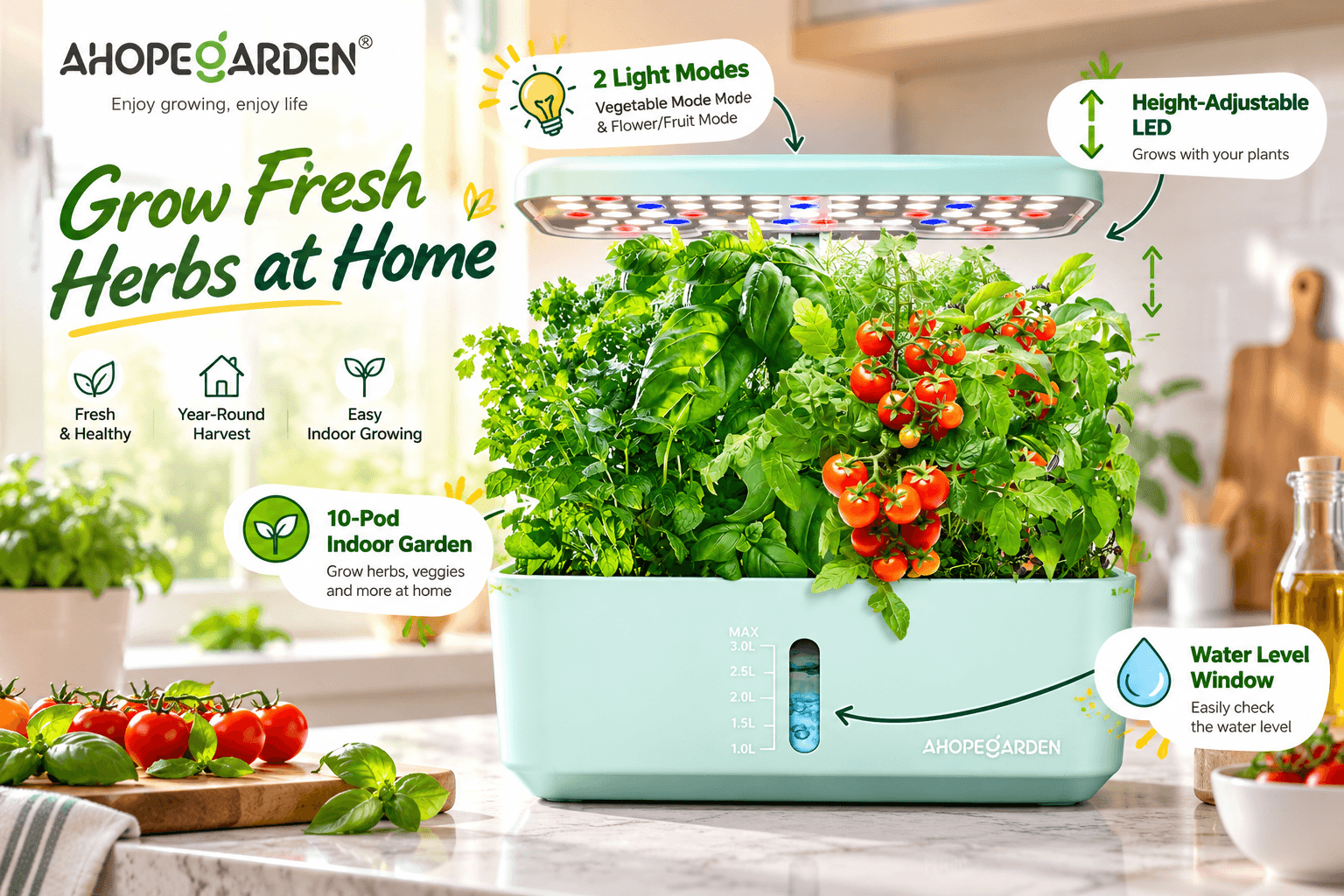
This is the entry unit, and it is the one most people meet the brand through. Ten pods on a compact footprint, a fully adjustable LED light post, a recirculating pump, and a tank sized for roughly four to seven days between refills. It is designed for a single kitchen counter, an apartment balcony table, or an office break room where nobody wants to manage a complicated device.
The ten-pod count is interesting. Four pods are cute but limiting; you basically grow basil, mint, cilantro, and parsley and then run out of room. Six pods are slightly better but still cramped once lettuces mature. Ten pods give you room for three or four culinary herbs, two leafy greens, and a cherry tomato or a dwarf pepper, all at the same time, without crowding each other out. It is the smallest footprint that actually lets a household harvest something at every meal rotation.
The included LED panel runs on an automatic light cycle, so once it is set the unit handles its own day and night. For a first-time grower this is the most important feature in the box, because the single biggest failure mode in indoor gardening is forgetting to manually turn the light on and off. The adjustable post handles the growth trajectory of the plants, and the pump cycle handles the oxygenation, leaving the grower to top off water every few days and feed nutrients at the labeled intervals.
Who this unit is for: a first-time hydroponic grower, a gift for a relative who likes cooking, a small urban apartment kitchen, or an office desk where fresh herbs are eaten weekly rather than daily. It is not the unit for someone who wants to replace the grocery store’s vegetable section, and it is honest about that.
Product 2 — The 66-Pod Kitchen Hydroponic Planter with LED Grow Light
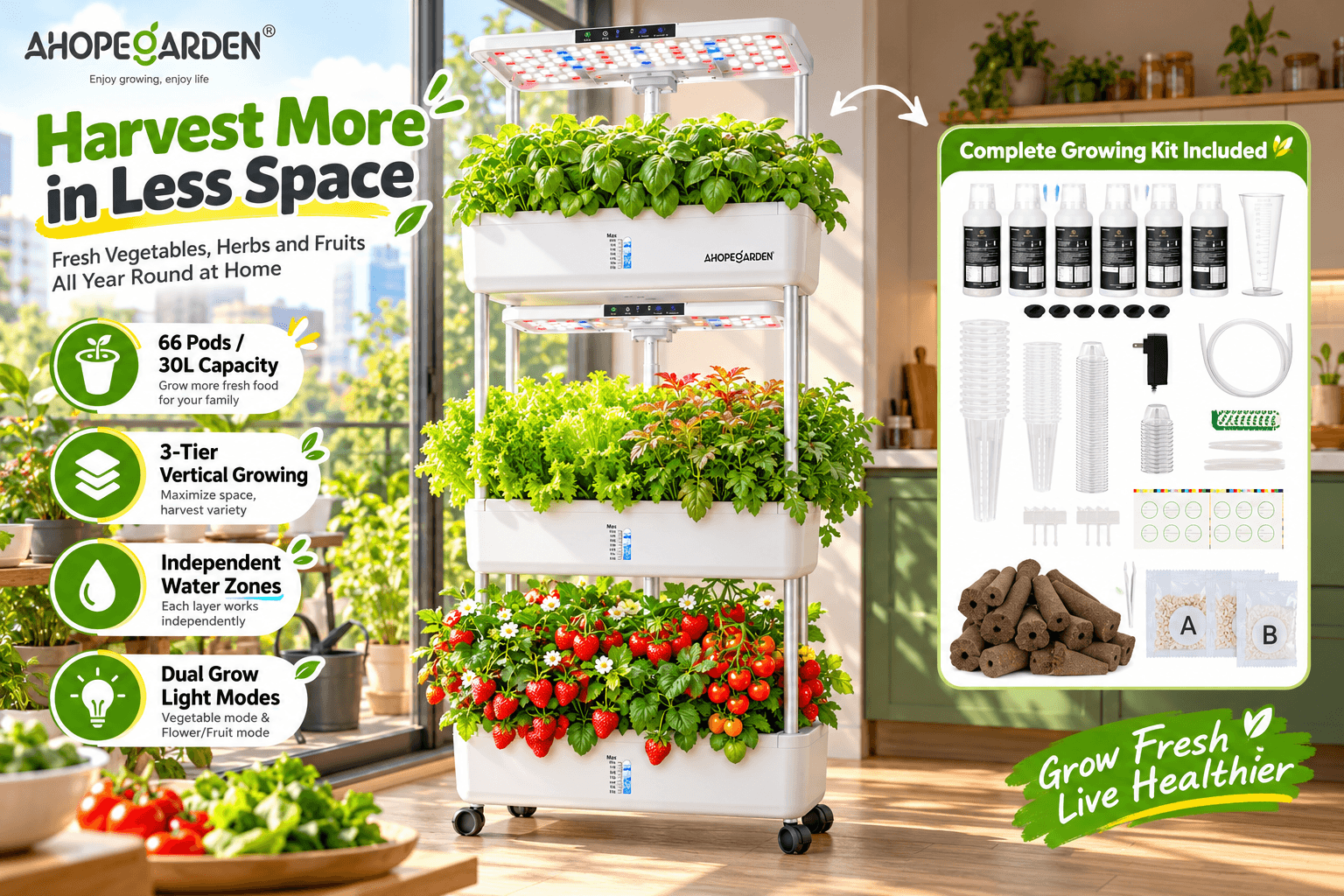
If the 10-pod unit is the entry, this is the system that takes indoor growing into actual vegetable-growing territory. Sixty-six pods, a thirty-liter reservoir, and a tall, full-spectrum LED array sized to cover a much larger canopy. The unit is explicitly marketed toward vegetables and fruits rather than herbs alone, and that shift changes the math of what you can grow.
Thirty liters of water is a meaningful jump from the four-to-five-liter tanks on countertop units. It means you can go a full week without refilling, even in a warm kitchen. It also means the root system has thermal mass, so the water temperature does not swing wildly between night and day. Stable root temperature is one of the underrated factors in preventing root rot, and it is the reason a larger tank behaves more predictably than a small one in seasonal weather.
Sixty-six pods also lets you plan the growing space differently. You can dedicate a section to leafy greens — a rotation of butterhead lettuce, arugula, kale, and bok choy — a middle section to culinary herbs, and a top row to fruiting crops like strawberries, cherry tomatoes, and dwarf peppers. The two lighting modes let you bias the spectrum toward leafy growth or fruit development depending on what is currently in its active stage. That flexibility is what turns this from a garnish station into something that actually contributes to weekly meal prep.
This is the unit for serious home growers, for families who cook most evenings, for people who eat salads daily, and for anyone in a season where outdoor gardening is not possible for months at a time. It occupies more floor or counter space than a countertop unit, so it is better suited to a dedicated kitchen corner, a sunroom, or a garage-workshop conversion than to a tiny studio.
Product 3 — The 132-Piece Hydroponic Pods Kit: Refills Without the Brand Tax
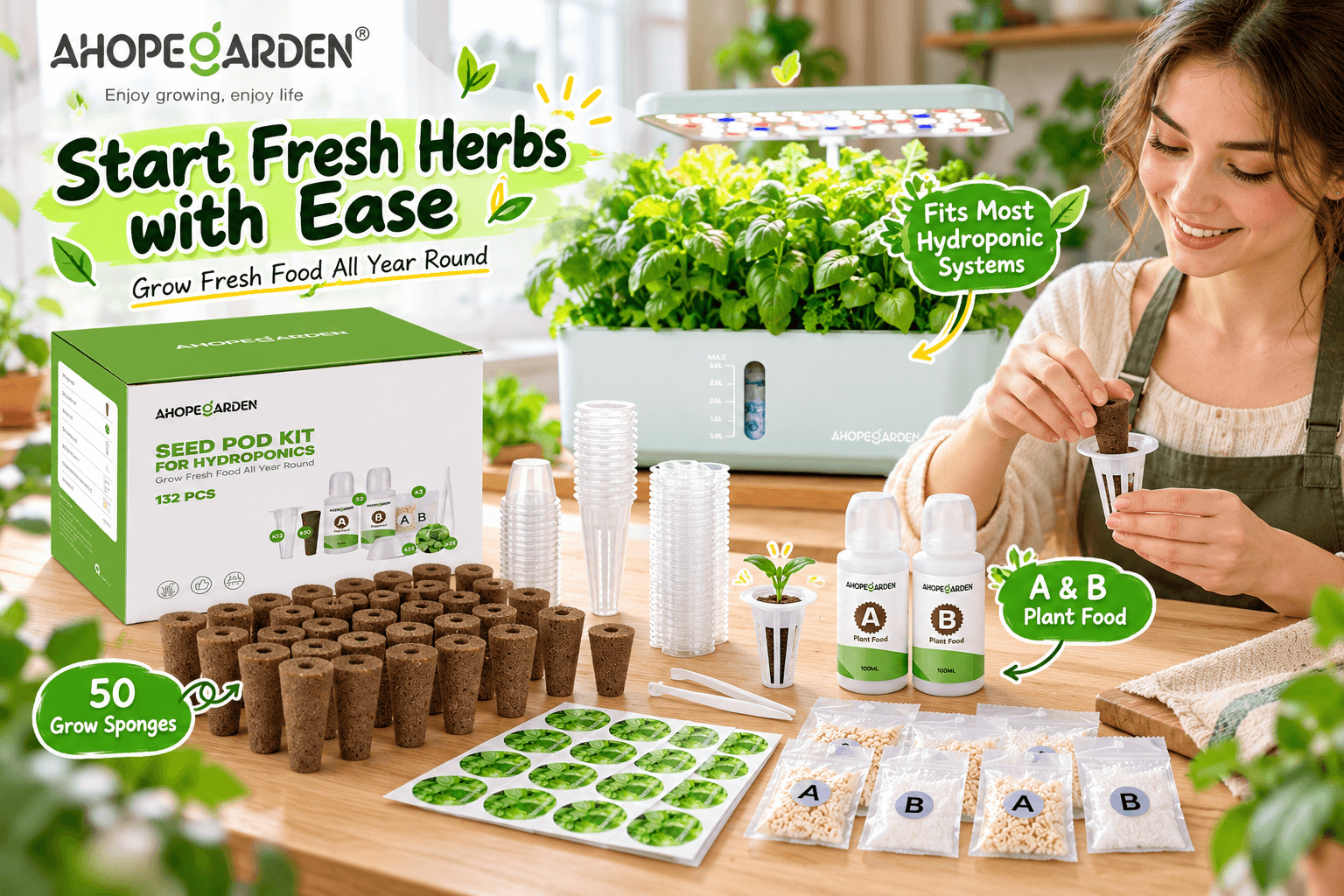
This is not a growing unit at all. It is a consumables bundle, and it is one of the most strategically important products in the Ahopegarden lineup. The kit contains fifty grow sponges, fifty pod labels, twelve grow baskets with matching domes, and eight separate sets of A-and-B plant food. The sponges and baskets are designed to fit the standard dimensions used by most countertop hydroponic brands, including AeroGarden-style platforms, which is the headline feature.
Grow sponges are the medium the seed sits in. They wick water from the reservoir to the seed, provide physical support for the emerging root, and slowly release nothing while the seed germinates. Over time they degrade, and if you try to reuse them you risk introducing mold and pathogens into a brand-new grow. A serious indoor grower replaces sponges every cycle, and that means the refill cost is not optional — it is recurring.
The inclusion of pod labels is a small but valuable touch. Once you plant six different herbs in a row, you will not remember which basket is which two weeks later. The labels let you write directly on the tag and clip it onto the basket, which is the kind of detail that keeps a grow journal actually useful instead of aspirational.
The eight sets of A-and-B nutrients are the part that makes this bundle genuinely cost-effective compared with buying branded refills separately. Each set is dosed for a certain volume of reservoir over a certain number of weeks, so a 132-piece bundle effectively covers multiple full grow cycles across several units. For someone who already owns an Ahopegarden countertop unit and a larger kitchen planter, this is the refill that keeps both running through a full season without reordering every month.
Who this is for: existing owners of any standard-sized countertop hydroponic unit, regardless of brand; people who want to experiment with seed-saving and non-proprietary seed sources; and anyone who has been paying premium prices for branded pods and wants a more economical refill path.
Product 4 — The Indoor Hydroponic Growing System with 167-Piece Seed-Starting Accessory Set
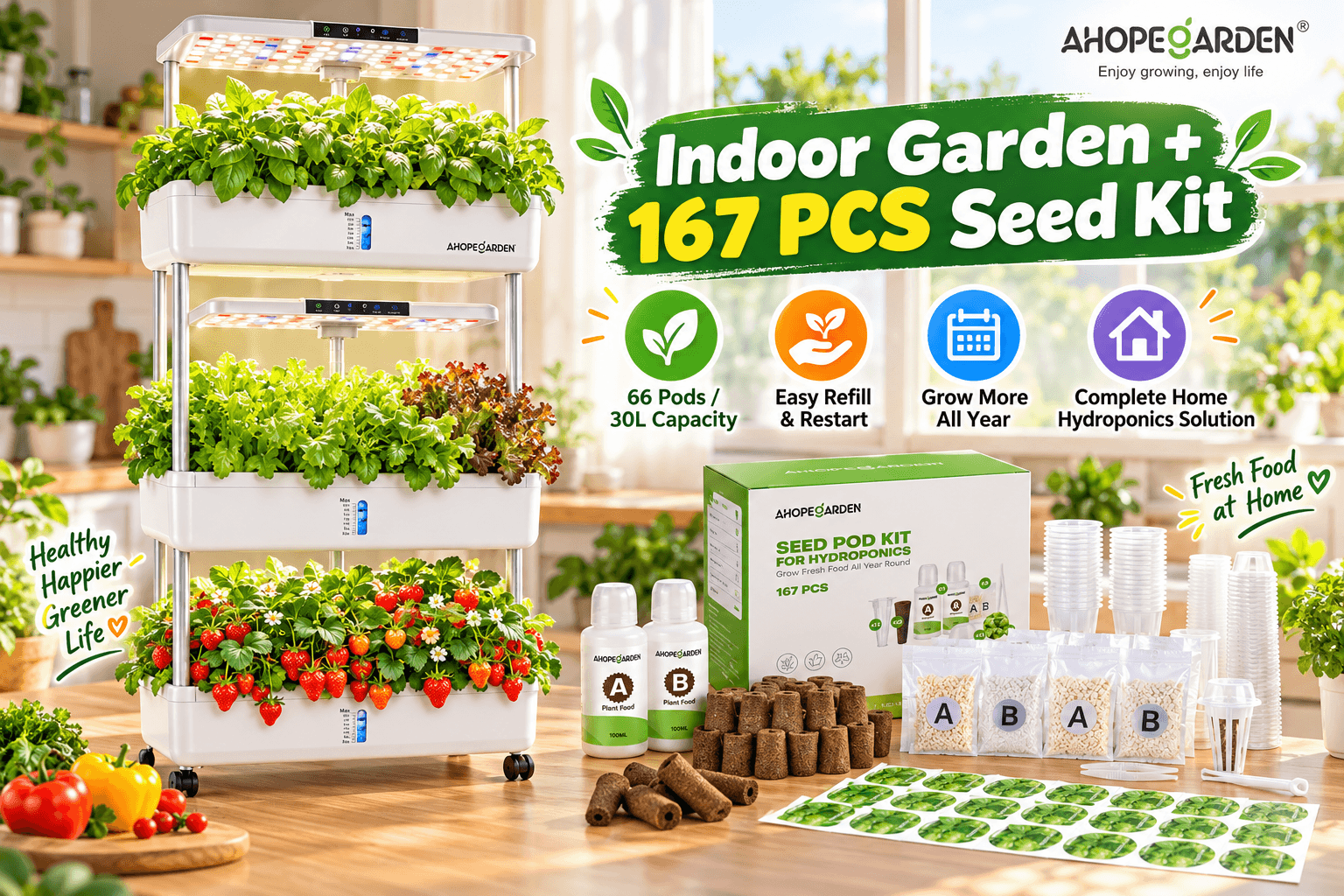
This is the most complete package in the lineup. It combines a growing unit with a very large accessory bundle — 167 pieces in total — so that a new grower is not scrambling to buy sponges, baskets, domes, labels, and nutrients separately. The value proposition is “start today, nothing else to buy.”
The 167-piece accessory set goes beyond what is included with a standard refill kit. It typically adds a wider variety of basket sizes, more domes for humidity retention during the germination phase, additional labels, measuring tools for dosing nutrients, and enough consumables to run multiple plantings back-to-back before any reorder is needed. For a household that wants to run a continuous harvest — harvesting one section while replanting another — that kind of buffer is what makes the system actually continuous rather than seasonal.
The bundled nutrients being A-and-B, rather than a single pre-mixed liquid, is again worth noting because it gives the grower control over feeding intensity. Leafy greens want a leaner feed; fruiting crops want a heavier feed. Having both bottles on hand means you can tune the mix per growth stage rather than running the same dose for everything.
This is the product to recommend to someone who is committing to indoor growing seriously, rather than trying it out as a curiosity. It removes the friction of piecemeal purchasing, and it gives a new grower the materials they need to learn without running out of supplies mid-cycle. It also makes a strong housewarming or first-apartment gift, because it is the kind of present that keeps producing for more than a year.
How the Four Products Fit Together
It helps to think of the Ahopegarden lineup as a stack rather than as four unrelated gadgets.
The 10-pod unit is the on-ramp. It teaches you how light cycles, pump cycles, and nutrient dosing feel in practice, without asking you to manage a large space. Most people who start here decide within two growing cycles whether they want to stay small or scale up.
The 66-pod kitchen planter is the scale-up step for those who decide yes. It is designed for the same daily habits — top off water, feed nutrients, harvest as needed — but at a volume that affects actual grocery spending.
The 132-piece pods kit is the refill layer for both of those units. It is the product that arrives on your doorstep a few months after you have already fallen in love with growing, when you realize the branded pods are becoming an expensive habit.
The 167-piece bundle with the growing system is the all-at-once version. It is the route for someone who skips the trial phase and commits directly, or for a gifting scenario where the giver wants the recipient to have everything needed for a full year of growing.
That coherence — small entry, serious scale, economical refills, and a complete all-in-one package — is what makes the brand feel designed rather than assembled.
Who Benefits Most From an Ahopegarden Setup
Different households hit different value thresholds.
For apartment dwellers with no outdoor space, the value is obvious. You are replacing weekly grocery runs of herbs and small greens with something that grows on a counter. The amortized cost of a 10-pod unit over a year is comfortably less than what most people spend on clamshell herbs that wilt in the refrigerator by the end of the week.
For families who cook from scratch, the 66-pod unit changes meal math. Lettuce, cherry tomatoes, peppers, and strawberries from a fresh harvest taste meaningfully different from refrigerated grocery versions, and the kids’ involvement in the growing process often translates into their willingness to actually eat those vegetables.
For people in cold climates or with long gray winters, the unit is partly a piece of horticulture and partly a piece of interior decor. The soft glow of a grow lamp on a kitchen counter in February is one of the more underrated mood upgrades in a home.
For remote workers, a small unit on the desk solves two problems at once. It provides a small reason to look away from the screen — top off the water, pinch the basil, rotate a pod — and it gives the desk something alive to look at during long afternoons.
For gift buyers, the 167-piece bundle removes the guesswork. A bare planter can feel like a chore; a complete bundle feels like a year’s worth of small daily harvests.
What a Real Week of Growing Actually Looks Like
To keep this grounded, it is worth describing the actual rhythm of running one of these units, because the marketing language around “set it and forget it” can be misleading. Hydroponics is not fully automated in the way a washing machine is. It is low-effort, not no-effort, and the weekly workload is what most people should plan for.
On day one, you plant. You fill the reservoir to the marked line, insert the sponges into the baskets, drop two seeds per sponge, snap the baskets into the deck, add the nutrient dose per the A-and-B instructions, and set the light mode. The domes go on for the first week to hold humidity around the germinating seed.
By day three to five, most culinary herbs have sprouted. The domes come off. The pump cycles do their work. The light runs on its timer. You do almost nothing except look at it.
By week two, you top off the reservoir because water evaporates and plants drink. You might adjust the lamp height upward as the stems rise. You add the next scheduled dose of nutrients.
By week three to four, the first harvest is possible. Basil gets pinched from the top to encourage bushiness; mint gets snipped for a drink; lettuce gets outer leaves picked so the center keeps growing.
By week six to eight, the cycle winds down. You clean the reservoir, rinse the deck, and start the next planting. That full loop — clean, plant, grow, harvest, repeat — is roughly six to eight weeks for most culinary herbs, slightly longer for fruiting crops.
The point of describing this is to show that the effort per week is measured in minutes, not hours, and that the learning curve is front-loaded. Once you have run one cycle, the next cycles require almost no new decisions.
Sustainability and Water Use
The brand’s category is, by its nature, an efficiency story. Indoor hydroponic systems use dramatically less water than soil gardening because the reservoir recirculates rather than runs off. Industry figures commonly cite water savings of around ninety percent compared with conventional garden growing, because the water that reaches the roots is not lost to evaporation from open soil or to runoff from sprinklers. Indoor growing also eliminates the pesticide load that comes with commercial herb and lettuce production, because a small controlled environment does not need the same spray regime as a field.
There is also the food-mile angle. Growing lettuce on a kitchen counter means that a head of greens traveled zero miles before reaching the salad bowl. That sounds trivial until you think about how many supermarket greens are refrigerated, trucked, and shelved before they reach you, and how much of their weight is lost to wilting along the way. An indoor unit does not replace a garden, but it replaces a surprising amount of weekly grocery traffic for fresh herbs and greens.
Common Questions Before You Buy
A few questions come up consistently and are worth addressing directly.
Does it grow fruit, or just herbs? Smaller units grow fruiting plants reluctantly — cherry tomatoes and dwarf peppers are possible but space-limited. The larger 66-pod unit is the one designed for fruit production, because the lamp spectrum, the tank size, and the canopy space all support heavier feeding cycles.
Will the light bother people in the room? Full-spectrum LEDs are brighter than a typical desk lamp but not harsh. Most growers set the unit up in a kitchen corner rather than directly in a bedroom, and the light cycles turn off at night anyway.
Can I use my own seeds? Yes. The sponges and baskets accept any standard-sized seed; you are not locked into pre-seeded branded pods once you own the refill kit. That is one of the advantages of the 132-piece bundle, because it is built specifically for this purpose.
How often do I clean the unit? Every full grow cycle. The reservoir gets emptied and rinsed, the deck gets wiped, and the sponges get replaced. Skipping this step is the main reason people see algae or odor develop in week three.
What if the power goes out? Newer units remember their light-cycle settings and resume where they left off once power returns, which is one of the practical advantages over older timers that reset to default.
Final Take: Indoor Growing Is No Longer Just A Niche Experiment!
The indoor gardening category has matured quickly, and the brands that will last are the ones that treat the product as a long-term habit rather than a one-time gadget sale. Ahopegarden‘s lineup is built around that insight: an entry unit to learn on, a larger unit to scale into, an economical refill path that works across brands, and a complete bundle for those who want to commit upfront. The design choices — dual-spectrum lighting, timed recirculating pumps, A-and-B nutrients, adjustable lamp posts, cross-brand compatibility — are not flashy, but each one is a decision a real grower will notice within the first month.
If you have been thinking about growing fresh herbs or small vegetables indoors, the practical next step is to match the unit to your actual usage. A countertop 10-pod system is the right starting point for a single household that mainly cooks with herbs. A 66-pod kitchen planter is the right step for a household that wants greens and fruit in the rotation weekly. The 132-piece refill kit is what you want on hand once you know you are staying with it, and the 167-piece bundle is the version to choose when you want everything in one box on day one.
Whichever route you take, the broader point is worth holding onto. Indoor growing is no longer a niche experiment. It is a daily routine that fits into modern kitchens, and the brands that make that routine frictionless are the ones that will keep a spot on the counter year after year.