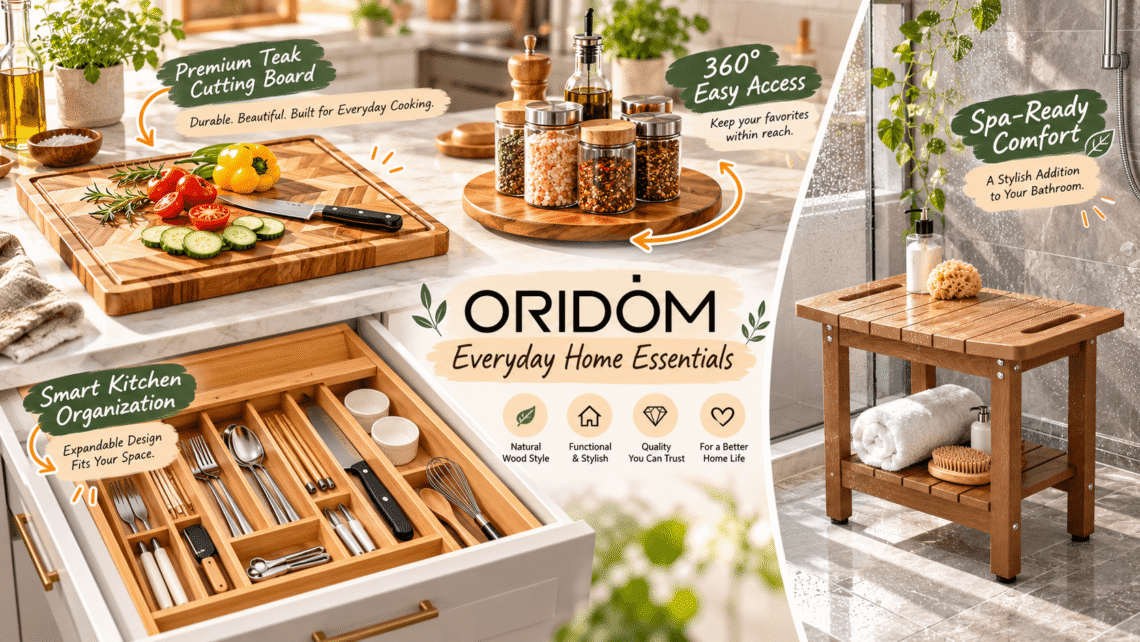
There is a particular kind of quiet defeat that happens in a home, and it almost never announces itself. It happens on a Tuesday morning, when you open the silverware drawer and a whisk launches itself at your knuckles. It happens when you reach into a cabinet for olive oil and knock over three bottles of vinegar on the way. It happens in the shower, when the bottle of body wash slides off the floor edge for the fourth time that week, and at the dinner party where you promise yourself you will finally, finally, own a cutting board that does not look like a crime scene after twenty minutes of chopping.
None of these moments is dramatic. That is precisely the point. Clutter does not arrive like an earthquake; it accumulates like dust. And the home brands of the last twenty years largely responded to it in one of two ways: cheap plastic systems that yellow and crack within a year, or aspirational “lifestyle” organization so precious that nobody actually uses it. 🌿 Oridom was built in the gap between those two failures — a home organization brand that starts from a simple, almost stubborn premise: the things that bring order to your home should be durable enough to earn their place, beautiful enough that you do not want to hide them, and honest enough in their materials that you can live with them for years rather than apologize for them in a landfill.
If you have never heard the name Oridom before, this piece is the proper introduction. Consider it a long, unhurried tour of who the brand is, what it believes, and four pieces from its collection that, together, explain its way of thinking better than any slogan could.
The Problem Oridom Was Actually Built to Address
Walk through any average kitchen — including, at various points, the kitchens of the people reading this article — and you will notice something odd. We spend genuine money on the objects inside our homes and almost nothing on the relationships between them. The knives are nice. The spice collection is impressive. The bathroom tile was chosen over three weekends. But the systems that hold all of it together are an afterthought: a warped plastic tray from a big-box bin, a turntable that sticks halfway through its rotation, a shower stool that began delaminating within months because someone confused “waterproof-ish” with “designed for actual water.”
Oridom looked at that landscape and asked a question that sounds obvious only after someone says it out loud: what if organization were treated as furniture, not as packaging? What if the tray in your drawer were made from the same grade of material as a good cutting board, the turntable in your cabinet spun with the confidence of a well-made hinge, and the seat in your shower were engineered for the reality of 300 pounds of human being on a wet, sloped floor?
That reframing matters, because it changes what “competing” even means. A disposable plastic divider competes on price alone; there is no other axis left. A piece built from natural bamboo, solid acacia, FSC-certified teak, or rigorously engineered high-impact polystyrene competes on something entirely different — how it feels in your hand six years in, whether the mechanism still operates in silence, whether you would be proud to carry it from kitchen to table in front of guests. 🌾 Oridom chose the harder race, and every product in its lineup reflects that choice.
The Oridom Philosophy in Four Convictions
Brand philosophies are easy to print and hard to prove. Oridom’s is best understood through the convictions that visibly govern its products.
1. Material is not a styling decision; it is an engineering one. Bamboo is not in Oridom’s drawer organizers because wood is “on trend.” It is there because bamboo is remarkably strong for its weight, naturally resistant to the minor moisture excursions of kitchen life, and fast-renewing in a way that hardwoods simply are not. Acacia is used for the turntable because it is dense, stable, and forgiving of frequent handling. Teak is reserved for the cutting board — the most mechanically punished object in a kitchen — because teak’s natural oils and tight grain have defended butcher blocks for centuries. And in the one environment where genuine wood cannot win, a permanently wet shower, the brand does not pretend otherwise: it reaches for high-impact polystyrene formulated to look like wood while outperforming it against water, scratches, and stains.
2. A mechanism you can hear is a mechanism that will fail. Notice how often silence appears in Oridom’s engineering choices. The lazy susan rotates without the grinding protest typical of cheap turntables. The drawer tray sits on non-slip feet rather than rattling against the drawer walls. The shower bench levels itself on adjustable rubber feet instead of rocking on a sloped shower floor. Silence, in a well-made object, is the sound of tolerances done correctly. 🔇
3. One object, honestly designed, should serve more than one room. The brand’s photography makes this explicit: a drawer tray organizing office supplies on a desk, the same tray holding cosmetics on a vanity, the turntable rotating skincare in a bathroom and condiments at a picnic. Multipurpose is not a marketing bullet appended after the fact; it is a consequence of clean geometry and neutral, natural finishes that belong anywhere.
4. The home is a system, so the lineup should behave like one. This is the conviction most invisible to shoppers and most valuable to them. When your drawer organizer, your turntable, and your cutting board share a material language — warm natural tones, honest grain, rounded edges, no visible hardware — the kitchen stops feeling like a collage of impulse purchases and starts feeling composed. The shower bench extends that same warm, wood-adjacent calm into the bathroom, where most “functional” objects are aggressively clinical. Cohesion is a feature Oridom designs deliberately.
💡 Why this matters for you: Most organization purchases are made one crisis at a time — a messy drawer today, a slippery shower next month. Buying into a brand with a coherent material language means those emergency purchases quietly add up to a home that looks curated, instead of one that looks rescued.
How to Read the Oridom Lineup
Four products best represent what the brand does. They are deliberately different in function but identical in discipline, and each one answers a specific failure that shoppers consistently report in cheaper alternatives.
The Expandable Bamboo Drawer Organizer: Order That Adapts to the Drawer You Actually Have
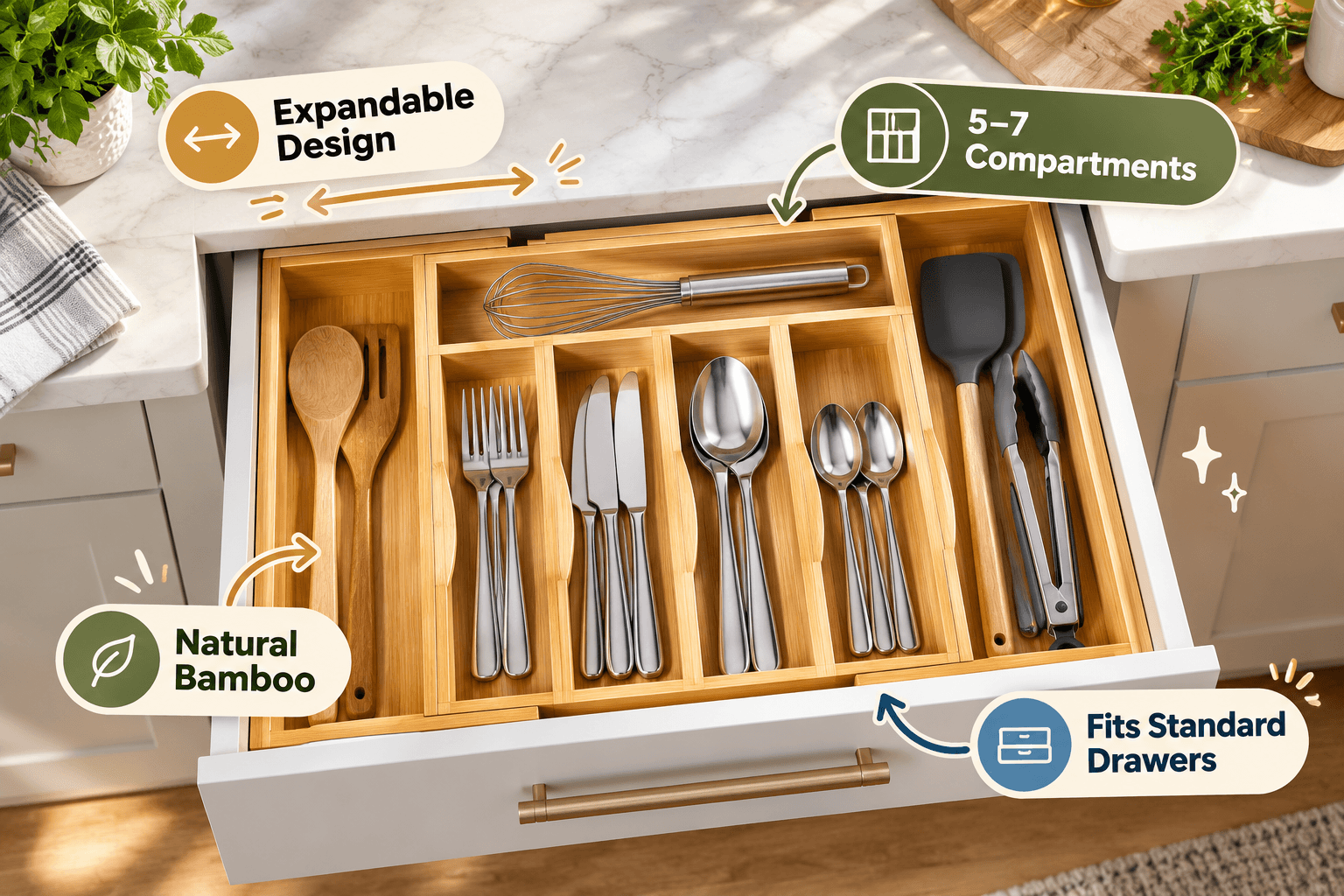
The most common reason drawer organizers fail is embarrassingly simple: they do not fit. Drawers vary wildly in interior width, and a fixed tray either leaves a useless gap on one side or refuses to slide in at all. Oridom’s answer is an expandable bamboo tray that adjusts from roughly 10.1 to 15.4 inches, which covers a surprisingly large swath of standard kitchen drawers without a single measurement-induced headache. 🗂️
Inside, the tray offers seven to nine deep, generously proportioned compartments — the count changes as the tray expands — with gently curved grooves along the dividers so fingers can actually retrieve the last spoon without flipping the whole arrangement. It is cut from natural bamboo in a clean, light finish that reads as “furniture inside the drawer” rather than “plastic insert.” Small non-slip feet underneath hold the tray in place, so it does not migrate every time the drawer is slammed shut by a late-night snack seeker.
What elevates it beyond the kitchen is the geometry itself. Flatware is the obvious application, but the same compartments happily take pens and rulers in a desk drawer, brushes and compacts in a vanity, or screwdrivers and bits in a workbench drawer. The brand even shows it in these contexts rather than hiding them, which tells you something about how the company thinks about its own products: as structures for small objects, wherever small objects happen to be causing chaos.
Care is reassuringly unceremonial: wipe with a damp cloth, dry promptly, and treat bamboo as the natural material it is rather than soaking it. That is the entire maintenance contract.
The Acacia Wood Lazy Susan, 14 Inches: The 360-Degree Answer to Dead Cabinet Space
If the drawer organizer solves horizontal chaos, the lazy susan solves depth — the specific torture of a cabinet where everything in the back third is functionally invisible. Cans vanish. Spices expire in exile. The olive oil becomes a myth told by older members of the household.
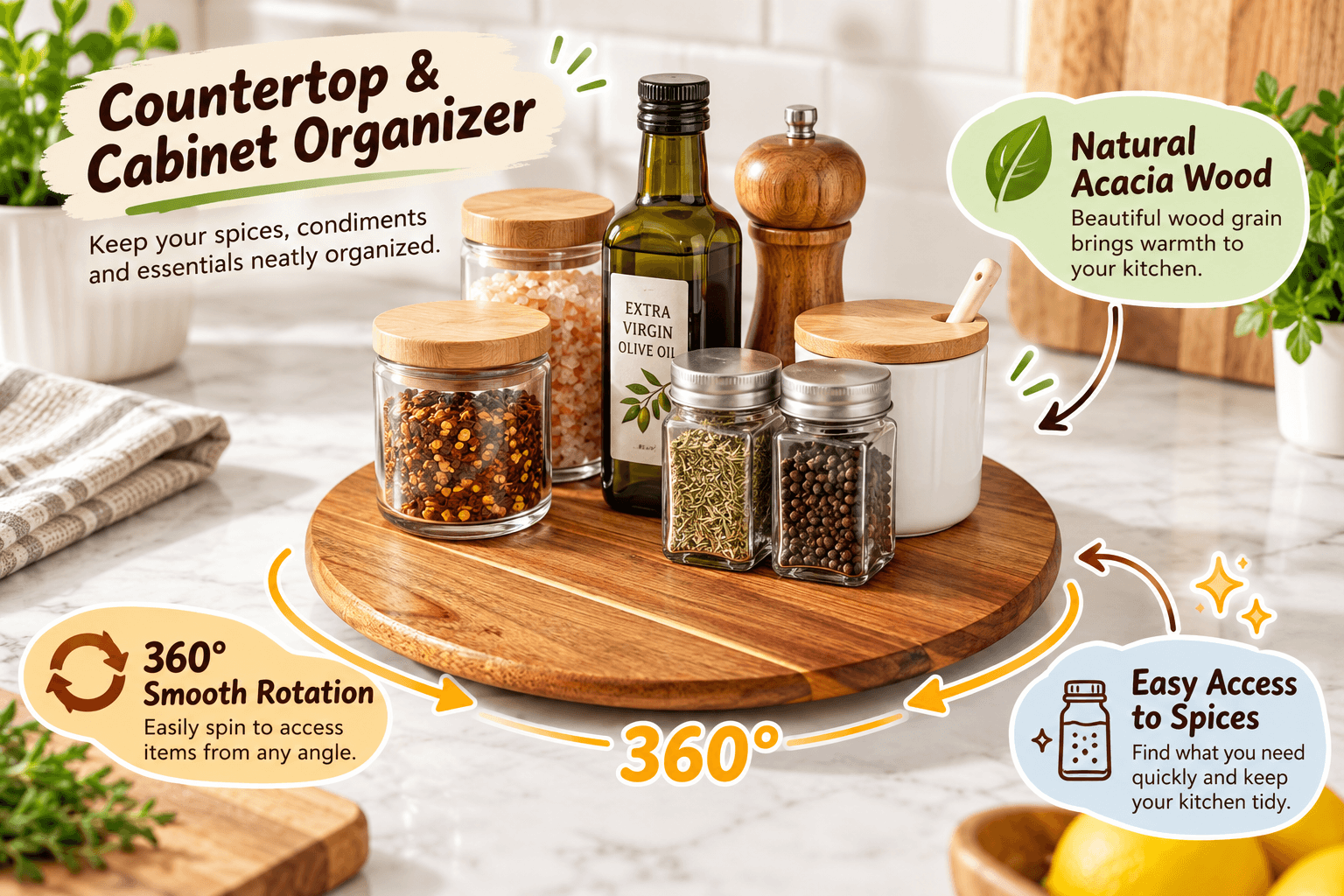
Oridom’s 14-inch turntable is a single-tier disc of solid, high-density acacia, standing about 1.18 inches tall with a low raised rim to keep contents from walking off the edge. Acacia was the right call here: the wood is dense enough to feel substantial under a loaded arrangement of jars, naturally varied in grain so no two units are identical, and resilient under the wipe-clean life of a frequently handled kitchen object. 🍯
The engineering headline is the rotation itself — a full 360 degrees, smooth and quiet, with a bearing design that remains stable even when the load is uneven. That last detail is quietly important. Anyone who has owned a flimsy turntable knows the physics: put the vinegar on one edge and the salt grinder on the other, give it a spin, and the whole thing pitches like a rowboat. Oridom’s version turns under the same imbalance without drama, which is the difference between a turntable you use and one you stop loading heavily after the first scare.
Its off-label life is where the personality shows up. In a cabinet, it organizes spices, oils, and supplements. On a counter or dining table, the same disc becomes a centerpiece for salt, pepper, sauces, and napkins. In a bathroom, it rotates skincare and grooming products. On a patio table or an RV dinette, it carries condiments and coffee supplies without rattling. Acacia does benefit from an occasional rub with food-grade mineral oil to keep its finish content — a five-minute ritual once in a while, and frankly an excuse to stand in a quiet kitchen and touch something real.
The HIPS Shower Bench: Spa Calm, Engineered for Actual Water
Here is where Oridom demonstrates a discipline many “natural materials” brands lack: knowing when not to use wood. A shower is one of the most hostile environments in a home — constant water, humidity, soap residue, temperature swings, and often a deliberately sloped floor. Real wood can survive there with heroic maintenance, but it is a lifelong commitment most people do not want from a stool.
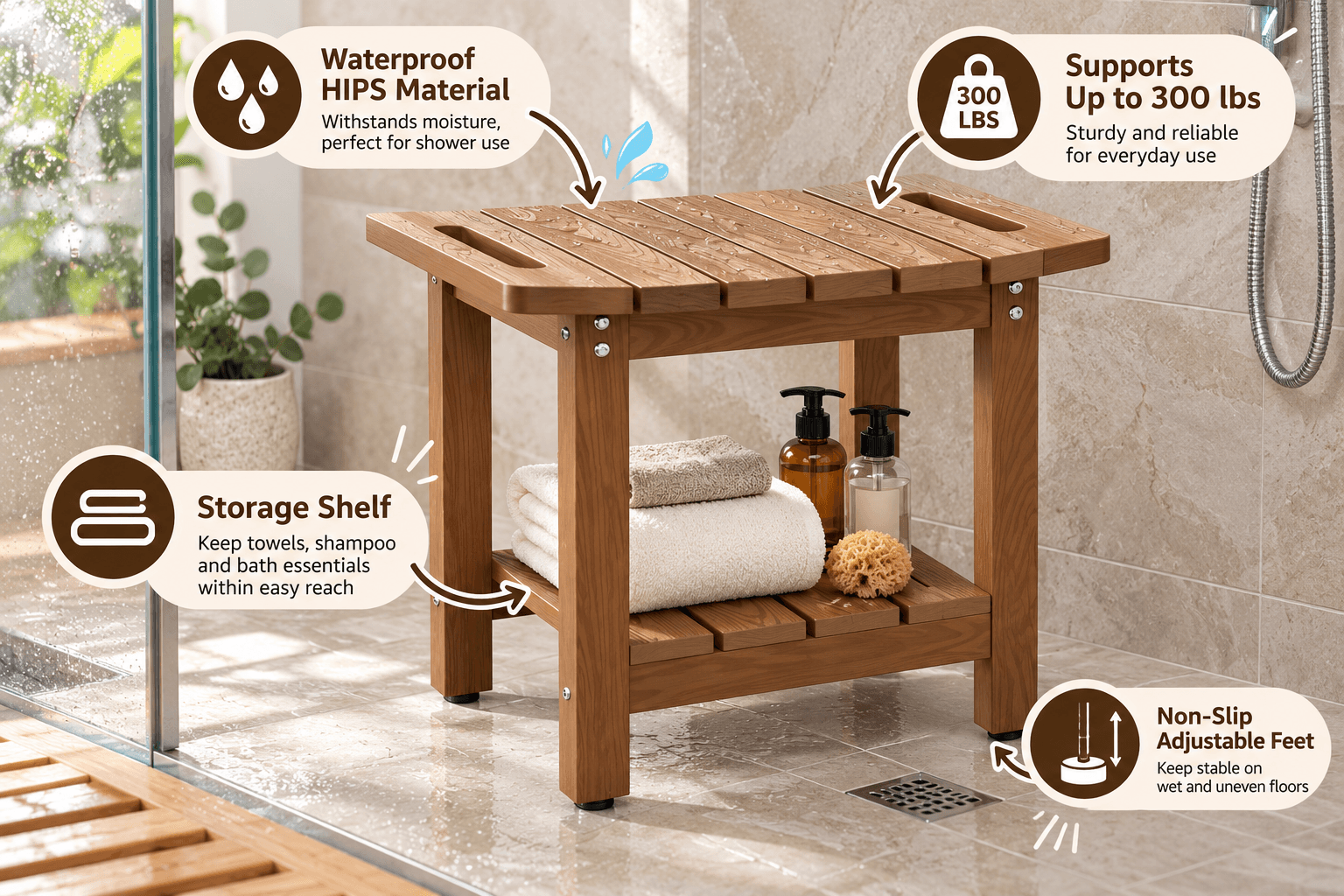
Oridom’s shower bench is therefore built from HIPS — high-impact polystyrene — in a warm brown wood-grain finish that reads visually as timber while behaving like the engineered polymer it is. It shrugs off water, weather, scratches, and stains; nothing in its daily life requires sealing, oiling, or anxiety. ☔
The specification sheet reads like it was written by someone who has actually stood in a shower. The seat uses a slatted profile so water drains rather than pooling under the user. Adjustable non-slip rubber feet independently compensate for sloped shower floors, eliminating the slow rocking that makes cheaper benches feel unsafe. The structure is rated to support up to 300 pounds, and a lower shelf turns the footprint into storage for shampoo, body wash, a pumice stone, or a folded washcloth — recovering the floor space that a shower caddy would otherwise claim. Assembly is straightforward, and the bench ships with a small cleaning brush, a tiny tell that the brand thinks about the full ownership experience rather than ending the relationship at unboxing.
The versatility follows the Oridom pattern. It is, of course, a shower seat — genuinely useful for shaving, leg-care routines, anyone who is pregnant or managing limited mobility, and anyone who simply wants a slower, spa-paced morning. But because HIPS is weather-tough, the same bench migrates to a patio, a mudroom, a bedroom corner, or beside a bathtub as a side table for a book and a candle. It is the brand’s calmest object and, in some ways, its most quietly inclusive one.
The Teak End-Grain Cutting Board: The Centerpiece That Also Does the Hard Labor
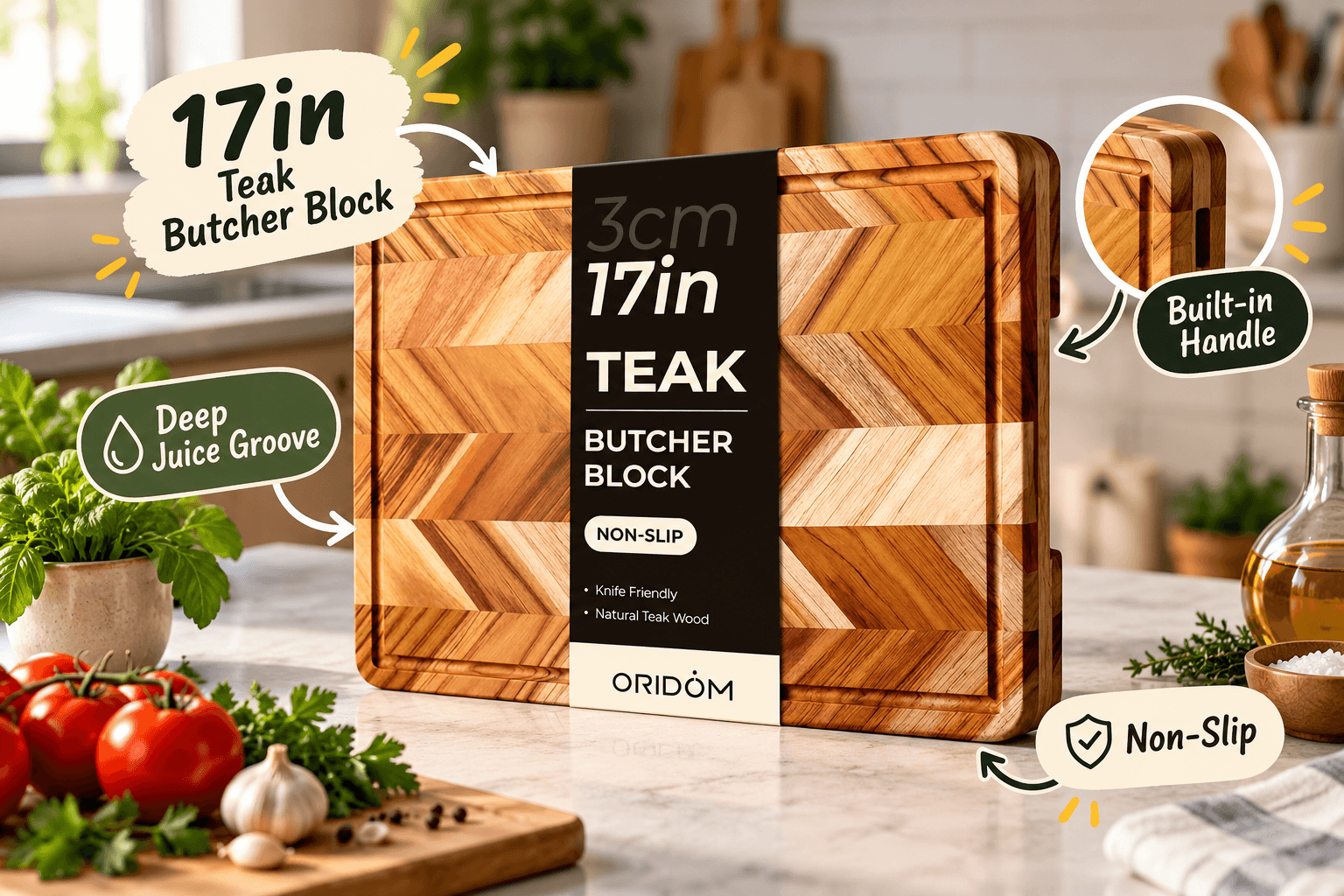
Cutting boards fall into two camps: the utilitarian slab you hide in a cabinet, and the gorgeous serving piece you are afraid to scratch. Oridom’s large teak board refuses the distinction. It is built to be worked hard and then carried, by its built-in handle, straight to the table as a charcuterie platter. 🧀
The construction is where board nerds will lean in. This is an end-grain board — meaning the wood blocks are oriented so the cut ends of the fibers face upward, arranged in a checkered herringbone pattern that is as functional as it is striking. End grain is the traditional butcher-block configuration for a reason: knife edges sink between the fiber ends rather than slicing across them, so blades stay sharper longer and the board self-heals visibly over time as the fibers swell back. The pattern itself is genuinely beautiful — alternating tones of natural teak forming a geometric field that looks considered rather than rustic-by-accident.
The material is 100% solid teak, FSC-certified, finished with a food-grade, non-toxic coating so it is safe for daily prep from the very first use. At roughly 17 by 12 inches and 1.25 inches thick, it is a heavy-duty, stable platform with the mass to stay put on a counter — aided, for full certainty, by non-slip silicone feet underneath. A deep juice groove runs the perimeter to contain the runoff from tomatoes, citrus, and rested meats instead of letting it migrate across the countertop. The integrated ergonomic handle does double duty: easy transport from prep zone to sink, and an invitation to flip the board’s role from workshop to stage, loaded with cheeses, fruit, and bread.
It is the clearest single expression of the Oridom thesis: an object that earns its keep through engineering and its place on the table through appearance, without making you choose.
The Four at a Glance
| Product | Star material | The problem it removes | The detail worth noticing | Best second life |
|---|---|---|---|---|
| Expandable Bamboo Drawer Organizer | Natural bamboo | Trays that never quite fit any drawer | Expands ~10.1″–15.4″; 7–9 deep compartments; non-slip feet | Desk, vanity, or tool drawer |
| Acacia Wood Lazy Susan (14″) | High-density acacia | Dead space at the back of cabinets | Silent, stable 360° spin even when unevenly loaded | Table centerpiece or picnic/patio turntable |
| HIPS Shower Bench (Brown) | Wood-look high-impact polystyrene | Wet, wobbly, maintenance-heavy shower seating | 300-lb support, leveling feet, drain slats, lower shelf | Patio, mudroom, or bedside seat |
| Teak End-Grain Cutting Board (17″) | FSC-certified solid teak | Boards you must choose between using and displaying | Herringbone end grain, juice groove, silicone feet, handle | Charcuterie and serving platter |
A Saturday Morning, Told the Way It Actually Happens
Sometimes a philosophy is easiest to judge in motion. Here is the kind of conversation Oridom’s products quietly enable:
“Where’s the good knife?” “Second compartment from the left. It’s always there now.”
“And the smoked salt I bought?” “On the rotating tray. Spin it — back left, no, keep going… there. See?”
“Can I use the big board for the steaks and still serve cheese on it in an hour?” “Wash the one side, carry it out by the handle, build the board on the other. The groove hides whatever the board is still thinking about.”
“And after lunch?” “I’m taking the bench idea to the shower. Twenty minutes, no products falling, no standing. Then we do this again tomorrow.”
That is the entire pitch, stripped of marketing: every object removes one small, recurring friction, and none of them demand that you become a different, tidier person first. 🕊️
Who Oridom Is Actually For
Honesty cuts both ways, so it is worth saying who the brand suits best — and where a different shopper might look elsewhere.
Oridom is a strong fit if you:
- 🌱 prefer natural materials and can offer them the minimal care that natural materials politely request;
- 🍳 cook often enough that knife feel, juice management, and prep stability are real concerns rather than abstractions;
- 🚿 want bathroom function without the clinical look of institutional bathware;
- 📦 buy organization pieces in the expectation of keeping them for years rather than replacing them each season;
- 🏡 value a consistent warm, modern-organic aesthetic across multiple rooms.
It may be less persuasive if you are optimizing purely for the lowest possible upfront price, or if you genuinely prefer the look of glossy white plastic systems. Oridom competes on lifespan, feel, and cohesion — none of which is the cheapest route on day one, and all of which tend to look like the cheaper route by year five.
The Bigger Idea Hiding in the Drawer
It is worth pausing on why any of this matters beyond convenience, because organization brands rarely ask the deeper question and shoppers rarely stop to ask it of them.
A home is not merely a place where objects are stored. It is the physical infrastructure of your attention. Every minute spent searching for a tool is a minute not spent cooking. Every object that falls, sticks, wobbles, or jams is a tiny withdrawal from a finite daily account of patience. The design movement most worth paying attention to is not the one that adds more novelty to a home; it is the one that quietly cancels these withdrawals — that returns minutes, reduces low-grade irritation, and lets the rooms function as backgrounds to life instead of as problems to be managed. ✨
Natural materials do something further that is harder to measure but impossible to fake. Bamboo, acacia, and teak age with the home rather than against it; they develop character instead of accumulating damage. A plastic tray can only become an older plastic tray. A wooden one can become yours — familiar in grain, specific in wear, quietly beautiful in a way that mass-produced objects are not supposed to be. And when the same language runs from the drawer to the cabinet to the countertop to the shower, the home begins to speak in one calm voice.
That is the real product Oridom is selling, and it is why a brand whose catalog is technically “organizers and cutting boards” is worth taking seriously as a name rather than as a transaction. The company is building a coherent, material-first answer to a genuinely universal problem: how to live among hundreds of small objects without being governed by them.
Where to Begin
If this is your first encounter with Oridom, the sensible way in is through the friction you feel most often. 🚪 Start in the drawer if the morning scramble for utensils is the thing that irritates you daily; start with the turntable if your cabinets are where good ingredients go to disappear; start with the teak board if you cook often and deserve a surface that honors the effort; or start with the shower bench if the bathroom is where you most want a slower, safer, spa-paced routine.
Pick one. Live with it. The pattern tends to take care of itself from there, because once a single drawer, cabinet, counter, or shower corner begins operating the way it should, the disorganized space beside it becomes harder to tolerate — and the answer is already a brand you know, made from materials you recognize, in a voice that matches.
Order, it turns out, does not require a personality overhaul or a weekend of heroic decluttering. It mostly requires objects designed with enough respect for materials, mechanisms, and the people who use them to do their jobs without asking for attention. That is a simple idea. Few home brands have the discipline to build an entire lineup around it. Oridom is one of them — and now, at least, you know the name. 🌿