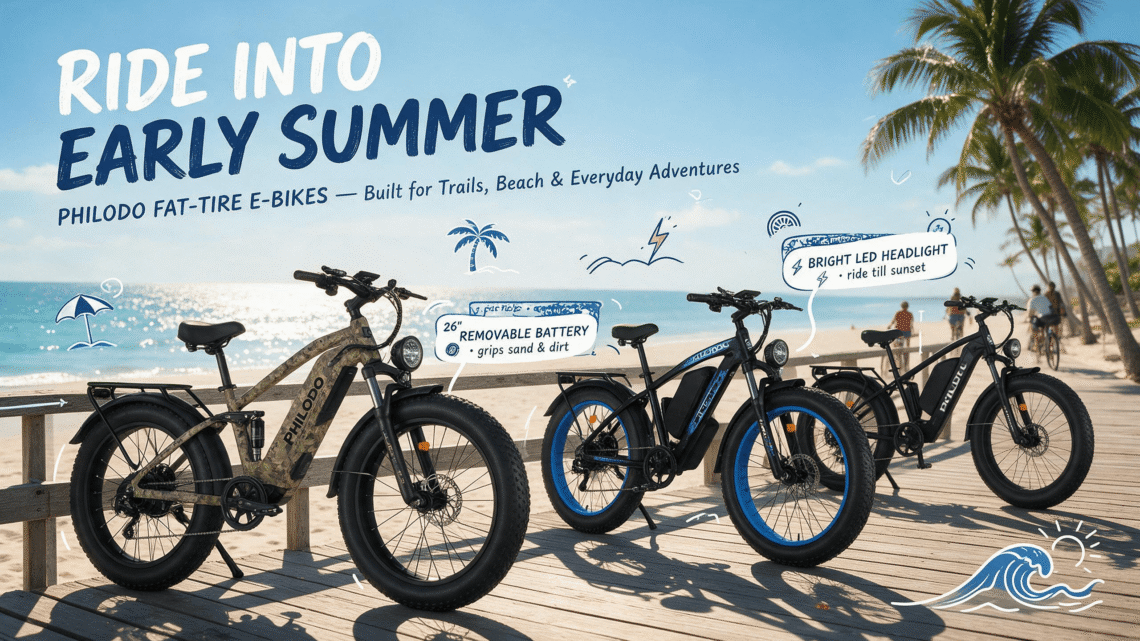
What Happens When a Bike Stops Making Compromises?
Most electric bikes ask you to choose. Do you want something practical for the city, comfortable for the neighborhood, capable on gravel, light enough to manage easily, or powerful enough to make hills feel irrelevant? Pick one, the usual playbook says, and accept the tradeoffs. PHILODO approaches the category from a different direction. Instead of building one gentle, generalized e-bike and asking riders to adapt their lives around it, the brand builds high-capability electric fat-tire bikes for people who want the same machine to handle commuting, exploring, hauling, climbing, beach riding, forest tracks, winter paths, and spontaneous detours.
That refusal to narrow the riding experience is the clearest thread running through the PHILODO lineup. The brand’s Amazon storefront presents rugged full-size e-bikes, step-through options, dual-motor configurations, high-capacity batteries, replacement components, and practical accessories. The visual language is intentionally bold: desert roads, dense woodland, summer shorelines, aggressive tire tread, prominent power figures, and bikes photographed like tools built to move through landscapes rather than merely pose in front of them.
But PHILODO is not simply about louder specifications. The more interesting idea behind the brand is accessibility to capability. A rider does not need to become a specialist to own a bike that feels specialized. A commuter can use pedal assistance on Monday, a camper can explore a fire road on Saturday, and a rider recovering confidence can choose a step-through frame without being pushed toward a timid, low-performance machine. PHILODO packages these possibilities into bikes that look substantial because they are designed to be substantial.
The short version: PHILODO is for riders who want an e-bike that begins where ordinary pavement ends—but still behaves like a useful vehicle when the ride starts at home.
The PHILODO Philosophy: Power With a Purpose
It is easy to reduce a powerful e-bike to numbers, but numbers only explain part of the experience. A dual-motor system matters because it can improve traction when the surface becomes loose. A large battery matters because it reduces the mental math before a longer trip. A fat tire matters because it broadens the range of surfaces a rider can reasonably approach. Full suspension and hydraulic disc brakes matter because confidence depends as much on control as on acceleration.
PHILODO combines those elements into a cohesive riding concept rather than treating them as separate checklist items. The brand’s bikes tend toward the rugged end of the e-bike spectrum: thick tires, sturdy frames, upright riding positions, generous battery mounts, cargo-friendly rear sections, and enough visual presence to signal that these are not delicate urban runabouts.
This positioning fills a particular gap. Some e-bikes are built almost entirely for smooth roads and light recreation. Others are expensive adventure machines aimed at deeply experienced riders. PHILODO speaks to the rider in the middle: someone who wants serious terrain ability without abandoning practicality, and who wants to buy through a familiar marketplace with accessible parts and accessories rather than entering a niche hobby ecosystem.
The Brand’s Three Main Promises
- Capability across changing surfaces. Fat tires, strong frames, suspension, and dual-motor options are combined for trails, sand, snow, gravel, grass, and uneven urban streets.
- Assistance for demanding rides. High-output motor setups and 60V battery systems target steep climbs, heavier riders, cargo loads, and long excursions.
- Usability beyond the first purchase. The storefront includes chargers, bags, displays, stems, and replacement parts, acknowledging that real ownership involves maintenance, customization, and support.
A PHILODO bike is therefore not designed to be the lightest, quietest, or most minimalist choice in the e-bike market. It is designed to be ready for more: more distance, more slope, more gear, and more uncertainty about what the road—or the absence of a road—will ask next.
A First Look at the PHILODO Riding Formula
The core PHILODO formula is easy to understand. Start with a stable electric bicycle platform, add voluminous tires for grip and floatation, use a strong frame to support the weight and torque, provide generous electrical capacity, and then let the rider choose how much assistance to use. The result feels less like a conventional bicycle with a small motor attached and more like a compact personal mobility vehicle that still preserves the familiar controls of a bike.
New riders often notice the posture first. These bikes encourage an upright, commanding view of the path ahead. The wide handlebars provide leverage, the long wheelbase contributes to stability, and the fat tires create a reassuring contact patch with the ground. The riding experience is not darty or nervous; it is deliberate and planted. That characteristic makes the bike feel predictable when carrying groceries, traveling over broken pavement, or moving slowly through rough terrain.
The second thing riders notice is flexibility in assistance. Depending on the model and configuration, a PHILODO e-bike can be used like a normal bicycle with partial assist, a strongly assisted commuter, or a near-motorized adventure vehicle depending on the selected mode and local riding rules. That range is important because the same bike may serve completely different missions from one weekend to the next.
💬 Imagine this: You leave home with no firm destination. The city block becomes a creek-side path, the path turns to gravel, and the gravel leads toward a hill. On a conventional bike, that sequence might trigger a U-turn. On a PHILODO, it feels like the ride is finally getting interesting.
Why Dual Motors Change the Feeling of the Ride
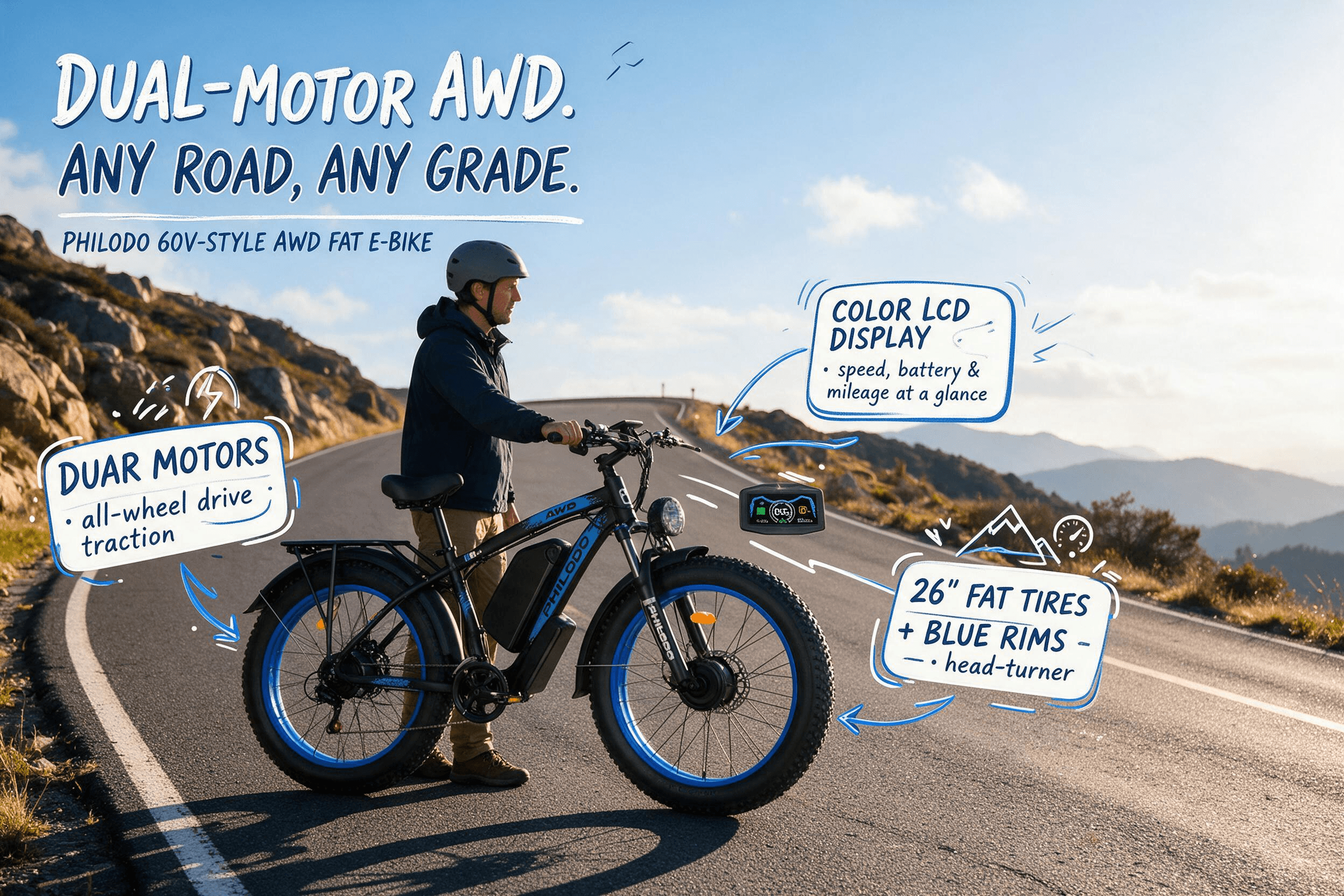
Several PHILODO models emphasize dual-motor, all-wheel-drive-style propulsion. Rather than relying on one motor to drive either the front or rear wheel, these setups use power at both ends. The appeal is not simply straight-line acceleration; it is traction management. When one wheel encounters mud, wet leaves, loose stone, sand, or a slippery patch, the other wheel can still contribute drive.
A single powerful motor can sometimes overwhelm available grip, especially on loose climbs. Dual motors distribute the workload and help the bike maintain composure in conditions where a rider might otherwise feel the rear wheel stepping out or the front wheel wandering. The system gives the bike a sure-footed character, especially when climbing or traveling at low speed over uneven ground.
PHILODO’s storefront highlights peak outputs as high as 5000W on dual-motor bikes, along with torque figures and steep-climb claims for certain upgraded models. Those figures are attention-grabbing, but they should be interpreted as peak system capability rather than constant output during every ride. Conditions, rider weight, tire pressure, battery state, assist setting, surface, and legal restrictions all affect real-world behavior.
Where Dual-Motor Assistance Is Most Noticeable
- Steep residential streets: The bike requires less physical effort and maintains steadier momentum.
- Gravel climbs: Power at both wheels can reduce slipping and hesitation.
- Loose sand or snow: Fat tires provide floatation while motor assistance helps sustain momentum.
- Loaded riding: Extra rider weight, bags, camping gear, or supplies put more demand on the drivetrain.
- Stop-start terrain: Regaining speed after a cautious corner or obstacle becomes less draining.
Dual motors are not necessary for every rider. Someone traveling only on smooth, flat neighborhood streets may be perfectly served by a simpler setup. But for riders who regularly encounter hills, weather, unpaved surfaces, or cargo weight, the feature moves from “exciting specification” to “genuinely useful engineering.”
Fat Tires Are Not Just a Styling Choice
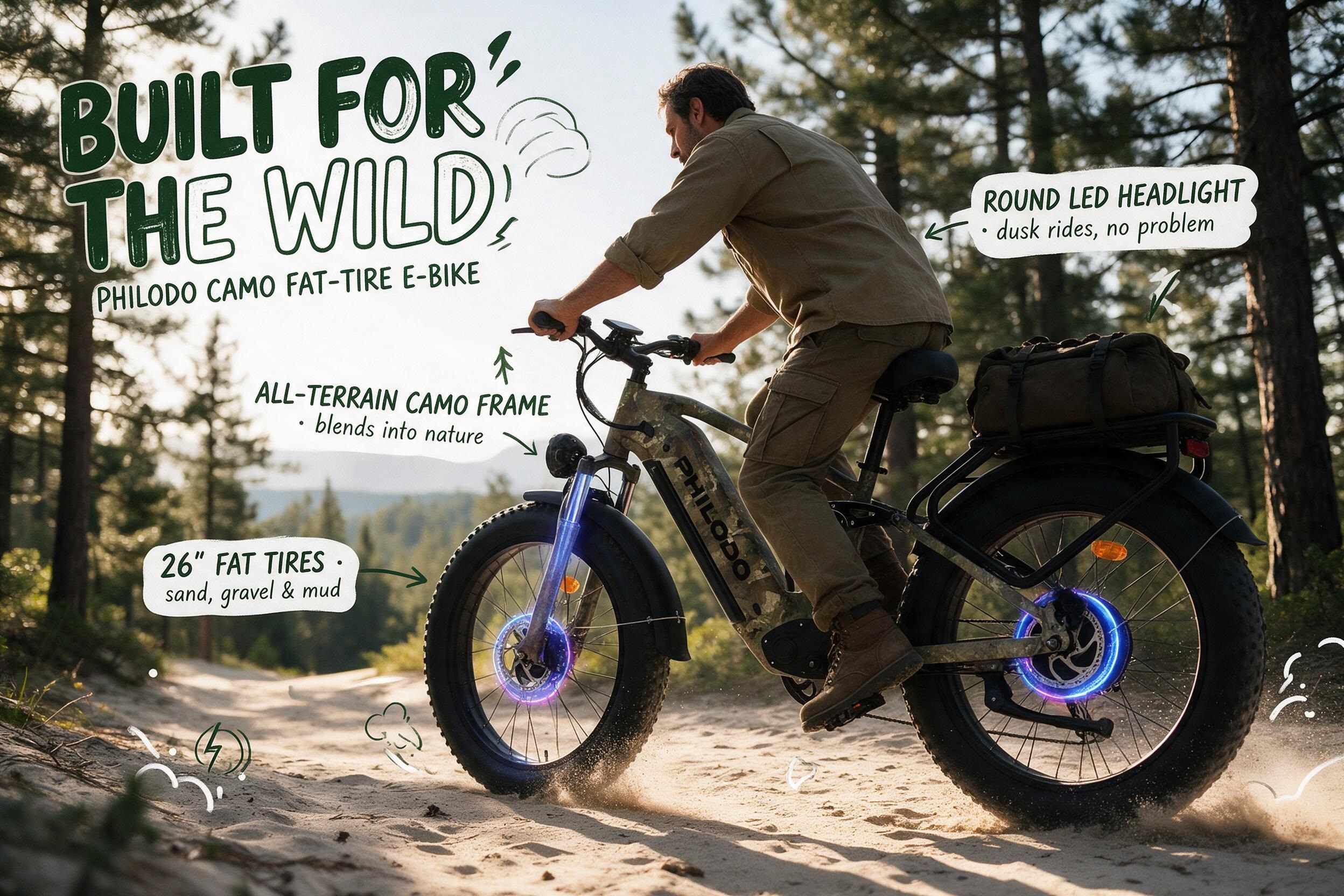
PHILODO’s bikes would look very different without their fat tires, but the tires are not merely aesthetic. Their width creates a larger contact area with the ground, which helps with comfort, stability, and traction. At lower pressures, fat tires can absorb small vibrations and conform more readily to uneven terrain. At higher pressures, they roll more efficiently while retaining the sturdy look and rugged stance of the bike.
On pavement, a fat tire smooths out expansion joints, pothole edges, gravel patches, and rough asphalt. Off pavement, it becomes a practical tool. It can roll over loose material more confidently, resist sinking slightly better in soft ground, and give a less experienced rider more margin when the surface changes suddenly.
The tradeoff is expected: fat tires generally create more rolling resistance and more visual bulk than narrow road-bike tires. That is why strong motor assistance and a stable frame are essential parts of the package. PHILODO does not pretend these are lightweight road racers. It designs around the tire’s strengths—confidence, grip, and versatility—rather than trying to hide its character.
A Quick Fat-Tire Reality Check
| Riding Surface | What Fat Tires Help With | What to Keep in Mind |
|---|---|---|
| City pavement | Comfort over bumps and broken road | Tire pressure should suit the rider’s load |
| Gravel | Stability and impact absorption | Loose corners still require smooth control |
| Sand | Better floatation and momentum | Soft sand remains physically demanding |
| Snow | Wider contact with packed or shallow snow | Depth, ice, and temperature matter greatly |
| Forest trails | Grip over roots, dirt, and stones | Ride within visibility and local trail rules |
The fat tire is an enabler, not a magic pass through every landscape. Good judgment, appropriate pressure, lawful use, and controlled speed remain essential.
Battery Capacity: The Freedom to Stop Planning Every Mile
One of the most practical parts of the PHILODO lineup is its emphasis on larger 60V battery systems, with storefront materials referencing capacities such as 25Ah, 26Ah, and 32Ah depending on the model or version. Range estimates in the broader market can stretch from around 50 miles to more than 100 miles under favorable conditions, but such numbers require careful interpretation.
Real range is never a fixed number. It changes with assist level, throttle use, speed, wind, tire pressure, terrain, temperature, rider and cargo weight, stop frequency, and battery age. A rider using modest assistance on smooth pavement may achieve considerably more distance than a rider climbing repeatedly at high power into a headwind. The value of a high-capacity battery is not that it guarantees a maximum figure in every situation; it is that it creates reserve.
Reserve matters psychologically. It means taking the longer scenic route without immediate concern, using assistance while carrying gear, reaching a overlook and still having power for the return, or running several errands without recharging between each one. It also means the bike can be shared by riders with different fitness levels without the slower rider becoming the limiting factor.
Callout: Think in terms of usable range, not headline range. The best range figure is the one that leaves you comfortable on the kind of ride you actually do—not the one measured in ideal conditions you rarely encounter.
Charging habits are also worth considering. Large batteries take time to recharge, and owners should plan for safe, dry charging locations, regular inspection of cables, and storage practices that follow the manufacturer’s guidance. A high-capacity e-bike is a small electric vehicle, and treating the battery with respect is part of ownership.
Braking and Suspension: The Features That Make Power Usable
Power without control becomes exhausting, and quickly. PHILODO pairs its high-output concept with hydraulic disc brakes and suspension systems across key models, two features that directly affect rider confidence.
Hydraulic disc brakes generally offer strong stopping force with less lever effort than mechanical alternatives. They are particularly useful on heavier e-bikes, because the bike itself, the battery, the motor, the tires, and optional cargo can create substantial moving mass. In wet or uneven conditions, controlled braking is as important as motor assistance. Riders should still bed brakes in properly, inspect pads, account for longer stopping distances, and avoid riding beyond their visibility.
Suspension helps in a different way. A front suspension fork absorbs impacts from the trail, while full-suspension configurations can help the rear wheel stay in contact with uneven ground. The benefit is not purely comfort; traction improves when the wheel is not bouncing over every rock or root. A suspended bike often feels less fatiguing on a long route, especially when the ride involves unpaved tracks, poorly maintained streets, or loaded panniers.
The Control System Checklist
- Hydraulic discs for confident speed management
- Wide tires for grip and bump absorption
- Suspension for uneven terrain
- Upright geometry for a clear view ahead
- Multiple assistance levels for adjusting effort
- Digital displays for monitoring ride information
- Sturdy frames designed to carry the weight of the system
These components work together. A large motor without adequate brakes would be poorly balanced. Fat tires without a stable frame would feel vague. A long-range battery without selectable assistance would waste energy. PHILODO’s appeal comes from the way the pieces support one another.
Meet the Lineup: Which PHILODO Personality Fits Your Ride?
PHILODO’s storefront places several model identities in view, including the rugged FORESTER, the step-through FALCON ST, and upgraded seasonal versions of its fat-tire collection. Exact colors, equipment, and specifications can change by version, so buyers should always review the current product listing before purchasing. Even so, the broad model themes give riders a useful starting point.
FORESTER: Built for the Trees and the Tough Spots
The FORESTER name makes the intended landscape immediately clear. Presented against woodland scenery and described with language such as “limitless terrain dominance,” this model leans into the adventure side of the brand. It is for riders whose routes are likely to include dirt, shade, roots, uneven inclines, and surfaces that would make a city e-bike feel out of place.
The FORESTER’s identity is sturdy and purposeful. It combines dual-motor power, 60V electrical architecture, fat tires, and suspension in a package aimed at riders who want one bike for both practical travel and outdoor exploration. It is an appropriate choice for campers, rural residents, trail-adjacent commuters, adventure riders, and anyone whose route regularly includes sections that are not neatly paved.
It may be more bike than a purely casual rider needs. Its size, weight, power, and rugged stance are best suited to owners who have somewhere to store it, the strength or assistance needed to manage it when unpowered, and a real desire for all-terrain capability.
FALCON ST: Easier Access Without a Softer Attitude
The FALCON ST brings step-through convenience to PHILODO’s rugged world. The “ST” matters because easier mounting and dismounting should not be treated as a secondary category. Riders with limited mobility, shorter stature, joint concerns, long coats, city parking routines, or frequent stops often benefit from a frame that does not require swinging a leg high over the rear of the bike.
What makes the FALCON ST interesting is that the easier-access frame is paired with the brand’s bold visual character and strong mechanical themes. It is not presented as a timid comfort bike. Storefront imagery places it in desert settings and camo styling, while PHILODO’s promotional language emphasizes expanded riding boundaries. That combination broadens who can participate in powerful fat-tire riding.
The FALCON ST is especially compelling for utility-focused owners who may carry bags, make frequent stops, ride in ordinary clothing, or simply value confidence when putting a foot down. It demonstrates that accessibility and adventure are not opposites.
Upgraded Dual-Motor and 60V Models
The broader PHILODO range includes upgraded versions and high-power dual-motor builds, with some market materials referencing substantial peak output, strong torque, speeds around 40 mph or more under suitable conditions, and the ability to tackle severe slopes. These figures make the bikes exciting, but they also place responsibility on the rider.
High-speed capability may be legal only on private land or in specific jurisdictions, and many public paths, bike lanes, beaches, parks, and trails impose speed or motor-power limits. A responsible buyer should check local e-bike classifications, helmet requirements, age restrictions, insurance rules, and permitted locations before purchasing. The bike’s capability does not automatically determine where it may lawfully be used.
Accessories and Replacement Parts
A brand becomes more useful when it supports ownership after delivery. PHILODO’s storefront includes items such as rear rack bags, chargers, handlebar stems, displays, and replacement parts. That ecosystem matters because e-bikes are not disposable products. Components wear, displays may need replacement, charging equipment may need to be supplemented, and cargo needs can change.
Accessories also let riders tailor the bike to a mission:
- Rear rack bags for tools, picnic gear, commuting essentials, or shopping
- Chargers for convenient charging at home or another regular location
- Stems and cockpit parts for refining handlebar position
- Displays for monitoring assist level, battery status, and ride information
- Replacement components for keeping the bike in service over time
This approach supports a longer-term relationship between rider and machine rather than treating the purchase as a one-time transaction.
PHILODO Model Themes at a Glance
| Model Theme | Best Rider Fit | Core Strength | Smart Question to Ask Before Buying |
|---|---|---|---|
| FORESTER | Trail explorers, rural riders, adventure commuters | Rugged terrain presence and dual-motor confidence | Do I regularly ride surfaces that justify this capability? |
| FALCON ST | Step-through riders, frequent stoppers, utility-focused owners | Easier access with bold performance styling | Will the frame geometry make daily use more comfortable? |
| High-power dual-motor versions | Experienced riders seeking maximum assistance and traction | Strong climbing and loose-surface drive | Are these power and speed levels legal where I ride? |
| Accessories and parts | Owners who want long-term usability | Maintenance, storage, display, and cargo support | Which add-ons solve a real rather than imagined need? |
Who Is PHILODO Actually For?
PHILODO is not trying to be everything to every rider, but its bikes are unusually broad in intended use. The brand is especially relevant to five types of owners.
1. The Two-World Commuter
This rider travels through a neighborhood or city during the week but wants the same bike for recreation on weekends. They may encounter steep streets, poor pavement, gravel shortcuts, or weather-degraded paths. A PHILODO bike gives them assistance for punctuality and fat-tire stability for variety.
2. The Rural or Semi-Rural Explorer
Not every useful route is maintained like a city cycle lane. Dirt lanes, farm roads, campground tracks, winter slush, muddy shoulders, and long driveways can make a conventional e-bike feel limited. PHILODO’s rugged platform is designed for these mixed environments.
3. The Rider Who Wants Easier Mounting
Step-through designs are too often dismissed as purely “comfort” options. In reality, they are practical for a wide range of riders. The FALCON ST makes PHILODO’s adventurous positioning available to people who value convenience, stability at stops, and a less demanding mounting motion.
4. The Gear-Carrying Adventurer
A bike becomes more useful when it can support a bag, a cooler, beach equipment, camera gear, picnic supplies, or tools. The sturdy PHILODO platform and available storage accessories suit riders who want the bike to carry part of the load.
5. The Confidence-First Rider
Some riders do not want to balance on a light, fast, twitchy machine. They prefer something planted, visible, and predictable. PHILODO’s upright geometry, wide tires, strong brakes, and assisted acceleration create a reassuring ride for people who value control over sporty agility.
Who May Prefer Something Different?
PHILODO may not be the best match for someone who lives in a small upstairs apartment with no secure storage, wants the lightest possible liftable bike, rides only on smooth indoor-style paths, prioritizes maximum portability in a car trunk, or has no use for off-road or high-power features. These are large, capable machines, and capability inevitably brings size and weight.
The Real-World Jobs a PHILODO Can Do
A versatile e-bike earns its place by replacing car trips, enabling exercise, and creating reasons to go outside. A PHILODO can be used for morning commuting, campus travel, neighborhood visits, fishing trips with gear, beach cruising, campground movement, winter utility riding on suitable packed paths, photography excursions, or simply exploring roads that would feel intimidating on an unassisted bicycle.
The bike can also change how a rider thinks about distance. A hill that once determined whether a trip was possible becomes a setting for assist management. A route that used to require a car may become a viable ride when motor support handles the hardest sections. A rider recovering fitness can start with assistance and reduce it as confidence returns.
That adaptability is especially valuable for couples or households with different fitness levels. Two riders can travel together without one person constantly waiting at the top of every hill. One may ride aggressively, the other conservatively, but both can reach the same destination.
💬 “I just want to keep up.” That sentence is more meaningful than it sounds. Many people stop riding not because they dislike cycling, but because group rides, hills, distance, or recovery from injury make ordinary bikes feel discouraging. A thoughtfully used e-bike can reopen participation.
Owning a High-Capability E-Bike: What to Plan For
Buying a PHILODO is only the beginning. Owners get the best experience when they plan for storage, maintenance, charging, safety, and local rules.
Storage and Security
These bikes are substantial. A locked garage, secure shed, ground-floor storage area, or sturdy indoor location is ideal. Because high-capacity e-bikes are valuable, owners should use quality locks, avoid leaving them unattended for long periods, and consider registration or ride-record photos. Removing the display or using additional anti-theft measures may also be sensible in public locations.
Battery Care
Follow the manufacturer’s charging guidance, avoid damaged cables, charge in suitable conditions, and inspect connectors regularly. If the bike will be unused for an extended period, follow recommended storage practices rather than leaving the battery completely drained or continuously exposed to extreme temperatures.
Maintenance
Disc brake pads, tires, chains, cassettes, cables, lights, fenders, and bearings all require attention. Powerful e-bikes place more load through the drivetrain than ordinary bicycles, especially when ridden heavily with cargo or on hills. Regular cleaning and inspection protect both performance and safety.
Safety Gear
A properly fitted helmet is essential. Riders using high-power configurations should consider gloves, eyewear, sturdy footwear, visibility lighting, and protective clothing appropriate to terrain and speed. A bike capable of traveling quickly should not be treated like a casual sidewalk toy.
Local Laws
E-bike regulations vary widely. Motor wattage, assisted speed, throttle use, rider age, helmet requirements, permitted trails, sidewalk use, and road classification can differ by city, state, country, park district, or land manager. Before using the most powerful settings in public, confirm what is allowed.
How to Choose the Right PHILODO for You
The most tempting specification is not always the one that matches your actual life. Before choosing a model, answer these questions honestly.
- Where will most rides begin: a garage, apartment, curb, or rural property?
- Will you lift the bike often, carry it upstairs, or put it on a vehicle rack?
- What surfaces make up at least eighty percent of your expected routes?
- How steep are the hills you ride weekly?
- Do you need a step-through frame for comfort or mobility?
- Will you carry cargo, passengers where lawfully supported, or outdoor gear?
- What range do you genuinely need between charges?
- Where are high-power or high-speed modes legally permitted?
- Do you prefer relaxed cruising or more active riding?
- Will you perform basic maintenance yourself or use a local bike shop?
A buyer with mostly flat, short city trips may not need the most extreme dual-motor configuration. A rider with steep rural roads, loose driveways, and camping trips may use that capability every week. The right choice is the one that matches real routes rather than imagined aspirations.
A Simple Decision Path
- Choose the frame first. Standard frames often suit aggressive and taller riders; step-through frames favor easy access and frequent stops.
- Choose the power level by terrain. Hills, cargo, soft surfaces, and long distances justify more motor.
- Choose battery capacity by routine. Prioritize reserve if you cannot recharge at every destination.
- Choose accessories by actual use. Buy storage and replacement items that support known habits.
- Verify the legal environment. Confirm where the bike and each assistance mode may be ridden.
What Makes the Brand Feel Different?
PHILODO’s personality comes from contrast. It presents powerful, almost overtly rugged machines in a mainstream marketplace. It pairs adventure imagery with practical accessories. It offers step-through access without retreating from bold styling. It speaks in dramatic slogans while selling components that owners actually need over time.
That balance is uncommon. Many brands choose a lane and remain there: urban minimalism, weekend recreation, hunting and fishing utility, premium mountain performance, or budget simplicity. PHILODO instead presents a more flexible identity. Its bikes look ready for an expedition but can still be used for a Tuesday evening ride to watch the sunset.
The brand also understands that modern e-bike shoppers want confidence in numbers. Motor output, battery voltage, amp-hour capacity, torque, braking hardware, climbing claims, and suspension are all part of the conversation. Yet the better reason to consider PHILODO is not a single figure. It is the total package: a bike that looks capable, is specified to be capable, and is supported by accessories and replacement parts.
The Bigger Shift Behind Fat-Tire E-Bikes
Electric bikes are changing who rides and where riding can happen. Older cycling culture sometimes assumed that riders should adapt to the bicycle: become fitter first, learn the route, accept the hills, wear specialist clothing, and arrive sweaty if necessary. E-bikes reverse part of that equation by making the machine adapt to the rider’s goals.
PHILODO extends that shift by also adapting to the landscape. A fat-tire e-bike does not demand that every journey begin on a perfect lane. It gives riders a way to move through environments that have traditionally belonged to cars, trucks, off-road vehicles, or highly experienced cyclists. That can mean more time outside, fewer short car trips, better access to nature, and a gentler way to rebuild physical activity.
The environmental and lifestyle benefits should be stated realistically. An e-bike is not automatically sustainable if it is ridden rarely, charged carelessly, or replaced thoughtlessly. But when it replaces car trips, supports local exploration, and encourages regular movement, it can become a meaningful part of a lower-impact lifestyle. A brand that builds durable, useful, repairable machines contributes to that possibility.
Inspiration in one sentence: The best adventure vehicle is not always the one that carries you farthest from home; sometimes it is the one that makes you curious about the road two miles from your door.
Frequently Asked Questions About PHILODO
Are PHILODO e-bikes suitable for daily commuting?
Yes, certain models can work well for commuting, especially if the route includes hills, rough pavement, gravel, cargo, or weather conditions. Riders should consider weight, storage, battery charging, fenders, lighting, and local laws before choosing a high-power model for daily city use.
Are dual motors necessary?
Not for every rider, but they can improve traction and confidence on steep, loose, wet, or loaded rides. If most trips are short, flat, and perfectly paved, dual motors may be more capability than needed. If the route regularly involves hills or unpaved ground, the feature becomes more relevant.
Can a PHILODO be ridden on trails or beaches?
The bikes are designed with fat tires and rugged features that support mixed-terrain riding, but permission depends on local rules. Beaches, forests, parks, and multi-use paths may prohibit motor vehicles, impose speed limits, or restrict certain e-bike classes. Always check before riding.
How far can a PHILODO go on a charge?
Range varies by model, battery capacity, assist level, terrain, load, speed, weather, and riding style. High-capacity 60V batteries provide useful reserve, but buyers should not treat a maximum advertised range as a guaranteed result for every condition.
Is a step-through frame less capable?
No. Frame style affects access, mounting, standover height, and some carrying dynamics, but it does not automatically reduce capability. The FALCON ST shows that a step-through design can still be paired with rugged tires, strong assistance, and adventurous styling.
What should new owners do first?
Check local e-bike rules, inspect assembly or use professional assembly if needed, verify brakes, understand the display and assistance modes, charge the battery according to instructions, adjust tire pressure, wear appropriate safety gear, and begin in a controlled open area before using high-power settings.
Final Thought: Ride the Route You Would Normally Avoid
PHILODO is built around a simple but liberating idea: the surface in front of you should not automatically decide where your day ends. A fat-tire platform, strong brakes, generous batteries, suspension, and available dual-motor traction give riders more ways to keep moving when the road becomes steep, rough, soft, or unfamiliar.
The brand’s FORESTER side speaks to forests and rugged exploration. Its FALCON ST side speaks to easier access and everyday practicality. Its accessories and replacement parts acknowledge that a real bike must remain usable long after the first exciting weekend. Together, those elements create a brand for people who want capability without being forced into a narrow riding identity.
A PHILODO may be the right choice if you want a bike that does more than commute, more than cruise, and more than look adventurous in a photograph. It is for riders who want to turn toward the hill, follow the gravel track, carry the extra bag, and arrive without spending all their energy before the journey truly begins.
The best rides rarely begin with “maybe next time.” They begin when the bike is ready—and when you finally feel ready to take the less predictable route.