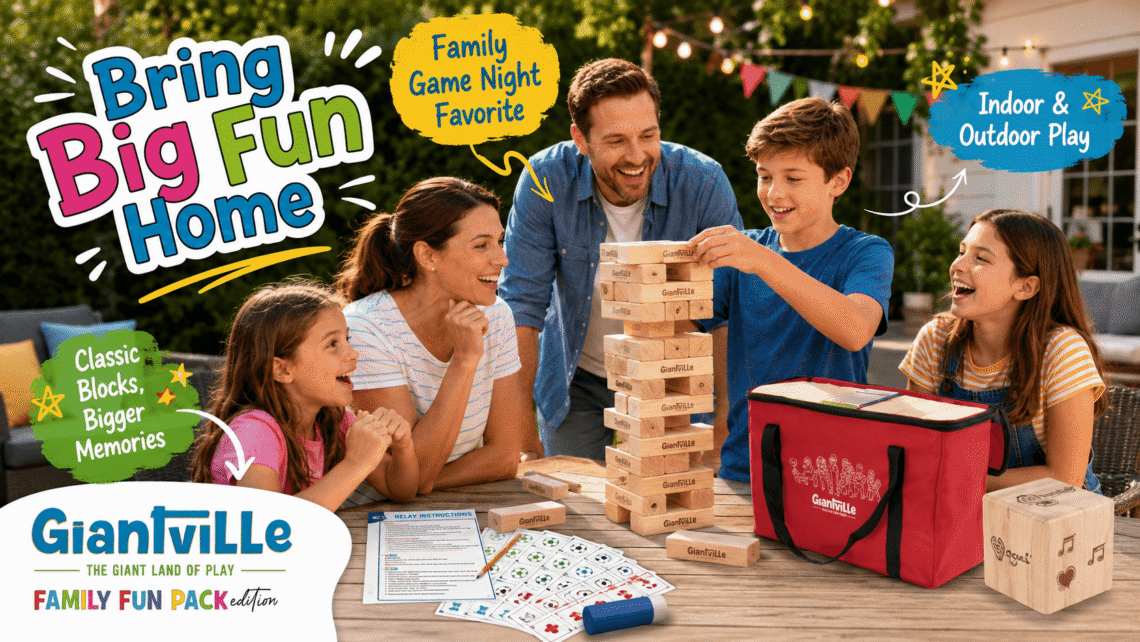
In an era increasingly defined by glowing rectangles and fragmented attention spans, the concept of collective family leisure has undergone a radical and somewhat disheartening transformation. We find ourselves occupying the same physical spaces—living rooms, patios, and backyards—yet navigating entirely different digital universes. The modern challenge for parents, educators, and community builders is no longer just finding time to spend together, but finding a compelling reason to disconnect from the virtual world and reconnect with the physical one. This is precisely the critical juncture where Giantville steps in, offering not just a product, but a philosophical shift back to tactile, shared, and unabashedly joyful experiences. Giantville is not merely a manufacturer of games; it is an architect of communal memories, specializing in oversized entertainment that demands presence, participation, and a healthy dose of friendly competition.
The core premise of Giantville is as simple as it is brilliant: take the timeless, universally understood mechanics of classic games and scale them up to monumental proportions. There is a fascinating psychological phenomenon that occurs when we interact with objects that are larger than life. The mundane becomes magical, the ordinary becomes an event, and the stakes of a simple game are visually and emotionally magnified. Giantville capitalizes on this by creating products that act as immediate focal points in any environment. When a Giantville set is unpacked, it physically alters the dynamic of the room or the outdoor space, serving as an irresistible invitation for people of all ages to gather around, strategize, and engage in genuine, unscripted interaction. The brand has successfully identified that in order to compete with the high-definition allure of modern technology, physical play needs to be bold, visually striking, and deeply engaging on a sensory level.
At the absolute center of the Giantville universe is their flagship offering, a masterclass in tension, balance, and structural physics: the Giant Tumbling Blocks. This is not the tabletop diversion you may remember from your childhood; it is an architectural endeavor that requires gross motor skills, spatial reasoning, and cooperative physical movement. The sheer scale of the blocks transforms the game from a solitary, localized activity into a full-body experience. Players do not just sit and flick small pieces of wood; they stand, they crouch, they circle the growing tower, assessing structural integrities and identifying load-bearing pieces with the focus of engineers. As the tower grows taller and increasingly precarious, the tension in the space becomes palpable. Every successful extraction is met with collective sighs of relief, and the inevitable, thunderous collapse is universally greeted with uproarious laughter rather than frustration. This dynamic is a testament to the brand’s understanding of play as a tool for emotional release and bonding.
Why Making a Familiar Game Bigger Changes the Experience
Among the brand’s most central products are its giant tumbling block games. The basic idea is universally familiar: build a tower, remove blocks one by one, and try not to cause a collapse. Scaling that experience up changes the emotional rhythm of the game. Every successful move feels more dramatic, every wobble attracts attention, and every collapse becomes part of the fun rather than simply the end of a round. For families, this kind of gameplay works particularly well because it requires very little explanation. The physical nature of moving large blocks also makes the experience feel more active than a standard tabletop game. Players are not just sitting and waiting; they are standing, reaching, judging balance, and reacting to the structure in real time.
This is where Giantville’s approach becomes more interesting than simply enlarging a conventional game. Size changes who can become involved. With a small tabletop game, the experience often belongs primarily to the people seated around the table. With a giant tower, everyone nearby can follow what is happening. A risky block removal can generate reactions from people who are technically not playing at all. Children may gather around the structure, adults may offer advice from the sidelines, and the next player can feel the entire group watching as the tower begins to lean. The game effectively becomes part competition and part social performance, which gives it much more energy in a group environment.
The Family Fun Pack: More Than a Single Game
Giantville’s Family Fun Pack concept expands on the tumbling block format by adding accessories and flexible ways to play. The brand’s storefront presentation highlights a special-edition package that combines giant tumbling blocks with additional game components, printed accessories, and activity materials designed to introduce more variety into the experience. This approach gives the product more than one role. It can function as a classic stacking challenge, but it can also become a customizable family game with symbols, additional rules, and alternative ways of interacting with the blocks.
The family-pack strategy reveals something important about Giantville’s broader product philosophy: the brand is not only selling scale; it is selling replayability. Large games can easily become novelty items if they provide only one way to interact with them. Giantville addresses that challenge by encouraging families to personalize, vary, and extend the basic game. Accessories and alternate play ideas make it easier to adapt an activity to different ages, personalities, and group sizes. A block game can become a competition between siblings one afternoon, a party challenge among adults the next weekend, a team activity at a family reunion, or a casual icebreaker during a neighborhood gathering.
That flexibility can make a meaningful difference in how often a game is actually used. Families rarely need another product that feels exciting for one afternoon and then disappears into a closet. The more situations in which an activity makes sense, the more naturally it becomes part of regular family entertainment. Giantville’s bundled approach gives its core gameplay room to evolve rather than asking owners to repeat exactly the same experience every time.
Simple Strategy, Larger Presence
Another important part of Giantville’s lineup is its giant four-in-a-row format. Like tumbling blocks, four-in-a-row works particularly well because the objective is immediately recognizable. Two players or teams take turns placing pieces and attempt to create a connected line before their opponent does. There is enough strategy to make each round competitive, but the rules remain simple enough that new players can join almost immediately.
The large format transforms that familiar concept into something more physical and more visible. Instead of leaning over a small board, players interact with a game that occupies its own space and naturally draws attention. It can fit into living rooms, patios, lawns, event spaces, school environments, and casual gatherings because the board itself acts as both an activity and a visual centerpiece. This type of product fits the Giantville identity particularly well: easy to understand, quick to start, competitive without being intimidating, and suitable for a wide range of ages.
The combination of tumbling games and simple strategy games also gives the brand variety without losing focus. Giantville does not need to make every kind of toy imaginable. Its stronger position is to develop recognizable group games that share similar qualities—physical presence, accessible rules, social interaction, and broad appeal. That creates a much clearer brand identity than a catalog filled with unrelated products.
A Natural Alternative to Screen-Centered Entertainment
Giantville’s relevance becomes even clearer when considering how its products fit into modern family life. Many households want activities that can compete with phones, television, tablets, and gaming consoles without turning “screen-free time” into an obligation. Giantville offers an alternative that does not depend on lecturing anyone about technology. The attraction comes from the activity itself.
A large tower that could fall at any moment is naturally interesting. A head-to-head strategy board invites immediate competition. Because these activities are tactile and visible, they generate interaction organically. Players look at one another, comment on moves, celebrate successes, laugh at mistakes, and react to unexpected outcomes. No one needs to be told to socialize because communication becomes part of the game.
This distinction is important. Some offline activities struggle to hold attention because they feel like substitutes for more exciting digital entertainment. Giant games have a different advantage: their physical scale creates an experience that screens cannot directly replicate. The suspense comes from a real structure wobbling in front of the players. The satisfaction comes from physically placing a piece or successfully removing a difficult block. Giantville uses tangible interaction as part of the entertainment rather than treating it as merely a nostalgic alternative to technology.
Designed for the Gatherings People Actually Have
Giantville also fits naturally into occasions where hosts need entertainment that works with minimal explanation. Birthday parties, backyard barbecues, family reunions, holiday gatherings, graduation celebrations, casual weekend get-togethers, camping trips, and community events can all benefit from activities that people can join without formal scheduling.
Giant games are especially useful in these settings because they do not require every guest to participate at the same time. A few people can begin a round, others can watch, and new players can rotate in whenever they are ready. Someone arriving late does not need a ten-minute explanation before participating. A guest who prefers observing can still enjoy the suspense. Children and adults can play together without requiring completely separate activities.
This flexible participation helps solve one of the most common challenges of group entertainment: finding something that does not exclude part of the crowd. Some games require detailed knowledge, specific team sizes, lengthy sessions, or players with roughly equal skill levels. Giantville’s core formats are far less demanding. They create structure without making the gathering revolve entirely around the game.
Fun First, With Useful Skills Built In
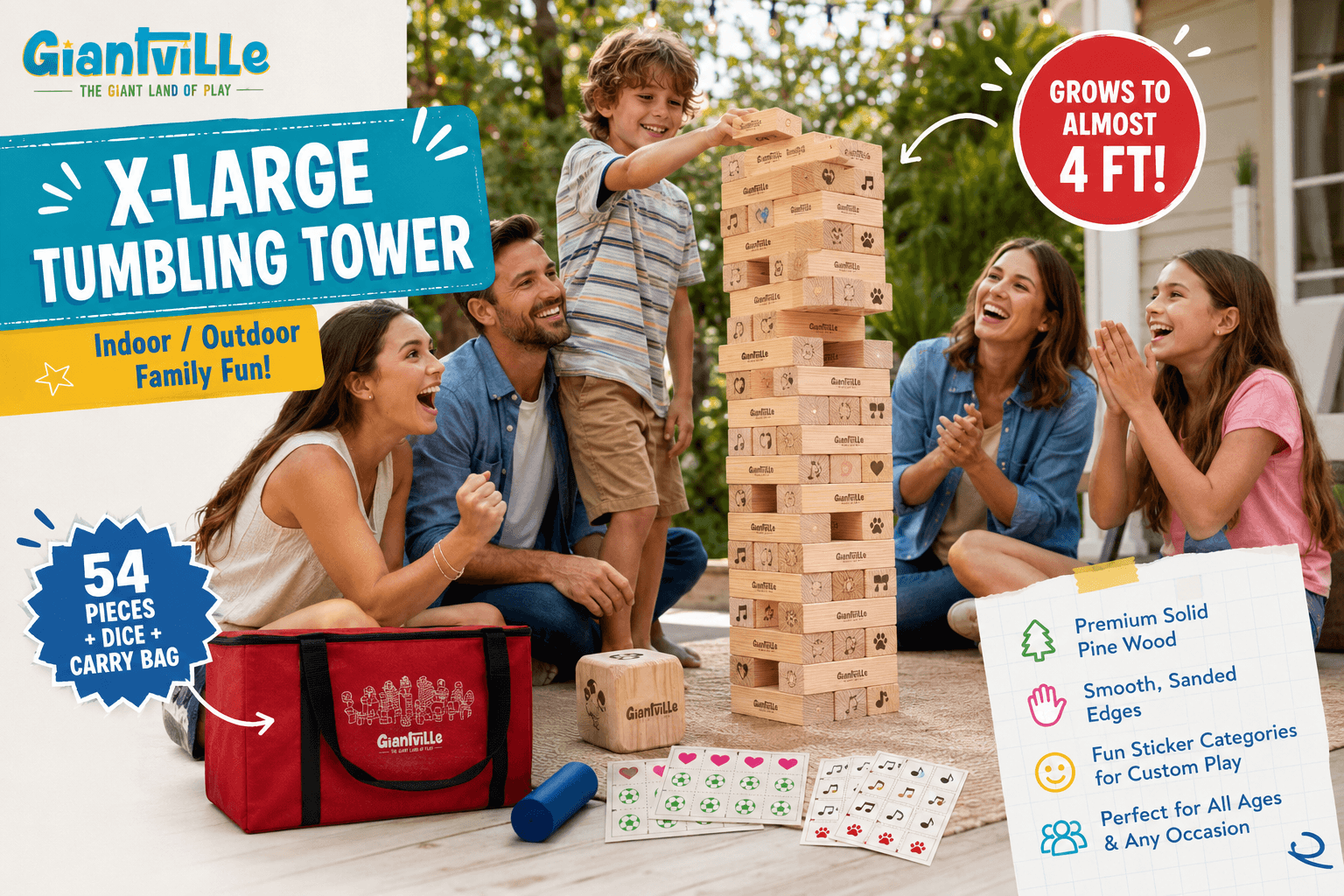
For parents, Giantville’s products can also provide a valuable balance between entertainment and developmental benefits. Without turning play into a formal lesson, tumbling block games can encourage hand-eye coordination, patience, spatial judgment, concentration, and simple strategic thinking. Four-in-a-row naturally introduces pattern recognition, planning, and cause-and-effect reasoning.
Perhaps more importantly, group games provide opportunities to practice social skills that are difficult to teach through instructions alone. Taking turns, waiting patiently, making decisions under pressure, accepting an unsuccessful move, managing friendly competition, and celebrating another person’s success all occur naturally during play. Children encounter these experiences as part of having fun rather than as an educational exercise.
That “fun first” approach is important to Giantville’s appeal. Parents may appreciate the skills involved, but children do not need to think of the game as educational. The learning happens quietly inside an activity that still feels like entertainment. This allows Giantville products to fit comfortably into family leisure time without feeling like disguised homework.
Practicality Matters With Giant Games
The design of Giantville’s brand experience also shows an awareness that family games need to be practical as well as entertaining. Large-format products naturally raise questions about organization, transportation, and storage. A game can be highly enjoyable, but if moving it from the house to a party is frustrating or keeping all of its pieces together becomes difficult, families may use it less frequently.
Giantville’s Family Fun Pack presentation places visible attention on keeping the game and its accessories organized, including a dedicated carrying and storage solution. Details like these may appear secondary compared with the excitement of the game itself, but they can have a major influence on the ownership experience. Being able to gather the pieces, transport the activity to another location, and set everything up again without searching for missing components helps transform an oversized game from an occasional novelty into something that can realistically travel between events.
Why Giantville Also Makes Sense as a Gift
There is also a strong gifting dimension to the brand. Toys and games can be difficult to select because many are tied to narrow age groups, particular characters, specialized interests, or short-lived trends. Giantville’s products have broader relevance because they can be enjoyed by groups rather than only one recipient.
A giant game can effectively become a gift for an entire household. That makes the category suitable for birthdays, holidays, housewarming occasions, family celebrations, and other events where a shared present may be more meaningful than another individual item. Oversized games also have immediate visual impact. They feel substantial when opened and, in many cases, can become part of the celebration almost immediately.
This quality strengthens Giantville’s position because the product itself can help create the memory associated with receiving it. Instead of being opened, admired, and set aside, a family game invites everyone present to begin interacting with it.
A Clear Place in Modern Family Entertainment
From a brand-positioning perspective, Giantville occupies an appealing middle ground between traditional toys, party games, and outdoor entertainment. It is not restricted to a single room, occasion, or demographic. The same product can move from a child’s birthday party to a backyard cookout, a family holiday gathering, and an adult game night without feeling out of place.
That versatility gives Giantville room to expand while maintaining a recognizable identity. Rather than chasing unrelated toy categories, the brand can continue building around a straightforward promise: familiar games made bigger, more social, and more suitable for shared occasions.
Modern consumers increasingly evaluate products according to the experiences they enable. A game is no longer judged only by what comes inside the package. Buyers also consider what happens after it is opened. Will people actually want to play? Is it easy to explain? Can different age groups participate? Will guests engage with it? Can it be used again at the next gathering?
Giantville’s strongest concepts answer those questions in a direct way. Their rules are familiar, their size attracts attention, and their physical nature encourages people to gather in the same space. That combination gives the brand something more valuable than novelty alone.
Giantville’s Bigger Idea
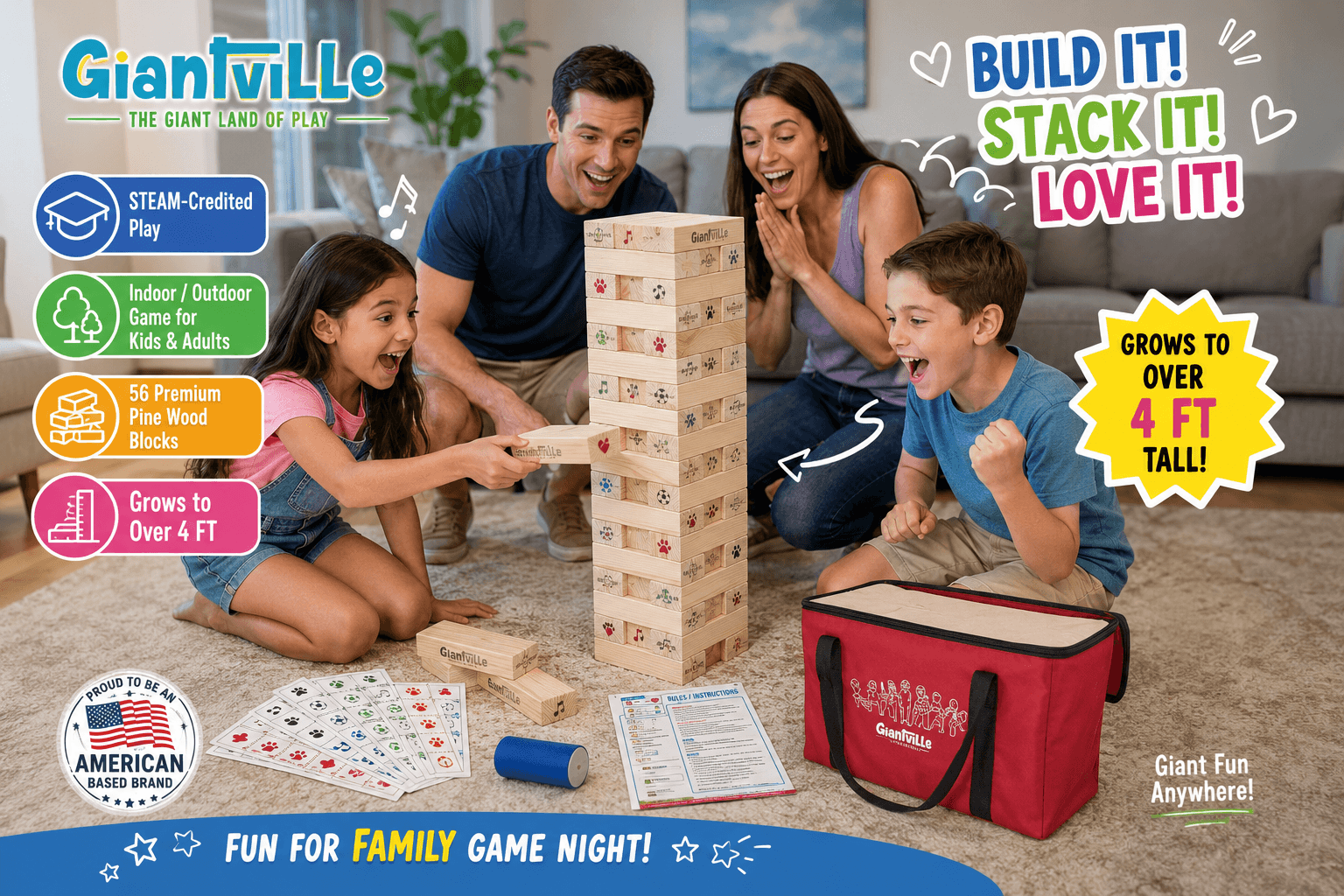
Ultimately, Giantville’s appeal comes from turning ordinary gatherings into more participatory ones. Its oversized games create visual excitement, but the real value lies in what happens around them: children challenging adults, relatives forming teams, friends gathering to watch a risky move, and guests who barely know one another finding an easy reason to interact.
Giantville also serves as a brilliant solution for event planning and social hosting. The modern host is often burdened with the task of facilitating interaction among guests who may not know each other well. A Giantville set placed strategically in a backyard or a reception hall acts as the ultimate icebreaker. It provides a shared point of focus, giving people an activity to engage in and a reason to converse. The low barrier to entry means that guests can easily drop in and out of the game without disrupting the flow of the party. It creates a secondary zone of entertainment, allowing those who prefer active engagement to thrive while others mingle. From casual neighborhood cookouts to highly curated wedding receptions, the presence of oversized wooden blocks adds a layer of whimsical, interactive charm that elevates the entire social atmosphere.
When evaluating the broader impact of a brand like Giantville, we must consider the cultural shift it represents. We are currently witnessing a broader societal craving for “analog” experiences. Just as vinyl records and physical books have seen resurgences, so too is there a growing appetite for tangible, physical play. Giantville is at the forefront of this movement, providing the tools necessary for families to reclaim their leisure time from the digital ether. By offering an experience that is massive in scale, infinitely customizable, and deeply rooted in physical interaction, they are not just selling a game; they are selling a methodology for connection.
The brilliance of Giantville lies in its simplicity and its profound understanding of human nature. We are, at our core, social creatures who learn, bond, and express ourselves through play. By supersizing this play, Giantville ensures that these moments are impossible to ignore and easy to cherish. They have taken the raw materials of joy—wood, gravity, suspense, and togetherness—and packaged them into a definitive, unforgettable experience. Whether it is a quiet Tuesday evening in the living room or a bustling weekend festival, Giantville has proven that sometimes, to bring people closer together, you simply have to build something a little bigger. In the end, the most significant thing Giantville constructs is not a towering wooden structure, but an enduring foundation for laughter, communication, and deeply felt family unity.