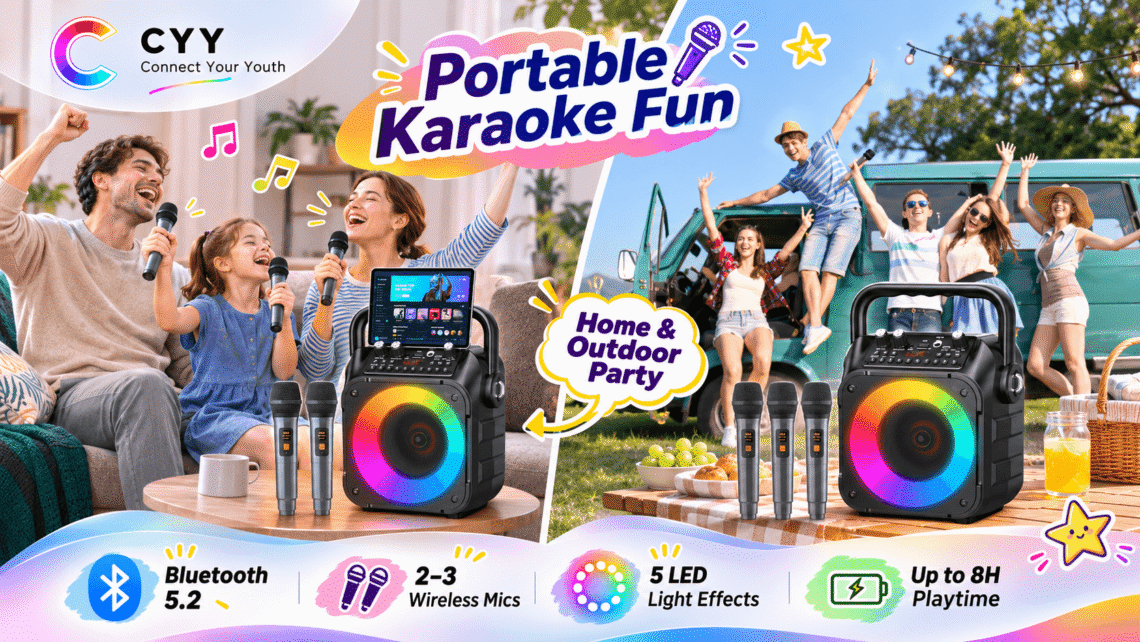
Most audio brands sell you a better way to listen. The CYY karaoke machine is built around a much older, much riskier idea: a better way to be heard. That distinction sounds tiny until you watch what happens in a living room when someone hands a microphone to a person who has spent forty years saying “I can’t sing.” The CYY philosophy — the brand spells it out in its own name, Connect Your Youth — is that the flinch before the first note is the thing worth designing against. Not the wattage. Not the codec. The flinch.
This piece is an honest walk-through of what CYY actually is, what its flagship portable karaoke machine puts on the spec sheet, and — more usefully — what those numbers turn into at 9 p.m. on a Saturday when the food is gone and nobody wants the evening to flatten out into phones.
A Name That Is Really a Sentence
Brands usually pick a name that sounds good on a logo. CYY picked one that makes a claim, and the claim is the interesting part.
Connect implies there is a gap to close — between people, between generations, between the version of yourself that dances in a parked car and the version that sits politely on the couch. Your Youth doesn’t mean being young. It means the part of you that hasn’t been trained yet: the part that belts out a chorus badly and beautifully, that doesn’t know which songs are “cool,” that still believes a hairbrush is a legitimate microphone.
Put the two together and you get a design brief that explains an awful lot about the hardware:
- Microphones come included, not sold separately. A karaoke product that ships with one mic is a solo product. Two mics turn a spectator into a participant.
- The speaker is meant to be held next to a face, not placed on a shelf. Vocal intelligibility matters more than audiophile frequency graphs.
- Lights are treated as social equipment. A glowing ring lowers the perceived cost of being watched.
- Portability is non-negotiable. An invitation has to be able to leave the building.
There’s a sentiment the brand circles around — the idea that everyone in the room has a moment coming — and it’s easy to roll your eyes at that as marketing. But it’s the only kind of positioning that produces a coherent product. If you genuinely believe the person holding the mic is not a performer, you design for forgiveness: echo that smooths pitch, gain that doesn’t shriek, a handle that makes handing-off physical and casual. CYY’s catalog reads like it was drawn from that belief rather than from a competitor teardown.
What Is Actually in the Box
Here is the flagship configuration as the brand presents it, along with the translation that matters. Specs vary by model and production batch, so confirm the exact figures on the listing before you buy — but the shape of the package is consistent.
| On the sheet | In the room |
|---|---|
| 15W amplifier output | Loud enough to fill a backyard and a mild crowd, not a club |
| 6.5-inch full-range driver | Real bass under pop tracks; vocals sit forward instead of buried |
| High-bass separation tuning | Music and voice stay on different shelves rather than smearing |
| Two wireless microphones | Duets, call-and-response, and a built-in audience |
| Bluetooth 5.2 | Phone connects instantly and holds through a few rooms of distance |
| USB, microSD (TF), AUX, mic input | Works without your phone; plug a grandparent’s MP3 folder straight in |
| TWS stereo pairing | Two units become left/right without a cable between them |
| Around 8 hours of playtime | Survives an entire evening, start to last-song |
| Five LED light modes | The room changes color when the chorus hits |
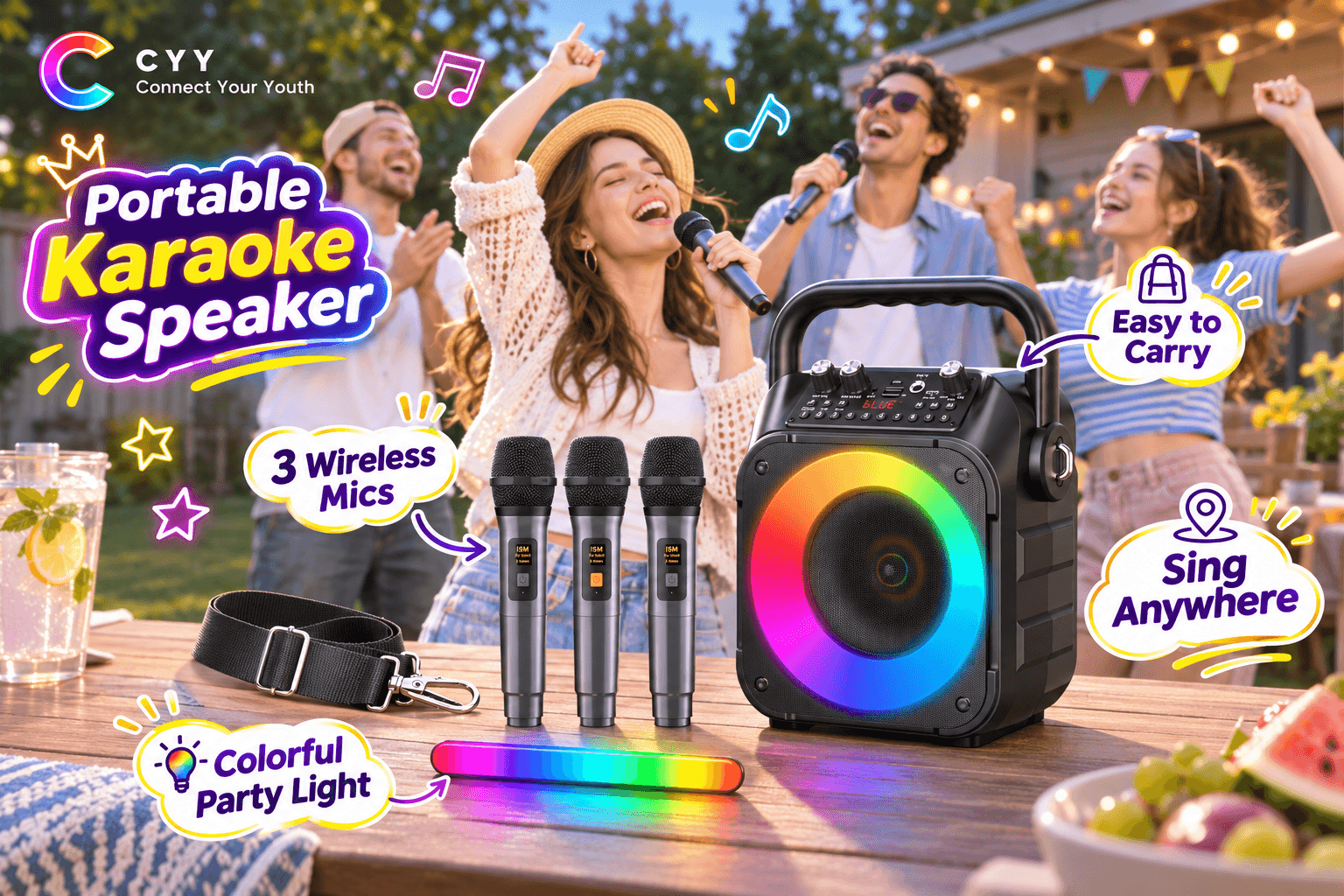
| Shoulder strap, roughly 4.4 lbs | Somebody other than you can carry it |
The weight figure deserves a note. Four-point-four pounds sounds like nothing in a spec table and turns out to be the single most important number on it, because it is inside the range where a child can lift something and feel helpful. Gear that only one adult can carry gets used by one adult. Gear anyone can carry gets used by everybody.
Fifteen Watts Is the Wrong Argument
Audio conversations collapse into power figures, and fifteen watts invites the reflexive smirk. It’s worth pushing back on that reflex, because karaoke is not music playback — it’s a different acoustic problem with different priorities.
When you listen to music, you want the room to disappear. When you sing, you want the room to respond. That means a karaoke system lives or dies on three things that have almost nothing to do with peak loudness:
- Vocal headroom. The moment someone gets excited — and they always get excited on the second verse — a badly designed mic path clips into harsh distortion. Separation between the voice channel and the music channel is what keeps that moment sounding enthusiastic rather than broken.
- Monitoring comfort. If you hear yourself thin and tinny, you tighten up and sing quieter. If you hear yourself full, you lean in. The 6.5-inch driver doing genuine low-mid work is what makes a non-singer commit.
- Feedback discipline. A speaker and two mics in the same three-meter radius is a physics lesson waiting to happen. Gain structure and mic placement matter more than any wattage claim, which is why the included strap-and-handle design isn’t just convenience — it keeps the speaker below and apart from mic axis.
There’s also a social ceiling that pure numbers miss. A 15W system is intimate by nature. Nobody performs at a 15W speaker; people gather around it. Bigger gear creates a stage. This creates a circle. For a family gathering, a campsite, or a classroom, the circle is the point.
💬 The Volume Test People Actually Run
“Is it loud enough for the backyard?”
It is loud enough for the backyard. It is not loud enough for a driveway full of forty people talking over it — and honestly, at that point you want the TWS trick later in this article, not a louder single unit. The honest answer to the volume question is: enough for the crowd that’s actually singing, not enough for the crowd that’s actually chatting.
Five Lights, and Why They Aren’t Decoration
The LED ring is the element most reviewers treat as a novelty, and most reviewers are looking at it sideways. Watch it from the other person’s position instead — the one holding the mic under it — and its function becomes obvious.
Light in a social space does four jobs, none of them cosmetic:
- It marks the performance zone. A pool of color says this is where the thing happens, so the person singing knows where to stand and the room knows where to look.
- It hides embarrassment. Half-lit faces are kinder faces. The glow reads as atmosphere rather than scrutiny, which is precisely what a nervous first-timer needs.
- It gives the quiet ones a role. Someone who won’t take a microphone will happily spend ten minutes cycling light modes, and that ten minutes keeps them inside the activity instead of outside it.
- It makes the moment photographable. Not cynically — practically. A colored ring around a black speaker in a dusk backyard produces a picture people want to send, and pictures are how a gathering recruits the next gathering.
The five modes are typically beat-reactive rather than static, which is the difference between lighting that accompanies a song and lighting that is part of the song. On a slow ballad, dim it or kill it entirely. On anything with a backbeat, let it pulse. That single adjustment changes the perceived quality of the whole evening, and it costs nothing.
The Two-Microphone Rule
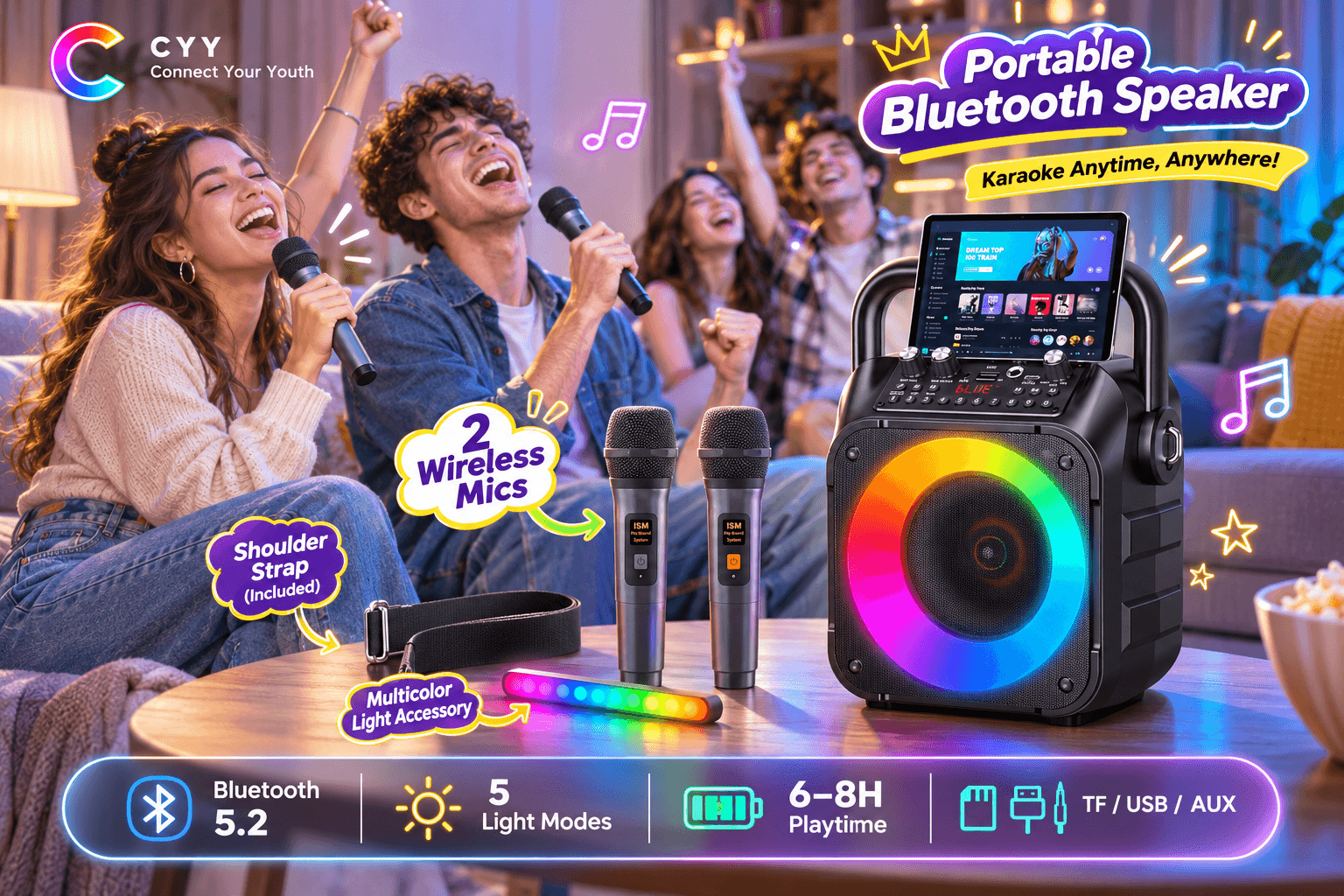
If you take one design insight from this brand, take this one: the second microphone is not a quantity increase, it is a category change.
One microphone produces a performance. Two produce a relationship. Consider what shifts:
- The reluctant participant gains an escape route. Singing alone in front of your family is exposure. Singing a duet is shared risk, and shared risk is survivable.
- Children get an instrument, not a spectator seat. A kid holding a live-but-muted mic is one step from being a singer; a kid with no mic is one step from being bored.
- Call-and-response becomes possible. Host and hype-man, parent and toddler, two grandparents who have been married since a previous era of pop music.
- Arguments about the playlist become duets about the playlist.
- The device stops being “yours.” Two mics means the speaker is communal property the moment it’s switched on.
Both mics are wireless and engineered to resist interference, which sounds like filler until you’ve been at a party where one microphone drops out mid-chorus. Stable RF is the unglamorous feature that protects the entire premise. Range is modest by design — tens of feet, comfortably across a yard — and that modesty is a virtue: it keeps the singer near the speaker, where the mix behaves.
Where It Ends Up, Which Is the Real Product
Portable karaoke machines are sold as indoor gadgets and used as outdoor ones. Here’s where a CYY-style unit genuinely earns its place, and what makes each case work.
Backyards and block parties. The dominant use, and the easiest to justify. Eight hours of battery means the thing outlasts the food. The strap means it goes out on a walk with the cooler. Fifteen watts is matched to the crowd size that forms when there’s singing, which is smaller and warmer than the crowd size at a barbecue.
Road trips and campgrounds. Bluetooth 5.2 from a phone, or — better for this scenario — a microSD card loaded with a family’s shared playlist, so nobody’s phone has to be the source and nobody’s data has to be touched. In a campground, a speaker with a light ring becomes a gathering point for people who aren’t in your party at all. This is the fastest way to convert a quiet weekend into a memorable one.
Birthdays, especially mixed-age ones. Two microphones solve the perennial problem of a kids’ party with adults who have been hiding from the karaoke app. Duet a children’s song with a grandparent and you have reset the room’s permission structure for the next three hours.
Classrooms, youth groups, and camps. A rugged, affordable, grab-and-go system with a strap and included mics is closer to what an educator actually needs than a rack of AV equipment. Songs become participation tools; the light ring becomes a focus anchor for a group of restless ten-year-olds.
Family gatherings at relatives’ houses. The critical detail: it fits in a car. The best party equipment in the world is worthless if it lives in a closet at your own address. Something a guest can throw over their shoulder on the way out the door is the thing that gets invited back.
Offices and small events. Not a conference substitute — an icebreaker. Fifteen watts keeps it from feeling like a corporate production, and the microphone queue does the work that a forced team-building exercise never manages.
Pairing Two Units: The TWS Detail Worth Knowing
True Wireless Stereo pairing is the most under-advertised feature in this category, and it’s the answer to the loudness objection raised earlier.
Two CYY units linked over TWS split into left and right channels, doubling coverage without doubling the setup complexity — no cable between speakers, no mixer, no app. Practically, that means:
- One unit handles the vocals near the singer.
- The second covers the far side of the crowd.
- Stereo width makes familiar recordings sound newly produced, which is a genuine effect on how seriously people take the singing.
The economics are also notable. Buying a second mid-priced unit to solve a coverage problem is usually cheaper, lighter, and more flexible than buying one large unit that you then have to transport like luggage. Two small speakers can be positioned around an obstacle; one large speaker cannot.
Where CYY Sits in the 2026 Portable Karaoke Picture
The category has shifted noticeably. A few years ago, “karaoke machine” meant a plastic toy for children or a TV-plugged system for households committed to hosting. Today’s demand is different, and the difference is legible in what buyers now filter for:
- Grab-and-go over install. Anything requiring a wall socket, a TV, or an app subscription has quietly lost.
- Cable-free microphones as table stakes. Wired mics now read as a cost-cutting flag.
- Battery life as a headline, not footnote. Six to eight hours is the band buyers expect, and the spec is compared the way phone batteries are.
- Party-speaker versatility. Buyers want one device that sings and plays music and survives a beach day, not a single-purpose karaoke box.
- Value density. The winning products are the ones whose included accessories make the box feel complete.
CYY competes on the last two points most aggressively. It is not trying to be a premium audio purchase; it is trying to be a finished one — mics in the box, lights in the box, strap in the box, inputs enough that no single source device is a dependency. That is a real position, and for the majority of buyers who want a singing evening rather than an audio system, it is the pragmatic one.
🔎 Buying Smart: Six Questions Worth Answering First
Before you order any portable karaoke machine — CYY included — these are the questions that separate a good purchase from a returned one.
| Question | Why it decides things |
|---|---|
| Does it ship with two microphones? | One mic means one singer means one audience. This is the participation threshold. |
| Is the driver size stated, or just “high power”? | A stated 6.5-inch full-range driver is a claim someone is prepared to defend. Wattage alone tells you almost nothing. |
| Are TF/USB/AUX inputs present? | Determines whether the device works when the phone is dead, borrowed, or offline. |
| What does the vendor say about battery under lights? | LED rings draw power. Realistic playtime is the number with lights on. |
| Is there a strap or a proper handle? | Portability you can’t carry is a spec, not a feature. |
| Can two units pair? | This is your upgrade path when the crowd grows, and it’s cheaper than trading up. |
One more, quietly the most important: who is going to hold the second microphone? If you can answer that immediately — your daughter, your brother, your friend who will not admit to being a fan of 2000s pop — you already know whether you’re buying an appliance or an event.
A Practical Owner’s Playbook
The gear is forgiving; the habits are what make it disappear into the family’s routine.
Setup, the first time. Charge fully before you need it. Pair the mics and test both at the same time, not one after the other — RF issues reveal themselves in pairs. Play a track you know extremely well, because you’re judging the system against a mental reference.
During use. Keep the speaker below mic level and never directly behind it. Start the voice gain lower than feels right and raise it while the song is playing, not while someone is testing. When the crowd passes the microphone, resist the urge to correct their grip; a foam windscreen forgives everything.
Storage and care. Silica packets inside the mic compartment are not optional clutter. Remove batteries from wireless mics if the unit will sit unused for weeks. Wipe the windscreens after shared use — that is the difference between a communal device and a tolerated one. Avoid leaving the LED ring at maximum on a hot car dashboard for an afternoon.
Troubleshooting, in order of likelihood.
- Mic cutting out → check battery first, always, before blaming the transmitter.
- Howl at 200 Hz → move the mic farther from the speaker; it’s geometry, not fault.
- Music but no voice → verify the mic is powered and the channel isn’t muted at the unit.
- Bluetooth drops → look for another active device nearby; 5.2 is stable but not magical.
- Short runtime → lights and high gain consume real current; that’s expected, not defective.
Twenty-Two Minutes: A Run-of-Show That Works
Here’s the creative bit — a miniature program for the moment an evening needs rescuing. It requires no announcement, no host, and no one consenting to anything.
| Time | Move | Purpose |
|---|---|---|
| 0:00 | Set the unit on a crate or low table, lights off, play one familiar track at low volume | Presence without pressure |
| 1:30 | Leave both microphones out, unattended, on the table beside it | Removes the act of offering |
| 4:00 | Someone picks one up “to check if it works” | The ice breaks itself |
| 4:30 | Switch on the softest light mode | Signals the zone is now open |
| 6:00 | First duet — usually two people who claim not to sing | Permission granted for the rest of the night |
| 9:00 | Hand the second mic to a child or a grandparent | Converts audience into cast |
| 12:00 | Beat-reactive lights on, volume up one notch | Energy climbs without instruction |
| 15:00 | Deliberately bad group song, everyone at once | Shared failure is the bonding mechanism |
| 19:00 | Lights down, one slow song, one microphone passed around | Brings the room back down gently |
| 22:00 | Stop. Don’t extend it. | Leaves the evening wanting the encore |
The whole thing hinges on one psychological lever: people will not volunteer to perform, but they will absolutely inspect equipment. Put the mics where they can be picked up without asking, and the rest is not your management problem.
Songs That Behave on a Fifteen-Watt System
Not an exhaustive list, and not about licensing — about acoustics and crowd dynamics.
Works beautifully: mid-tempo songs with strong, simple melodies and a chorus more than one person knows. Folk-rock, 80s and 90s pop, Motown, show tunes, nursery rhymes for the under-eight contingent, and anything with a hand-clap rhythm. Restricted bandwidth systems love midrange-forward mixes and forgive sparse arrangements.
Works surprisingly well: rap and hip-hop with a heavy kick, since a 6.5-inch driver with proper bass separation delivers punch rather than rumble, and the vocal-forward mix keeps lyrics audible.
Fights the system: wide-dynamic classical recordings, dense EDM with sub-bass you’ll feel on a big rig and miss here, and audiophile jazz where the point is nuance rather than participation. Fine as background music; poor as karaoke.
Secretly optimal: songs with a call-and-response structure built in. They were engineered for exactly two microphones and a crowd that half-knows the words.
What CYY Doesn’t Claim
Credibility in a buying decision comes from knowing limits, so here they are plainly.
This is not a PA system. It will not cover a wedding reception with 120 guests, and anyone telling you otherwise is selling you a bigger box. It is not studio recording gear — a built-in recording function, where present, captures the mix, not a produced vocal track. It is not waterproof in the sense of immersion-worthy; rain-shrugging is the honest expectation, so read the ingress rating on the specific listing. Bass is present and tidy rather than chest-thumping. And the maximum SPL is what fifteen watts is, which is plenty for singing and modest for a dance floor.
None of that is a complaint. It is the shape of the trade that makes the device weigh 4.4 pounds, run eight hours, and cost what it costs. Products that try to be everything end up carried by no one.
🌟 The Part That Isn’t Hardware
There is a reason a brand would name itself Connect Your Youth rather than something about decibels.
Somewhere between adolescence and adulthood, most people lose the willingness to make a sound badly in front of others. It isn’t a decision. It accumulates — a raised eyebrow at school, a karaoke night that went the wrong way twenty years ago, the slow discovery that being amusing is safer than being earnest. The loss is quiet and nearly total, and most households never notice it, because they replace singing with talking about not singing.
A small speaker with two wireless microphones in a backyard at dusk is one of the few inexpensive objects that reverses that. It doesn’t ask anyone to be talented. It asks them to hold a plastic cylinder while a light pulses and a song they’ve known since they were twelve plays underneath them. The people who end up loudest are usually the ones who insisted, ten minutes earlier, that they couldn’t sing.
That’s the product. Not the driver, not the codec, not the five LED modes — those are the means. The thing CYY is actually selling is a low-cost, high-return permission slip, roughly four-point-four pounds, with a strap so it can be brought along to where the permission is needed.
Frequently Asked Questions About the CYY Karaoke Machine
Does a CYY karaoke machine need a TV or an app to work?
No. Bluetooth from a phone is the simplest path, but USB, microSD, and AUX inputs mean the speaker can run entirely independently of your phone, and the mic input lets a source device handle lyrics while the CYY unit handles sound. That independence is a genuine advantage over systems that assume a screen.
How many people can realistically sing at once?
Two, comfortably, with the included wireless microphones — and that’s the sweet spot. A third person typically joins by sharing a mic or singing along, which is exactly how a small gathering becomes a group number rather than a series of solos.
Will the microphones work with other speakers, or other mics with the CYY unit?
The included mics are matched to the receiver, which is why they’re stable and interference-resistant. Cross-compatibility with third-party gear isn’t guaranteed, so treat the boxed set as the intended system and buy extras of the same model if you want more than two.
Is this appropriate for young children?
Very much so, and the weight and strap are part of that answer. Set microphone gain lower than you’d use for an adult, since small voices are close to the capsule and children grip mics in ways that invite feedback. Nothing about the design is toy-grade; it’s just friendly-sized.
How should I charge and store it between uses?
Full charge before storage, remove mic batteries if it will sit for more than a few weeks, keep it somewhere dry and out of direct summer heat, and leave the microphones in their compartment with the desiccant. Devices like this fail from neglect far more often than from use.
Is a second unit worth buying?
If your crowd regularly exceeds about fifteen people, or your space has walls and corners that swallow sound, yes. TWS pairing turns two mid-priced units into a stereo coverage system for less than the price gap to a large-format speaker — and you can still carry them separately.
Where do people actually buy CYY products?
The brand’s storefront on Amazon is the primary channel, which is where warranty, returns, and model-specific spec sheets live. Confirm the exact configuration — driver size, included accessories, battery rating — on the specific listing, since figures shift between models and production runs.