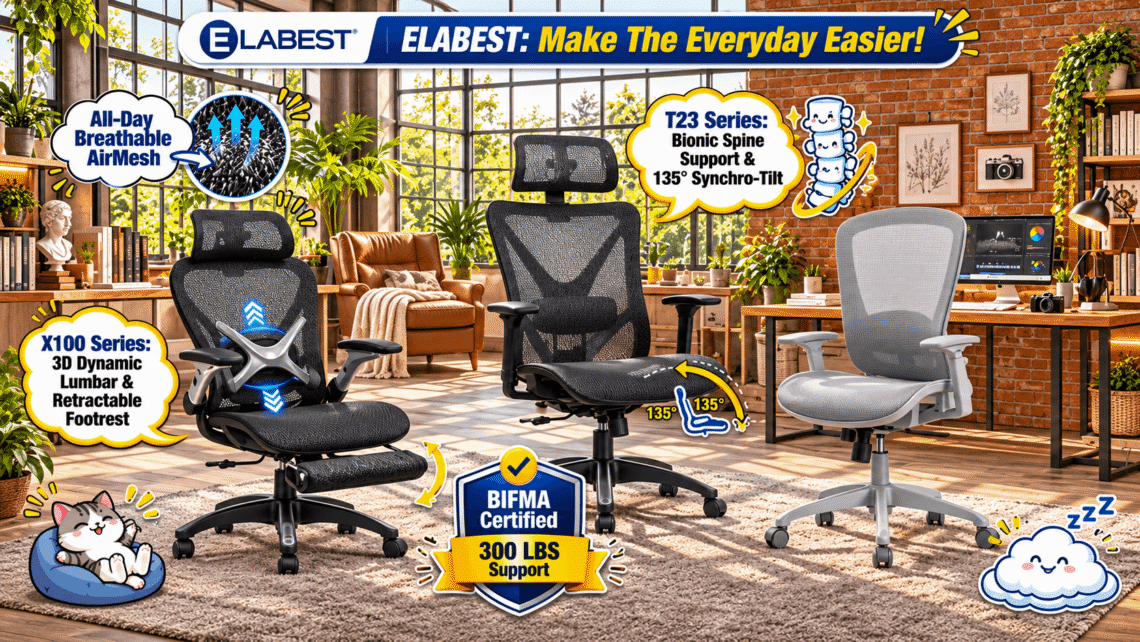
Your chair is probably the most underrated piece of furniture you own. You sleep eight hours, you drive a little, you eat — but there are easily six, seven, sometimes nine hours where you are locked to that one piece of foam and mesh beneath you. And yet, most of us choose our office chair with roughly the same amount of thought we give to a bottle of hand soap. An ELABEST ergonomic office chair enters the conversation precisely here: not as another box on a feature comparison chart, but as the furniture equivalent of finally taking a deep breath after years of holding your shoulders up to your ears.
This post is an introduction to the brand. Not a spec dump, not a sales pitch disguised as a review — just an honest look at who ELABEST is, what they actually make, and why their chairs have been climbing the wishlists of remote workers, gamers, and taller-than-average office dwellers alike.
Your Chair Is Quietly Running Your Workday
Here’s a truth that doesn’t get said enough: discomfort changes your behavior, and behavior shapes your day.
When your chair forces you to perch on the edge of the seat, you squirm. When the lumbar support floats somewhere behind your lower back instead of touching it, you slouch. When your armrests are at the wrong height, you lift your shoulders to type. None of these things feels dramatic in the moment — but accumulated over hundreds of hours, they become your posture, your fatigue, and eventually your afternoon headache.
Most people solve this the way they solve everything at a desk: they push through it. They take a pain reliever, they switch to the couch for an hour, they tell themselves they should “just stand up more.” But the standing desk trend already taught us something important — your body is not the problem. The setup around you is. And the chair, more than the desk, more than the monitor, is the piece that dictates how your spine actually behaves for eight hours.
ELABEST’s whole reason for existing is this observation. Their chairs are designed around a simple premise: if a chair can genuinely adapt to you — your height, your weight, the way you lean back to think, the way you sit cross-legged when you’re reading — then sitting stops being a compromise and becomes, well, barely noticeable. And that is exactly what good office furniture should do. It should disappear into your day.
Who Is ELABEST, Anyway?
Brand stories tend to fall into two traps: either they read like a mission statement written in a boardroom (“we passionately innovate synergies”), or they lean hard into an underdog legend that nobody can verify. ELABEST, refreshingly, sits in between.
At its core, ELABEST is a furniture brand built around ergonomic seating. Their catalogue is focused — there’s no kitchenware, no pet beds, no random accessories. They make chairs, and they make variations on chairs: high-back mesh models, big-and-tall configurations, executive-style builds, and versions with extras like retractable footrests and flip-up armrests. That focus matters. A brand that only does one thing tends to know that one thing deeply, and the iteration you see across their lineup — the way the same design language shows up in lighter and heavier versions — reads like a company actually using customer feedback, not just re-skinning a generic factory product.
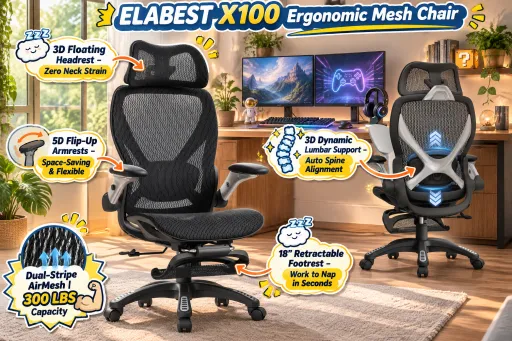
Their flagship, the X100, is the clearest expression of this philosophy. It’s the chair that put them on the map in crowded Amazon comparisons: mesh back, adjustable lumbar, multi-directional armrests, an extendable footrest, and a frame built generously enough for bigger body types. If you’ve ever watched one of those “best ergonomic chair” roundups and seen a name you half-recognized, chances are the X100 was somewhere near the top of the list.
What distinguishes ELABEST from the sea of similar-sounding chair brands is the attitude toward adjustability. A lot of “ergonomic” chairs give you one lumbar knob and call it a day. ELABEST’s designs treat adjustability as a system — the arms, the back, the seat depth feel, and the recline all work together, so that one part doesn’t end up undoing another. That’s a small difference on paper and a huge difference at hour six of a workday.
The Problem Most Budget Ergonomic Chairs Ignore
Walk into any office-chair comparison page and you’ll notice the same three adjectives recycled relentlessly: comfortable, supportive, adjustable. And yet, people still end up with chairs that hurt. Why?
Because the chair industry quietly solved the wrong problems. Here’s what usually happens:
- One-size-fits-all frames. Most chairs are built to fit a mythical “average” body — roughly 5’9″, medium build. If you’re taller, shorter, broader, or just differently proportioned, the chair is never actually right. The lumbar pillow lands at your mid-back, the armrests hit your elbows too low, and your thighs hang over the front edge instead of resting on it.
- Fake adjustability. A chair that lists “adjustable armrests” but only raises and lowers them vertically is technically adjustable and practically useless. Your arms don’t move in straight lines; they move in arcs, forward, sideways, and outward when you lean.
- Stiff mesh or spongy foam. Mesh that’s too hard feels like a folding chair after an hour. Foam that’s too soft lets you sink until your spine folds. The sweet spot — responsive cushion with real give — is genuinely hard to engineer, and most brands skip it.
- Ignoring the recline. Few people sit bolt upright for eight hours. We lean back to read, to think, to take a call. If the recline mechanism is either too stiff or too floppy, you stop using it, and the chair becomes a prop you fight against.
ELABEST’s lineup is essentially a response list to those four problems. The chairs are sized generously from the start (their core models lean toward the big-and-tall side of the spectrum, which automatically serves smaller users too, since adjustability brings everything in). The armrests move in multiple directions — flip up, slide, swivel — so they actually clear your desk when you need to tuck in. The mesh is tensioned rather than drum-tight. And the recline has real resistance tuning, the kind that lets you lean back and stay leaned back, not snap back like a porch swing.
Inside the ELABEST Lineup: A Quick Guide
ELABEST doesn’t bombard you with forty SKUs. Their lineup is organized around a handful of core models, each aimed at a slightly different sitter. Here’s the lay of the land, in plain language:
| Model Direction | Best For | Signature Traits |
|---|---|---|
| X100 (flagship mesh chair) | All-day sitters, big-and-tall users, people who want the full feature set | 5D flip-up armrests, 3D adjustable lumbar, retractable footrest, mesh back rated for heavier builds |
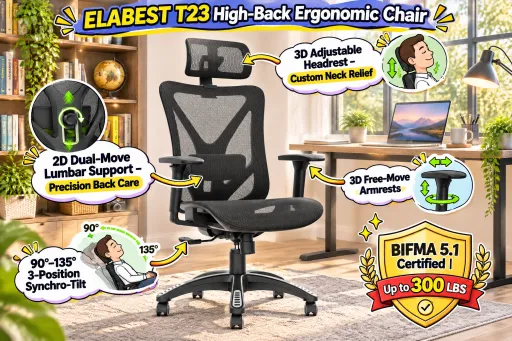
| High-back mesh office chair | Taller users, executives, anyone who wants head-and-neck support | Extended back frame, headrest included, tall seat-piston range |
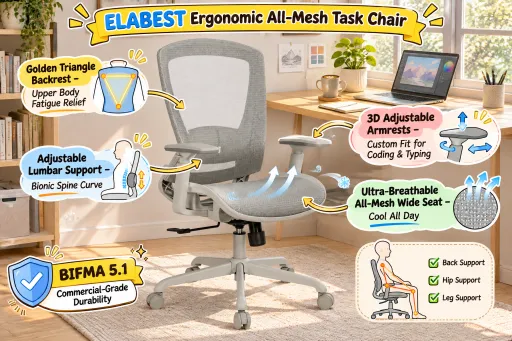
| Mid-back home desk chair | Smaller workspaces, lighter users, tighter budgets | Simpler adjustability, compact footprint, clean aesthetic |
| Big & tall configuration | Users over 250 lbs or wider frames | Reinforced base, wider seat pan, heavy-duty gas lift, tested weight capacity |
| Executive / bonded-leather-style variant | Home offices that want a formal, traditional look | Padded surfaces, polished base, refined detailing without losing the ergonomic core |
If you’re brand new to the brand, the X100 is the natural starting point — it’s the chair where every design decision the company makes is fully expressed. But the mid-back and big-and-tall variants are worth a look if your space is small or your build demands something sturdier.
Taking the Chair Apart: What Each Adjustable Part Actually Does
This is where ELABEST gets genuinely interesting. A spec sheet lists features; it doesn’t tell you why they matter. So let’s translate.
The 3D lumbar support.
- Vertical movement raises or lowers the support pad so it lands exactly on your lower-back curve, not your mid-back or your sacrum.
- Horizontal / depth movement pushes the pad in and out, so a thin person and a broad person both get firm contact without it feeling like a kick in the spine.
- Tension adjustment lets you choose how much it pushes — firm for focus mode, gentle for lean-back reading mode.
The 5D flip-up armrests.
- They lift up and flip out of the way, so you can roll the chair fully under your desk or pull it sideways to chat.
- They adjust in height, slide side to side, and pivot forward/backward, matching the natural arc of your arms as you type, reach, or rest.
- The padding is soft enough for long phone calls and firm enough that your elbows don’t sink through after an hour.
The retractable footrest. It tucks under the seat when you don’t need it and slides out when you want to recline fully. This is the feature that quietly converts an office chair into a genuine midday-nap-in-disguise piece of equipment — and it’s shockingly rare in chairs at this price.
The tension-controlled recline. You’re not stuck bolt upright, and you’re not tipping backward uncontrollably. The knob under the seat tunes how hard the chair resists your lean, so heavier sitters and lighter sitters both get the same smooth motion.
The mesh back. Breathable, responsive, and self-supporting. No sweat circles, no sagging pillows to replace later.
Built for Bodies That Don’t Fit the “Average” Mold
Here’s a detail worth dwelling on: ELABEST’s chairs are, by and large, engineered generously. Wider seat pans, taller back frames, stronger gas lifts, and casters that roll smoothly on carpet. That’s a deliberate choice.
The ergonomic-chair world has a dirty secret: most “supportive” chairs are secretly built for a 150-pound, 5’9″ male frame. Sitters outside that range — taller people, broader people, heavier people, curvier people — end up squeezing into furniture that was never measured for them, and then they’re told their back pain is a “posture problem.”
ELABEST’s big-and-tall configuration takes the opposite approach. The reinforced base, the tested weight capacities, the denser foam under the seat — these aren’t upsells; they’re admissions that a chair should fit you, not the other way around. The welcome side effect is that smaller users also benefit: a generously sized chair, combined with deep adjustability, brings everything inward until it fits. One chair, a wider range of bodies.
💬 Quick Callout: What “BIFMA Certified” Actually Means for You
“Wait — the product page says BIFMA certified. Is that just badge-jargon?”
Fair question. BIFMA stands for the Business and Institutional Furniture Manufacturers Association, and a BIFMA-certified chair has been cycle-tested: the base gets weight-loaded and rolled, the gas lift gets raised and lowered thousands of times, the armrests get pressed, the recline gets opened and closed. It’s not a guarantee of perfection, but it’s an independent check that the chair won’t fall apart in two years of normal use. For a desk chair you’ll own for half a decade, that certification is the difference between buying furniture and buying a disposable gadget.
Who Actually Sits in an ELABEST Chair?
Brand introductions always skip to who the product is for, so let’s make it concrete. ELABEST chairs tend to find their way into the lives of:
- The full-time remote worker who upgraded from a dining chair after a year of back pain and never went back.
- The gamer who wants the support of an executive chair without the neon racing-seat aesthetic.
- The big-and-tall sitter who’s tired of chairs advertised as “large” that still pinch at the shoulders.
- The home-office aesthetic shopper who wants something that doesn’t scream “call center.”
- The freelancer or creator who lives in their chair for eight-plus hours and notices the difference in their afternoon energy.
The through-line is simple: they all treat sitting seriously. They’ve realized that a chair isn’t a backdrop to work — it’s the operating environment for it.
Let’s Talk: A Few Real Questions People Ask
Blogs love a polished FAQ, but nobody talks like a FAQ. So here’s a more natural version — the questions that actually come up when someone is considering their first ELABEST chair.
“Does it really take twenty minutes to assemble?”
Honestly, yeah. Most of the work is sliding the backrest into the seat, attaching the base, and plugging in the armrests. The tools come in the box. The first ten minutes feel fiddly; the last ten minutes feel easy. One person can do it. Two people is just faster.
“Is the mesh actually breathable, or is that marketing?”
It’s breathable, but with nuance. On a 90°F day with no airflow, no mesh chair is a swimming pool. In a normal room, the difference between mesh and padded fabric is real — your back stays dry, and the chair doesn’t hold heat like a radiator.
“What if the lumbar support feels too strong?”
You adjust it. That’s the whole point of the depth control. If a feature is set-and-forget, it’s not really ergonomic — it’s decorative. ELABEST’s pads let you dial the pressure down to almost nothing, which is useful when you’re leaning back into reading mode.
“Will it fit under my desk?”
Probably, which is exactly why the flip-up armrests matter. Flip them up, and the chair slides in far enough that you’re not visually swimming in your own workspace.
“Is this a ‘forever’ chair?”
That’s a tall claim for any brand. What you can say fairly: it’s built to BIFMA standards, the parts are standard-size and replaceable when needed, and the design isn’t tied to a fad that will look embarrassing in three years. Forever is your call to make from there.
Creative Corner: Styling an ELABEST Chair in Your Space
Ergonomic tools usually get treated like gym equipment — functional, slightly clinical, hidden in the corner. But your chair is one of the largest objects in your work environment, and it doesn’t have to disappear. Here are a few ways people are incorporating ELABEST’s mesh chairs into rooms that actually feel like homes, not offices:
- The minimal setup. A light-walled room, a wooden desk, a black mesh chair. The mesh back is visually light, so it reads as part of the architecture instead of dominating the space. Add a single plant and the corner feels intentional, not cubicle-like.
- The warm-industrial corner. Concrete, dark wood, a warm lamp. A high-back mesh chair in dark tones anchors the scene without fighting the materials — the open back keeps the visual weight low.
- The modern reading nook. Pair the chair with a small side table and a floor lamp. With the footrest extended and the recline tuned loose, it becomes a genuine reading seat, not just a workhorse.
- The dual-purpose room. Guest room by day, office by necessity. A mesh chair tucks neatly under a slim desk, and when guests come, it slides to the side and looks like intentional furniture rather than a storage problem.
The design philosophy underneath all of this is that ergonomic furniture should be quietly good-looking. ELABEST avoids racing stripes, neon accents, and over-scaled logo treatment. The result is a chair that works in a Scandinavian apartment the same way it works in a corner of a suburban basement office.
What to Expect When the Chair Arrives
A quick reality check, because brands rarely show you this part:
- The box. It’s heavy. Plan for a trip or two from the door. The packaging is compact — the chair ships disassembled for a reason, and it keeps shipping damage low.
- The setup. Lay out the parts, follow the order in the manual, and don’t fully tighten screws until everything is in place. That’s the universal chair-assembly trick, and it cuts your time in half.
- The break-in. The mesh and the foam will feel slightly firmer on day one than on week two. Give it a few sessions before deciding any adjustment is wrong.
- The tuning. Spend your first afternoon adjusting deliberately: seat height so your feet are flat, lumbar on your lower-back curve, armrests level with your desk, recline tension so you lean without tipping. Twenty minutes of tuning now saves you months of fighting the chair later.
Final Thoughts: The More Comfortable The Seat, The Better
ELABEST isn’t the cheapest chair on the shelf, and it isn’t trying to be. What it is is a brand that has listened to the specific, boring, daily frustrations of people who sit for a living — the lumbar pad floating in the wrong place, the armrests that never clear the desk, the mesh that gets hot, the chair that tips you out when you lean back — and designed a lineup that answers each one directly.
If your current chair is quietly ruining your afternoons, and you’ve been telling yourself that “a new chair is a luxury,” consider the arithmetic differently. You don’t upgrade a chair because you want nicer furniture. You upgrade it because you want your focus, your energy, and your back to survive another thousand days at the desk without complaint. That’s less a purchase than a repair — of the thing underneath you, and eventually, of how your entire working day feels.
ELABEST’s chairs won’t eliminate hard days. They will make those hard days physically tolerable — and for most people, that is the difference between finishing the work and finishing the work well.