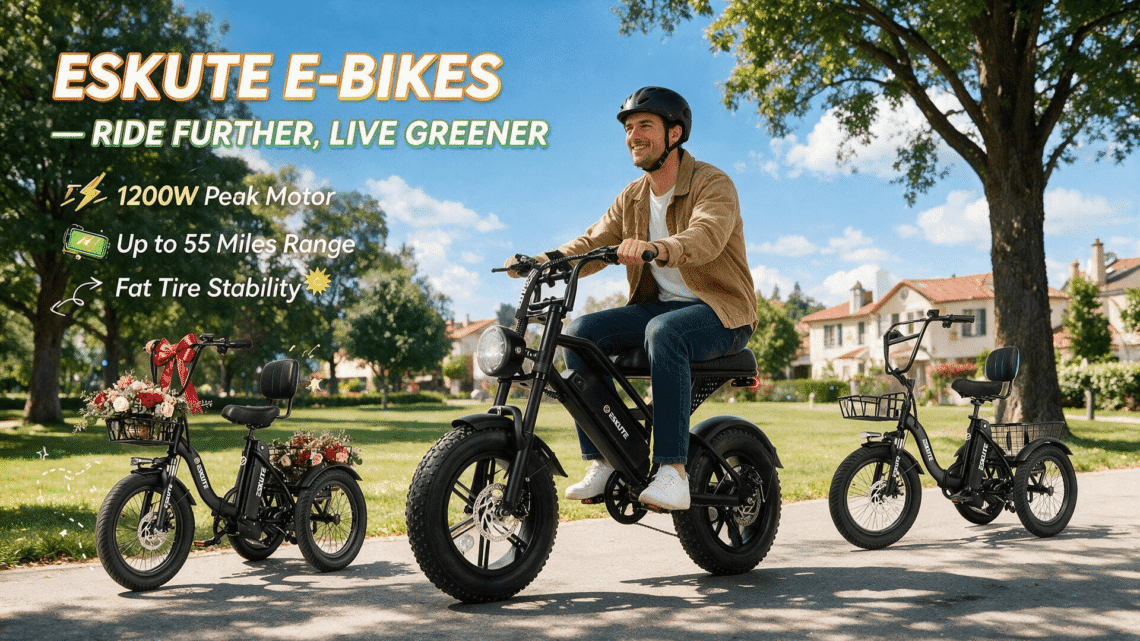
Most people arrive at an ESKUTE e-bike the same way: a listing in the Amazon storefront, a bold number on a white background, and a suspicion that the number is doing some theatrical work. That suspicion is healthy. It is also, in this case, the wrong place to spend your skepticism, because the interesting thing about ESKUTE is not any single wattage figure. It is the logic that decides which figures get published in the first place.
ESKUTE entered the market in 2019, which makes it a young brand by cycling standards and a mature one by e-commerce standards. It sells a catalog that spans folding fat-tire commuters, full-suspension mountain bikes, dual-suspension city bikes, three-wheel utility machines and high-output off-road motorcycles-style electric bikes. That breadth is unusual for a company of its age, and it is the direct result of a design philosophy that starts at the battery rather than at the frame.
This article is a working guide to that philosophy, the catalog it produced, and the specific habits you need in order to judge any ESKUTE listing honestly. It is written for the buyer who has fifteen minutes and a spreadsheet instinct. Where a number comes from the brand, it is labeled as rated. Where a claim needs verification against your state’s rules, it is flagged. Nothing here asks you to take a leap of faith.
What ESKUTE Is, and the One Detail That Explains Its Spec Sheets
The single most useful fact about ESKUTE is that its parent organization came up through battery technology rather than bicycle manufacturing. That sounds like corporate background noise until you notice what it produces: a lineup in which removable lithium-ion packs of unusually high watt-hour capacity show up across categories, and in which the same core energy architecture is stretched across frames that otherwise have little in common.
Companies that begin as bicycle makers tend to source power as a component. They pick a motor supplier, a cell supplier, and integrate. Companies that begin on the energy side tend to do the reverse: they establish what the pack can store, what it can discharge continuously, and how it will be mounted, then hang a bicycle around it. ESKUTE’s catalog reads like the second approach. Capacity and voltage appear first in its marketing, and frame categories follow.
The 2019 origin, told without the brochure language
The year matters more than the founding story. Twenty-nineteen was late enough that cell cost curves had already fallen steeply, and early enough that the market was not yet saturated with lookalike folding bikes. A new entrant could not win on heritage, so it competed on measurable output: more watt-hours, higher peak figures, wider tires, and a price that undercut the incumbent by a visible margin.
That timing also explains the brand’s distribution instincts. ESKUTE built its US presence around marketplaces, where a shopper compares spec lines side by side rather than reading a founder’s manifesto. A brand that competes on published numbers will always prefer a channel where the numbers are the interface. The Amazon storefront is effectively a spec comparison table with a buy button attached, and ESKUTE has leaned into that format rather than fighting it.
“Freedom to explore” as an engineering constraint
The brand’s stated motto, “The Freedom To Explore Anywhere,” is easy to dismiss as a tagline. It is more useful read as a design brief, because it explains three recurring choices. First, fat tires appear far more often than in a conventional bicycle range. Second, removable batteries are treated as standard rather than premium. Third, the catalog refuses to settle on a single riding environment.
Each of those choices costs something. Fat tires add rolling resistance and weight. Removable packs require heavier frames and locking hardware, and they reduce the space available for down-tube storage. A multi-environment catalog splits engineering attention. ESKUTE accepted those trades deliberately, and the result is a range built for capability-per-dollar rather than for elegance in any one discipline. If your priority is the lightest bike for a specific use, this is the wrong shelf. If your priority is one machine that covers several, it is the right one.
Four Bikes Disguised as One Lineup
The catalog looks like a long list of alphanumeric names. It is more legible as four distinct products wearing a shared badge. Sorting them that way makes the buying decision obvious, because you choose a category first and a model second, not the other way around.
| Category | Representative models | Rated motor output | Rated top speed | Rated battery | Tire size | Built for |
|---|---|---|---|---|---|---|
| High-power off-road | NOVA RR, NOVA BEAST, Nova X, RT-X | Up to 5500W peak (NOVA RR) | 50+ mph (NOVA RR) | 60V 30Ah | 17″ | Trails, private land, performance riders |
| Full-suspension trail | M200F, M200P, M300F | 1500W peak | 31+ mph | 998.4Wh removable | 27.5 x 2.1″ | Rough roads, gravel, light singletrack |
| Folding fat-tire utility | D300 | 1200W | 28 mph | 998.4Wh removable | 20 x 4.0″ | Cars, elevators, small apartments, mixed pavement |
| Commuter and three-wheel | 300R-ST, 300R-SD, V-series, T300 series | Up to 1800W peak (300R-ST) | 32+ mph; 86-mile rated range | 48V 20.8Ah | 26 x 4.0″ | Errands, school runs, stability-first riders |
Nova and RT-X: the power end of the catalog
The Nova family is where ESKUTE publishes its most aggressive numbers, and it is also where buyer diligence matters most. The NOVA RR lists a 60V 30Ah battery, 285Nm of torque, a peak motor output of 5500W and a rated top speed above 50 mph on a 17-inch wheel. Those are motorcycle-adjacent figures on a product sold through a bicycle channel.
The practical consequence is regulatory rather than mechanical. A machine rated above 28 mph cannot be a Class 3 electric bicycle under the three-class framework that most US states have adopted, and it will not be legal on standard bike paths. Treat the Nova and RT-X lines as off-road and private-property purchases unless the listing explicitly documents street-legal configuration for your state. That is a verification task, not a criticism, and it is the single most common mistake in this price bracket.
M-series: suspension travel for people with rough driveways
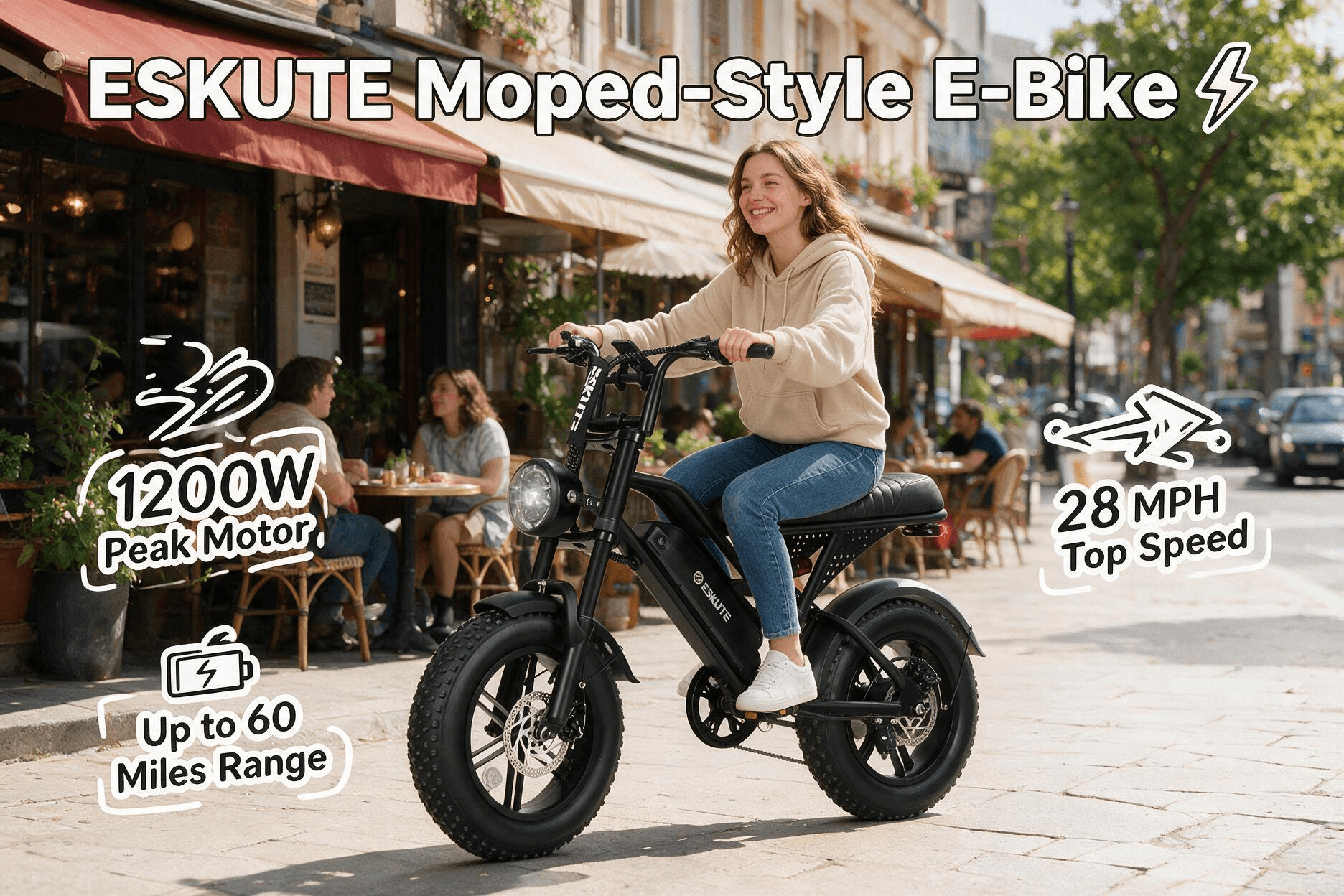
The M200F is the most legible expression of the brand’s energy-first logic. A 998.4Wh removable pack sits inside a full-suspension frame with 27.5 x 2.1-inch tires, a 1500W peak motor and a rated ceiling just above 31 mph. Nearly one kilowatt-hour of storage in a hardtail-adjacent weight class is the headline; the suspension is what makes that storage usable over broken pavement.
This is the category to choose if your riding is 70 percent infrastructure that was never designed for bicycles. Rail crossings, chip-seal gravel, frost-heaved trail edges and washboard fire roads all reward a suspended frame and a large pack far more than they reward a top speed figure. It is also the most versatile on-road/off-road compromise in the range.
D300: the folding fat-tire compromise
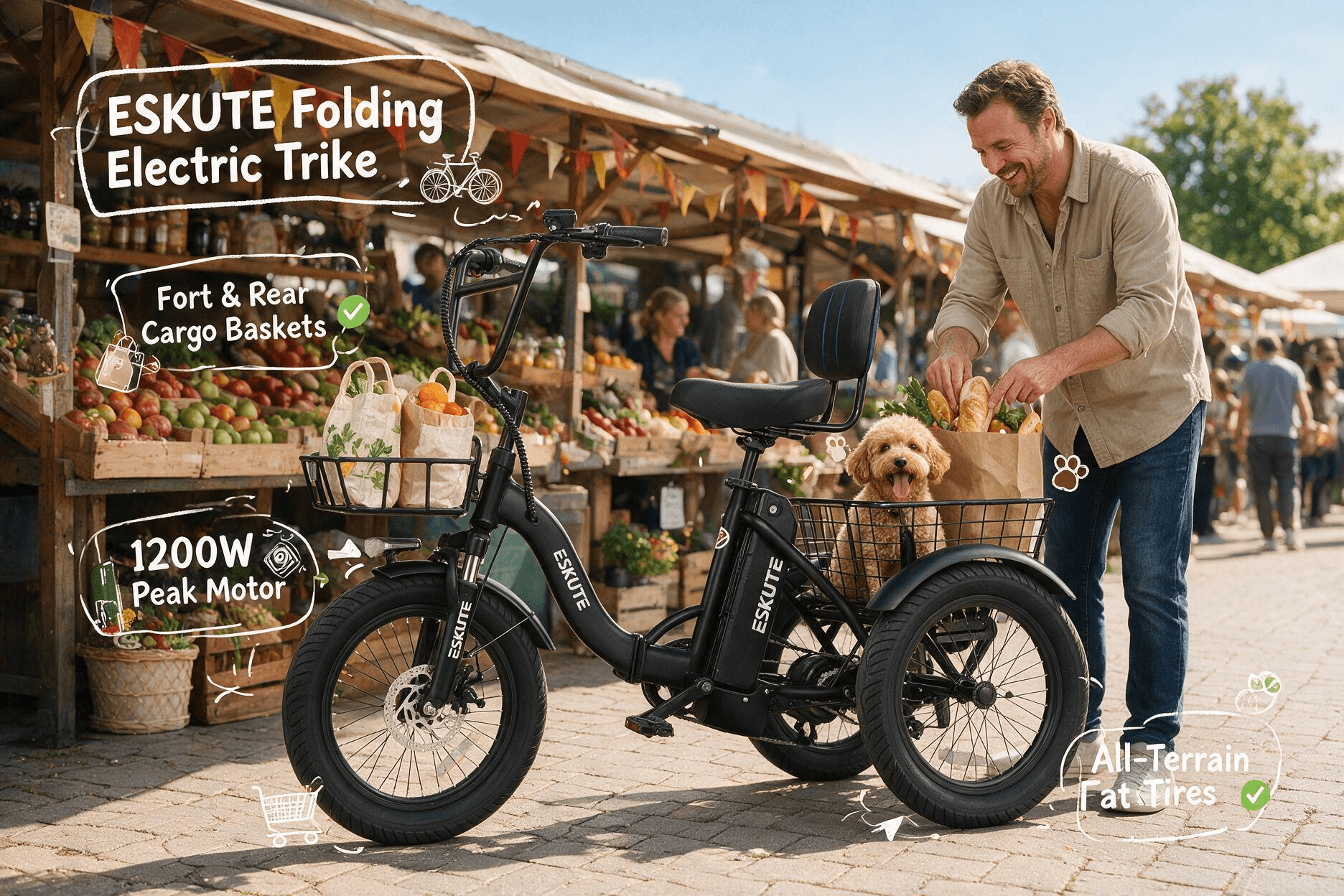
The D300 solves a storage problem rather than a performance one. It folds, carries 20 x 4.0-inch fat tires, uses the same 998.4Wh removable architecture, and lists a 1200W motor with a rated 28 mph ceiling. An NFC tag appears in its listing, pointing to phone-based pairing for configuration or anti-theft functions.
Who this serves is worth stating plainly: apartment dwellers, RV and boat owners, commuters with a last-mile transfer, and anyone whose bike has to survive an elevator. The trade is efficiency. A folding frame is heavier and less rigid than a comparable hardtail, and 4-inch tires on 20-inch wheels will never roll as freely as a 27.5-inch trail tire. You are buying the ability to bring the bike indoors.
R, V and T series: commuting, family hauling and three wheels
The commuter and three-wheel branches are the least glamorous and, for most households, the most used. The 300R-ST lists dual suspension, a 48V 20.8Ah battery, an 86-mile rated range, a 1800W peak motor and 26 x 4.0-inch fat tires in a step-through-friendly configuration with a rear rack. Pink included, which matters more than spec-sheet purists admit: color is a real purchase driver and a signal that the brand is designing for riders it has historically underserved.
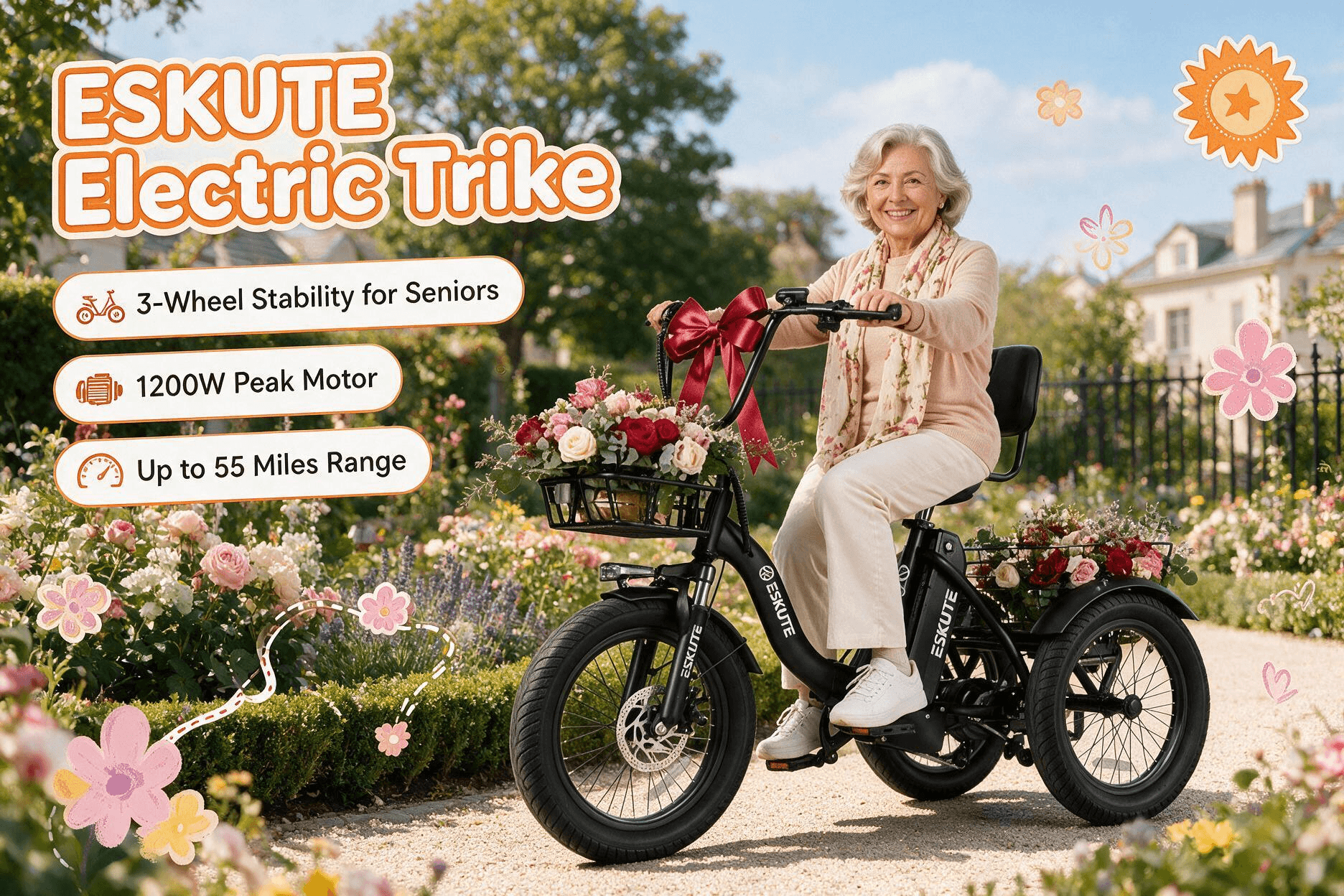
The T300 series extends the same platform thinking to three wheels, marketed around family use. Stability, load capacity and the ability to stop upright on a wet surface with a child aboard are the actual product goals there. If you have been priced out of an electric cargo vehicle, a three-wheel platform in this category is the closest legal equivalent per dollar.
How to Read an ESKUTE Listing Without Being Bullied by Numbers
Every value-driven e-bike brand has the same presentation problem: the biggest number wins the comparison, and the biggest number is rarely the most informative one. You can neutralize this in about ninety seconds by normalizing whatever you are reading into six fixed fields.
- Convert the battery to watt-hours. Multiply volts by amp-hours. A 48V 20.8Ah pack is roughly 998Wh; a 60V 30Ah pack is roughly 1800Wh. Watt-hours are the only unit that lets you compare endurance across brands, because “miles” claims are unfalsifiable and volts alone ignore capacity.
- Separate peak from continuous motor output. A 5500W peak figure describes a momentary burst, typically at stall or hard acceleration, limited by thermal cutoff. Continuous rating, if published, is the number that predicts whether you can hold a 12-percent grade for twenty minutes. Ask support for the continuous figure and record the answer.
- Note torque in newton-meters only for hub or mid-drive context. The NOVA RR’s 285Nm is a high figure consistent with a high-voltage hub setup. On a commuter in the 80-100Nm range, hill performance depends far more on rider input and gearing.
- Match tire size to your actual surface. 4.0-inch fat tires tolerate sand, snow and potholes at the cost of rolling resistance. 2.1-inch trail tires are quicker on hardpack and unforgiving in soft ground. There is no universal answer, only your pavement.
- Discount rated range by a factor you choose in advance. Manufacturer figures are typically measured at low assist, flat ground, moderate rider weight, no wind and no headwind. A 30 to 45 percent reduction is a reasonable planning assumption; throttle-only riding can push the discount higher.
- Check the certification markings before the features list. Whether a bike and its battery carry recognized electrical safety certification determines where you can legally sell it, insure it, charge it, and in some cities, own it at all.
Safety Certification Is the Boring Filter That Matters Most
Lithium-ion incidents reshaped e-bike regulation faster than any marketing budget could have. The relevant consequence for a buyer is that certification status is no longer a footnote; in several jurisdictions it is a condition of legality, and in all of them it is a condition of insurability.
Which standard applies to which part
Three documents govern most of what matters. The US Consumer Product Safety Commission’s consumer safety specification for bicycles, 16 CFR 1512, covers the mechanical bicycle baseline: brakes, tires, reflectors, steering and frame integrity. UL 2849, published by UL Solutions, covers the electrical drive system of an e-bike as an assembly, including motor, controller, wiring and the charger. UL 2272 covers individual battery packs and charger assemblies for personal e-mobility devices, while UL 2271 addresses lighter-electric-vehicle battery systems that some manufacturers use instead.
New York City made this concrete through Local Law 39, which requires certified electrical systems and batteries on e-bikes sold and operated within the city, with the battery requirement taking effect in November 2023 and the bicycle requirement in January 2024. Similar certification-linked rules have been adopted or proposed in other municipalities. The National Fire Protection Association publishes widely reproduced guidance on charging and storing lithium-ion packs that is worth reading once before you own any e-bike, at any price.
Practical instruction: before ordering, ask ESKUTE support in writing which certifications the specific model and its charger hold, and to which standards. A brand comfortable with this question answers with certificate numbers. Save the reply. It is also your insurance documentation.
The three-class system, in plain terms
Most US states organize electric bicycles into three classes. Class 1 provides motor assistance only while pedaling, cutting out at 20 mph. Class 2 allows a throttle-driven top speed of 20 mph without pedaling. Class 3 provides pedal assistance up to 28 mph, and in many states restricts riders by age or requires a helmet. Anything faster or thumb-throttle-driven above those ceilings falls outside the bicycle framework entirely, which is where high-output off-road machines land.
This is why a rated 32+ mph commuter and a rated 50+ mph Nova are not interchangeable purchases, despite appearing in the same storefront. Confirm your state’s adopted class definitions and any local path restrictions before assuming a model’s rated ceiling is a speed you may legally use anywhere. The brand’s listing tells you what the machine can do; your state law tells you what you may do with it.
The first 48 hours with a new pack
- Inspect the battery enclosure for shipping damage before accepting the delivery. A dented or swollen pack is a rejection, not a repair.
- Charge in a room with a smoke alarm, on a non-combustible floor surface, away from exits and upholstery. Not overnight on a bed.
- Use only the charger supplied for that specific pack, and never a third-party substitute with a different voltage or current profile.
- Unplug the charger when complete. Do not leave a pack at 100 percent on a trickle for days at a time.
- Verify the displayed range baseline on your first three rides, at your weight, on your hills. Write down the real number; it is worth more than any published claim.
- Register the bike and record the serial number. Registration is usually what converts a marketplace purchase into an actual warranty relationship.
- Store the bike, or at minimum the pack, at partial charge if it will sit unused for more than two weeks.
The Real Cost of Running One, Worked Out in Front of You
Fuel is where an e-bike quietly demolishes a second car, and the arithmetic is simple enough to reproduce with your own utility rate. Below are our assumptions stated openly so you can substitute your local numbers rather than trusting ours.
| Line item | Assumption used | Result |
|---|---|---|
| Battery capacity | 998.4Wh, per ESKUTE’s rated spec on M200F and D300 | ~1.0 kWh |
| Charging losses | 15 percent added to pack capacity | ~1.15 kWh drawn |
| Electricity price | Mid-teens US cents per kWh, as published by the US Energy Information Administration | ~$0.20 per full charge |
| Rated range | 86 miles, per ESKUTE’s 300R-ST listing | Upper bound |
| Realistic range | 40 percent discount on rated | ~50 miles |
| Energy cost per mile | $0.20 divided by 50 miles | Under half a cent |
| Gas car comparison | 30 mpg at roughly $3.15 per gallon | ~$0.105 per mile |
On a 20-mile daily round trip, that is roughly $2.70 in electricity per month against roughly $63 in gasoline for the equivalent car miles. The e-bike is not merely cheaper; the difference is large enough that the bike’s entire purchase price can be recovered against fuel alone inside a couple of winters, before counting parking, insurance, registration or maintenance. Maintenance is where buyers under-plan: brake pads, cables, chains, cassette teeth, tires, suspension seals and eventually a replacement pack all ask for money on a schedule. Budget roughly five to eight percent of purchase price per year for consumables and service on a heavily ridden fat-tire e-bike, and treat any battery replacement outside warranty as the single largest future cost.
An Original Framework: The Three-Bike Household
Here is a lens we have not seen used in other ESKUTE coverage, and we are offering it as analysis rather than as survey data. We have no poll to cite, so we are not pretending to. What we do have is a structural observation about how e-bikes get used once they are in a home with other vehicles.
The claim: most US households do not need one better vehicle. They need to stop using their worst vehicle for their most frequent trip. E-bikes compete for that specific slot, and the winning machine is not the fastest one but the one that gets used four times a week instead of once.
How we built it
We sorted trips by distance and by friction. The overwhelming majority of urban and suburban errands fall under eight miles one way, which is inside the realistic range of every model in the ESKUTE commuter and folding categories even after a heavy discount on rated figures. The friction variable is not distance; it is parking, traffic, the need to carry cargo, and whether the vehicle is by the door and charged.
That produces three archetypal households, and a different recommendation for each. The single-vehicle apartment household needs foldability and a removable pack, because the bike must enter an elevator and charge in a living space; the D300 archetype fits. The two-car suburban household needs a machine that replaces the short errand run, where the car is warmed up, loaded with cargo and driven five minutes to a queue; a 300R or T300 archetype fits. The rural or semi-rural household needs surface independence and range margin, because the next charger is eleven miles away in the wrong direction; the M-series and Nova archetypes fit.
What it predicts
The framework predicts that range anxiety is mostly a storage anxiety in disguise. A rider who can charge at home every night does not need 86 miles; they need 25 miles of honest margin. Conversely, a rider who cannot charge at home needs maximum capacity regardless of trip length, because the pack is a fuel tank they can only refill occasionally. This is why watt-hours, not miles, should drive the decision, and why ESKUTE’s habit of putting a near-1000Wh pack into folding and commuter frames is a smarter allocation of engineering than a top-speed bump.
It also predicts that the three-wheel category will outperform its novelty reputation among riders over fifty and among parents, for the boring reason that a machine which cannot tip over at a stop gets ridden more often in winter.
Where it breaks
Be honest about the limits. Households in flat, dense cities with excellent transit gain least, because the替代 vehicle is already adequate. Regions with long harsh winters shrink the usage window unless the bike has fenders, lights and fat tires, which several ESKUTE models do. And any household with a genuine mobility limitation that prevents mounting a step-through frame should evaluate adaptive tricycles and recumbents from specialist builders instead of forcing a standard platform.
Who Should Buy an ESKUTE, and Who Should Keep Shopping
Good fit:
- Riders whose priority is capability per dollar across several use cases, rather than optimum performance in one.
- Commuters replacing short car trips who can charge at home nightly.
- Apartment, condo and RV dwellers who need a folding frame and a removable battery.
- Off-road enthusiasts on private land who understand that a 50+ mph machine is not a bicycle-class vehicle.
- Families wanting a three-wheel platform for stability and light cargo before committing to an electric cargo car.
- First-time e-bike buyers who want high capacity so that a single charge covers a week of errands.
Poor fit:
- Weight-weaned riders counting grams, or anyone who must carry the bike up four flights of stairs weekly. Fat-tire e-bikes in this catalog are heavy.
- Performance cyclists wanting a mid-drive, low-mass trail machine for serious climbing. Hub-drive weight and geometry here serve a different rider.
- Buyers needing guaranteed street legality in a jurisdiction with strict certification mandates, without first confirming the specific model’s documented compliance.
- Anyone whose storage situation forces overnight charging on soft furnishings or in a blocked egress path. That is a fire-safety problem regardless of brand.
- Shoppers who want a single-purpose, minimalist city bike and would rather pay for refinement than for versatility.
Nine Questions to Answer Before You Add to Cart
- Where will it be charged, and is that spot non-combustible, unblocked and near an alarm?
- What is the bike’s continuous motor rating, not the peak, and did support answer in writing?
- Which certifications cover this model’s drive system and battery, and are they valid in any municipality that mandates them?
- How many watt-hours does the pack hold, and does that survive your longest realistic round trip after a 40 percent discount?
- Will it fit your elevator, trunk, rack or bike locker, folded or unfolded?
- What does your state classify this as, and which paths may you legally use at that class?
- What is the warranty term on frame, motor, battery and charger separately, and who services parts domestically?
- What is the replacement cost of the battery out of warranty, and does that number change your math?
- Is the sale price you are looking at a seasonal event price, and does the marketplace listing include the same support obligations as a direct purchase?
Question nine deserves elaboration because it is the one buyers skip. Marketplaces rotate promotional pricing around major sales events aggressively, and ESKUTE’s storefront is visibly built around those windows. A deep discount is genuinely good value only if the warranty, parts availability and return pathway survive the transaction. Confirm those before the price, not after.
Where the Brand Fits in the 2026 Market
Industry trackers including Grand View Research and Statista have placed the US e-bike market anywhere between roughly $1.1 billion and $4.1 billion in 2025, depending on what their methodologies count, with forecast compound annual growth rates spanning about 9 to 17 percent into the early 2030s. The spread in those estimates is itself informative: the category is still young enough that nobody agrees on its size, which is precisely the condition under which a value-focused challenger brand acquires share.
Three forces support that reading. Fuel prices remain volatile enough that households audit their transport spending more often. Municipal investment in cycling infrastructure, documented by the League of American Bicyclists and in federal non-motorized travel data, has expanded the network of routes where a bicycle is the fastest option for short trips. And cell costs have continued their long decline, which is the variable ESKUTE’s battery-first architecture was positioned to exploit.
The counterweight is consolidation. Certification mandates, insurance scrutiny and returns volume all favor larger incumbents with compliance departments. The brands that survive the next three years will be the ones that treated safety documentation as a product feature rather than an obstacle, and that is now the honest dividing line in the value tier. It is also the line on which any ESKUTE purchase decision should hinge, ahead of every bold number on the storefront.