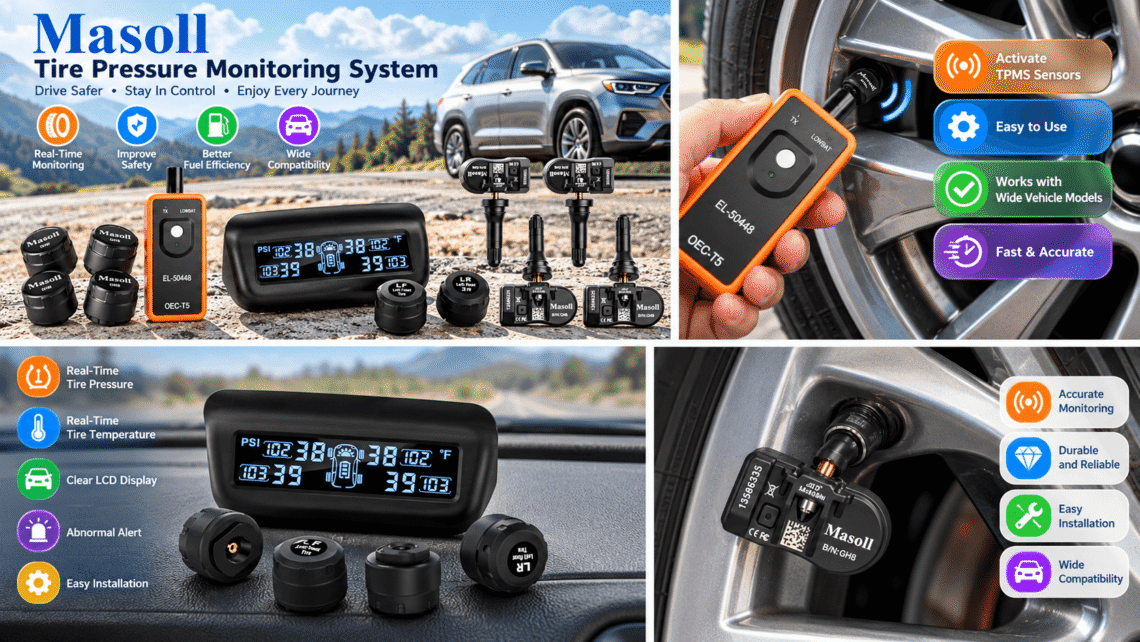
There is a particular kind of car-owner frustration that has nothing to do with breakdowns. Nothing rattles. No smoke appears. The truck still drives exactly as it did yesterday. And yet, parked in the driveway at 6:40 in the morning, it is glowing at you: a little yellow horseshoe with an exclamation mark inside, sitting in the cluster like an unpaid parking ticket. 🛞
The tire pressure monitoring system — TPMS, for short — is the most taken-for-granted safety hardware on a modern vehicle, and simultaneously the component nobody plans a budget line for. It is invisible while healthy, annoying while failing, and expensive while being replaced at a counter. Masoll is a brand that built its entire catalog around that single, unglamorous gap. Understanding why that niche produced such a focused product line tells you more about aftermarket automotive electronics than any press release could.
The Warning Light Nobody Budgets For
To understand Masoll, you first have to understand the economics of the thing it sells against. A factory TPMS sensor is a small sealed transmitter living inside your wheel. It has to survive heat cycles, freezing rain, road salt, centrifugal force at seventy miles an hour, and the occasional impact from a curb at parking-lot speed. Inside that housing sits a pressure cell, a temperature cell, a chip holding a unique ID code, and a battery. 🔋
That battery is the trap. It is not serviceable on a factory internal sensor, because opening the housing destroys the seal. So the sensor is, from the day it is manufactured, a countdown clock dressed up as a part. Somewhere between five and ten years in, the chemistry weakens, the signal gets intermittent, the ID drops out of the vehicle’s memory, and the light comes on. Often it happens all at once, and often it happens to two wheels before the owner notices.
Now consider the dealership path. Diagnosing a dead sensor costs labor. Sourcing the OE part costs a premium. Mounting and dismounting the tire costs labor again, plus balancing. Then the relearn procedure has to be performed with a scan tool. Multiply that by four corners and the repair quote can comfortably exceed the value of the wheels themselves on an older truck.
This is the failure mode Masoll is aimed at. Not crashes, not blowouts in the dramatic sense — although underinflation genuinely contributes to heat buildup and tread separation — but the ordinary, statistically boring reality that a consumable electronic part reaches the end of its life and the owner is faced with a repair bill shaped like a penalty.
What Masoll Actually Is
Here is an original read on the brand, drawn from how the catalog is arranged rather than from any marketing copy.
Most automotive parts brands organize themselves around vehicle classes: passenger, commercial, performance, off-road. Masoll organizes itself around a symptom. Walk through the storefront and the sorting logic becomes obvious within a minute. Every product answers one of a handful of questions: Which vehicle is throwing the light? Where does the sensor live — inside the wheel or on the valve? Does the vehicle already have a display, or does the driver need one? How far does the signal have to travel?
That symptom-first architecture is unusual, and it has a real consequence for shoppers. 🧭 A brand that thinks in vehicle classes will sell you a sensor and expect you to figure out the rest. A brand that thinks in symptoms has to sell you the whole chain: the sensor, the programming tool that wakes the vehicle up to it, the display that shows the reading in a cabin the factory never wired for telemetry, and the booster that pushes a signal from the back of a forty-foot trailer to the front of the tow vehicle. Masoll carries all four links. That is not a coincidence of inventory; it is a design philosophy visible in the shelf arrangement.
The breadth is also deliberate in an interesting way. The lineup spans General Motors light trucks and passenger cars, Ford platforms, Tesla-specific Bluetooth units, and the whole towing universe of Class A motorhomes, fifth wheels, travel trailers, and utility ramps. Yet nothing outside pressure monitoring appears. No oil filters. No brake pads. No generic “car care” serums. The refusal to diversify is itself the brand statement: this company intends to be the answer to one question, asked by one specific category of driver, at one specific moment of mild panic. ⚠️
Category Map at a Glance
| Layer of the catalog | What it solves | Typical buyer |
|---|---|---|
| Replacement internal sensors | Dead or aged factory-style sensor inside the wheel | Owner with a shop, or owner replacing a full set |
| External cap-style sensors | Same warning, without dismounting a tire | Weekend DIYer, driveway and a set of ramps |
| Dedicated monitors and displays | Vehicles with no factory screen for pressure data | RV, trailer, and older-truck drivers |
| Programming and relearn tools | The handshake between a new sensor ID and the vehicle’s module | Anyone doing the job at home |
| Signal boosters | Distance between sensor and receiver on long rigs | Fifth-wheel and double-trailer towers |
Three Products, Three Different Weekends
The three items in focus here look interchangeable from a hundred yards away. They are not. Choosing between them is really choosing how you want to spend an afternoon — or whether you want to spend one at all. ️
| Product A — DIY bundle | Product B — M13 system | Product C — 4-pack internals | |
|---|---|---|---|
| ASIN reference | B0FF33PY2N | B0D943S8NW | B0FR9JCT5F |
| Sensor placement | External, screws onto the valve stem | External caps on a trailer or RV | Internal, mounted inside the wheel |
| Vehicle focus | GM: Chevy Silverado, Buick, Cadillac, GMC | RVs, travel trailers, fifth wheels, trucks | GM: same family as Product A |
| Frequency | Dual 315 / 433 MHz in one unit | Proprietary to the bundled monitor | Dual 315 / 433 MHz in one unit |
| Display | Uses the truck’s own instrument cluster | Standalone solar-powered LCD unit | Uses the truck’s own instrument cluster |
| Relearn tool | Included in the box | Not applicable | Not included; bring your own |
| Battery situation | Replaceable CR1632, roughly two years | Solar plus USB, plus built-in lithium | Sealed CR2050, rated five-plus years |
| Effort profile | Fifteen minutes in the driveway | Thirty minutes at the campsite | A shop visit, or a confident home mount-and-balance job |
Read that table as a decision tree rather than a spec dump. Product A and Product C serve the same vehicles and answer the same warning light; they differ in how much of the job you want to do yourself. Product B serves vehicles that never had a factory system in the first place.
Product A: The DIY Bundle, or the Fifteen-Minute Answer
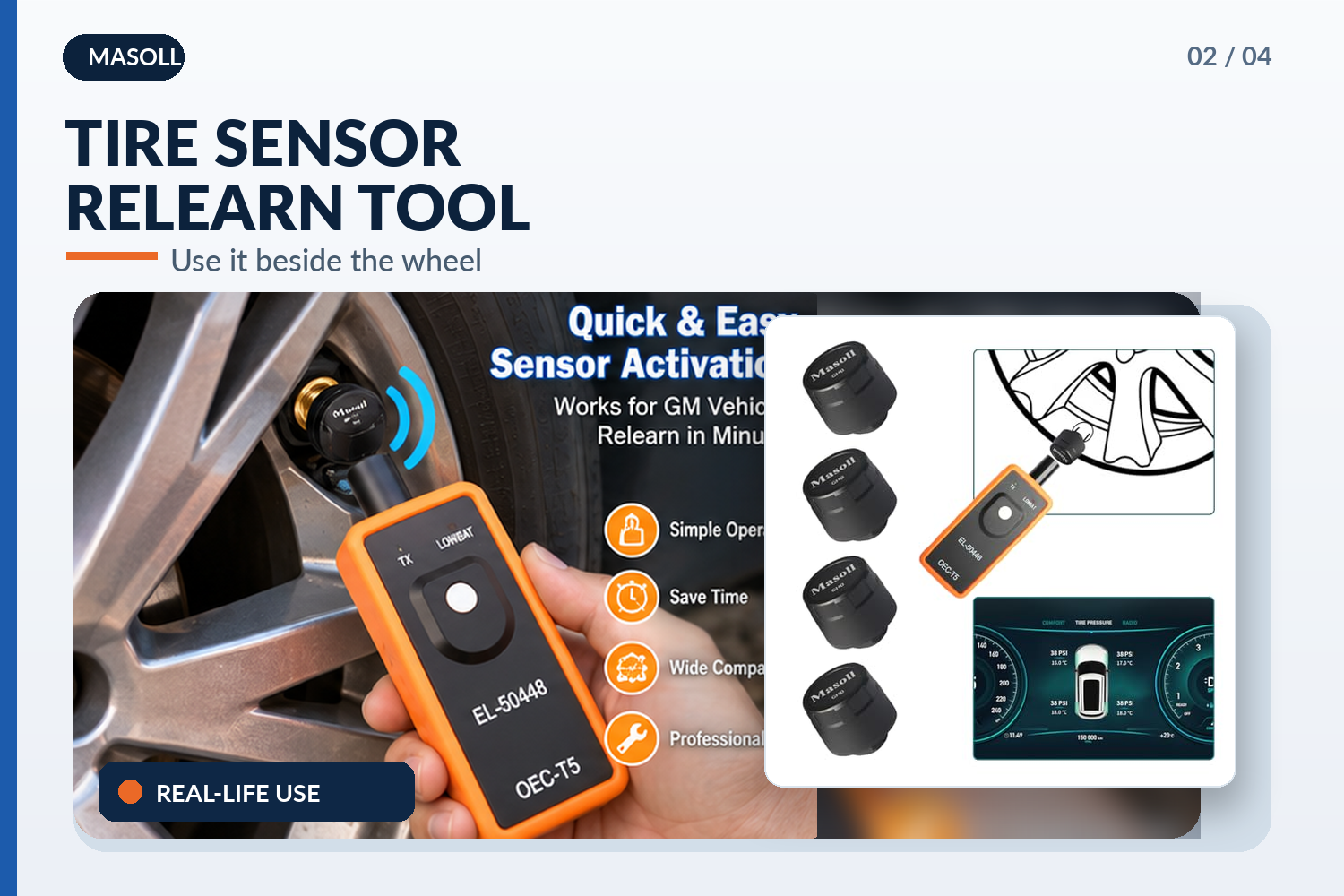
The listing for B0FF33PY2N is unusually honest about what it is: a Gen 2 external sensor set for GM vehicles, dual-band at 315 and 433 MHz, sold as a set of four, with an EL-50448 relearn tool in the box. Accuracy is quoted at 1.5 PSI. The battery is a CR1632, user-replaceable, with an expected life around two years. 🔧
Everything important is in that last clause. Two-year replaceable battery sounds like a weakness next to a five-year sealed cell, and for a moment it is. Then think about what the alternative actually costs. When a sealed internal cell dies, the sensor is scrap. When a cap-style cell dies, you crack the lid with a coin, drop in a two-dollar CR1632, and screw it back on. Over a decade of ownership, that difference compounds into a genuinely different total cost of possession — and it converts a disposal problem into a maintenance task. 🌍
The dual-band design deserves a note too. GM did not standardize neatly across its brands or model years; some platforms listen on 315 MHz, others on 433 MHz, and imports and crossovers within the same family have historically muddied the picture further. A sensor that transmits on both means the owner is not required to know which band their 2013 Buick Enclave happens to prefer. That is a small engineering decision that removes a large shopping decision.
What the Install Actually Looks Like
- 🪜 Park on level ground, chock the wheels if you have ramps, and let the tires cool so the first reading is meaningful.
- Remove the existing rubber valve caps. Save them or discard them; nothing else is disturbed.
- Hand-tighten the Masoll sensor onto the exposed valve stem. Do not over-torque; the seal is a small rubber gasket, not a plumbing joint.
- Note which corner each sensor is screwed onto. Position mapping happens during relearn, and mixing them up means chasing a phantom leak.
- Turn the ignition to the accessory position and start the vehicle’s relearn mode. On most GM trucks and crossovers the cluster responds with the message “Tire Learning Active.”
- Hold the included EL-50448 tool up to the valve stem at each corner, in the order the vehicle expects, until it sounds or the reading appears.
- Work the last corner, drive for a few minutes at moderate speed, and confirm the light has gone and stayed gone.
💬 Field note The single most common cause of a “the kit doesn’t work” complaint is skipping step five. The sensor is a transmitter, not a key. The vehicle’s module keeps a list of permitted transmitter IDs in memory, and until that list is refreshed, the truck will happily ignore four perfectly functioning sensors sitting on its valves. The relearn tool is not an accessory to the kit — it is half the product.
Who This One Is For
Owners who change their own wiper blades, rotate their own tires, and keep a small torque wrench in the bed. Someone with a Silverado that throws the light every October when the temperature drops. A household with two GM crossovers and no interest in learning the difference between them. 🚗🚙
Where Cap-Style Wins — and Where It Doesn’t
Any credible write-up has to say the quiet part. External sensors are not universally superior, and pretending otherwise would just cost a reader a bad weekend.
| Consideration | External cap sensor | Internal sensor |
|---|---|---|
| Tire dismount required | Never | Yes, at install and at every rotation |
| Exposed to curb strikes, car washes, theft | Fully exposed | Protected inside the wheel |
| Valve stem type | Needs a compatible stem; rubber is friendliest | Metal stem usually preferred |
| Battery service | User-replaceable | Sealed, replace whole unit |
| Balance impact on the wheel | Tiny, but at the very outer edge | Closer to the hub, negligible |
| Professional appearance | Aftermarket by sight | Indistinguishable from factory |
| Total install labor at a shop | Minimal to none | Mount, balance, relearn |
The honest synthesis: if your vehicle lives on the street, gets curated, and spends its life on alloy wheels with metal stems, the internal route is tidier and lasts longer per installation. If your vehicle is a working truck, a second family SUV, a winter-beater that sees unpaved shoulders, or you simply refuse to pay for labor to fix a warning light, the cap-style approach is the smarter economic instrument. 🧊
There is a third scenario that tilts the balance decisively: seasonal wheel swaps. If you run two full sets of wheels — summer alloys and winter steels — then a set of cap sensors travels with you. You unscrew four caps and screw them onto the other set. Internal sensors either have to be duplicated across both wheel sets, which is expensive, or transferred by a shop twice a year, which is also expensive and slightly damaging to tires over time.
Product B: The M13, Built for Anything You Tow
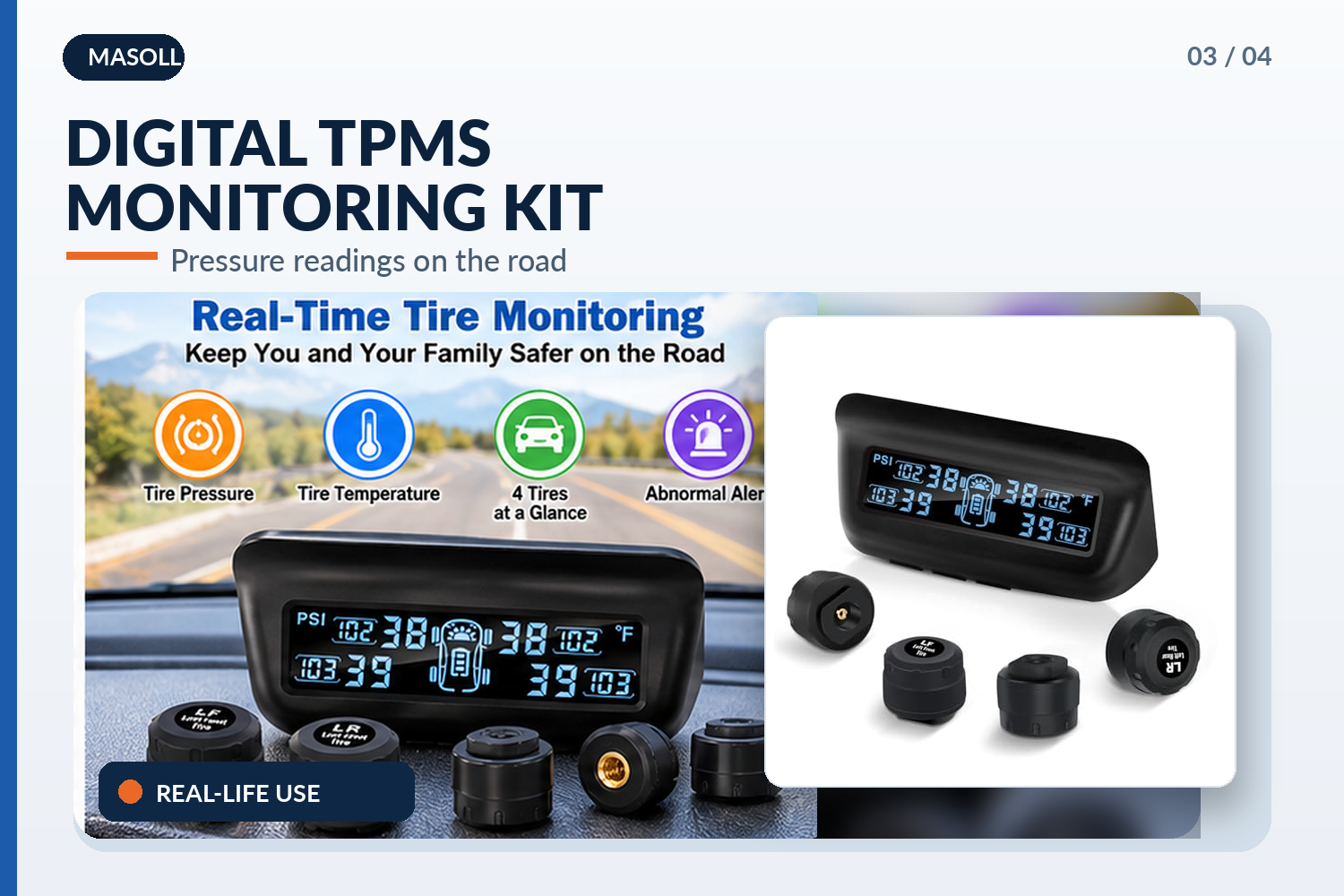
The M13 (B0D943S8NW) is a different animal. It is not a replacement part; it is a complete monitoring system for vehicles that never had one. Four cap sensors, one standalone display, no dependence on any factory module, no relearn tool, no handshake with a manufacturer’s software. 🚐
That matters because the towing world is full of vehicles where factory TPMS is either absent or uselessly incomplete. A pickup towing a thirty-eight-foot fifth wheel may have sensors at all four corners of the truck and precisely zero coverage of the trailer underneath the owner’s feet. A Class A motorhome has six or eight tires, and the driver sits maybe twenty feet from the rear axle. A vintage camper or a converted cargo van has no system at all. In every one of those cases, the failure the driver fears most — a slow leak on a remote dual tire discovered only after the sidewall has shredded — is completely unmonitored.
The Specifications That Do the Real Work
Pressure range runs from 0 to 99 PSI, which covers the practical span of light-truck and RV tires without wasting screen space. Alerts fire automatically when pressure deviates roughly 25 percent above or 15 percent below a reference value the system calibrates itself, rather than a number the owner has to remember to program. That auto-calibration is quietly clever: fill the tires at the placard pressure, turn the system on, and it adopts whatever it sees as normal. From then on it reports departures from your actual practice instead of from a manual’s assumption. 📈
Six distinct alert modes cover the realistic failure catalogue — over-pressure, under-pressure, rapid leak, high temperature, low sensor battery, and lost sensor signal. The temperature channel is the one towing veterans care about, because heat on a trailer tire is the leading precursor to a sidewall failure, and it climbs long before pressure visibly changes.
Power is handled twice over. The display tops itself up from a solar strip along the top edge while it sits on a windshield or dash, backed by an internal lithium cell, with a USB path for the weeks when the rig lives under a cover or the sky does not cooperate. Auto wake and sleep cycles keep the cell alive between trips, which is a real concern for a device that spends eight months a year in a garage. The backlight adjusts between daylight and night modes so the readout stays legible at noon without blinding the driver at 2 a.m. on a straight stretch of interstate. ☀️
Range is specified for vehicles up to about 38 feet. Beyond that, Masoll recommends pairing the system with one of its signal boosters — the fifth link in the catalog map from earlier, and a good illustration of why a brand that thinks in symptoms ends up stocking the accessory nobody else remembers.
A Conversation That Happens at Every Campground
🗣️ Maya, pulling the outriggers: You checked pressures this morning, right?
**** Dev, in the driver’s seat: Checked them cold, yeah. Ninety-five all around.
🗣️ Maya: And after that climb up Mount Talbert?
🗣️ Dev: …Which is exactly why I mounted the screen where I can see it. It read a hundred and nine on the outside rears.
🗣️ Maya: Should we let them cool?
🗣️ Dev: No — that’s normal. Hot pressure runs higher than cold. The thing that would worry me is if one corner sat ten PSI above its neighbors. That means it’s working harder, which means it’s carrying weight it shouldn’t be.
That exchange contains more genuine tire wisdom than most owner’s manuals. Warm tires read higher than cold tires; a properly loaded RV may sit two to four PSI higher on the highway than at the campsite. The number to fear is not a high absolute figure — it is asymmetry between corners, or a pressure that keeps drifting down over successive stops. A monitoring system’s value is not that it tells you a number you could have measured with a chuck gauge. It is that it tells you the number while you are moving, on the tire you would never think to check, at the moment the trend is still cheap to fix. 💡
Pre-Trip Checklist the M13 Makes Possible
- ✅ Cold-fill all corners to the load-and-pressure chart, not to the sidewall’s maximum.
- ✅ Let the system calibrate, then confirm all sensor IDs are reporting and none show as lost.
- ✅ Note the reference reading on a paper card in the door pocket.
- ✅ At every fuel stop under 100 miles, glance at corner symmetry before you pump.
- ✅ After a sustained mountain descent, check temperature alongside pressure.
- ✅ Before the first long highway pull each season, verify sensor battery status.
Product C: The 4-Pack, or Doing the Job Properly Once
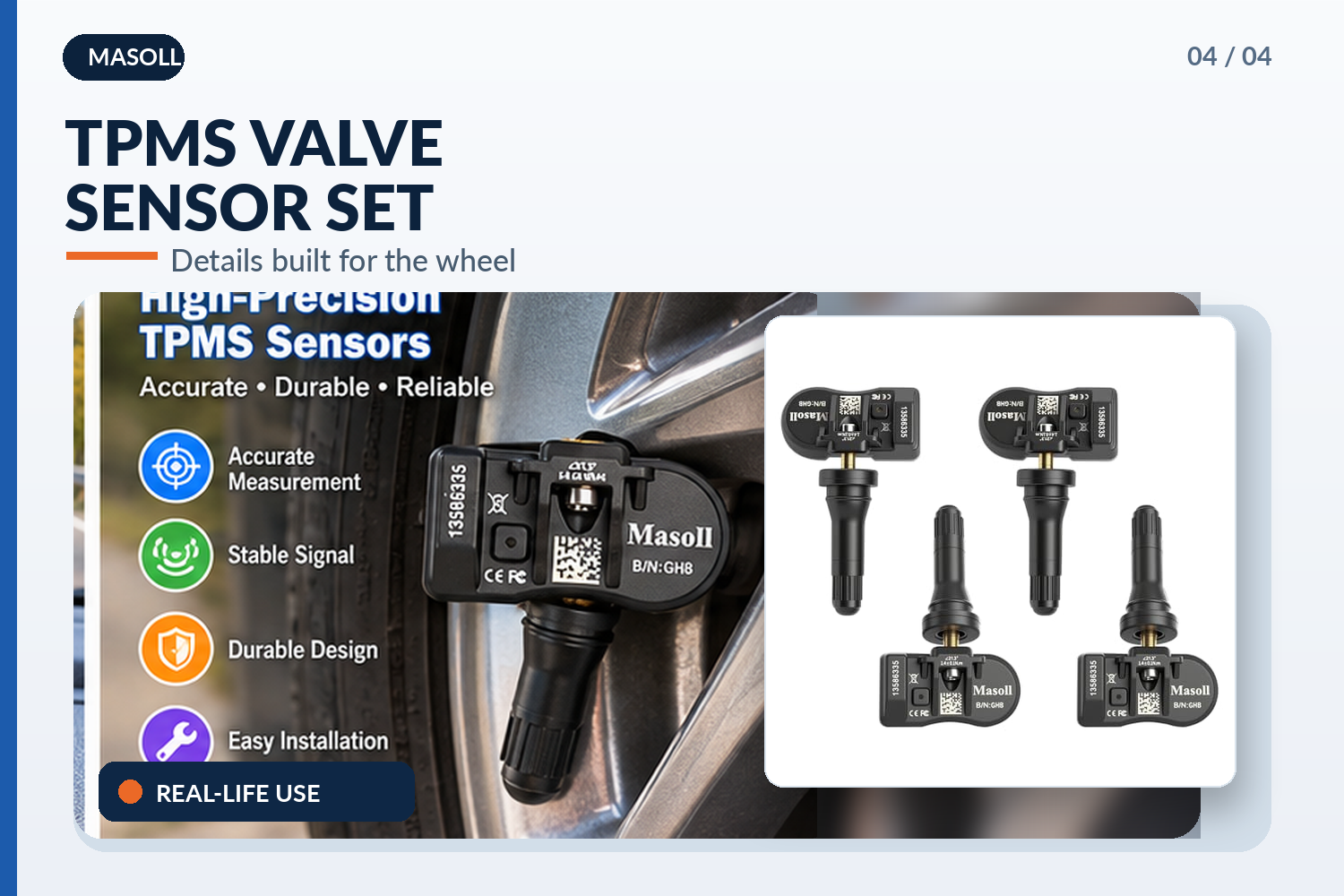
B0FR9JCT5F is the internal route: four pre-programmed sensors for GM vehicles, dual-band 315 / 433 MHz, with a dual-antenna layout inside the housing, a sealed CR2050 cell rated at five-plus years, an operating temperature window of −40 to 257 °F, and a pressure range extending to 900 kPa. It cross-references a long list of OE numbers, including 13598771, 13598772, and 13586335. 🔩
Two details in that spec sheet are worth slowing down for.
The dual-antenna design is not decoration. A TPMS sensor transmits a short burst from inside a metal wheel, which is effectively a Faraday cage with a rubber hole in it. The receiver sits in the cabin, on the far side of seats, a firewall, and a fuel tank. A second antenna gives the design diversity in polarization and placement, improving the odds that at least one path reaches the receiver cleanly. In practical terms, this is the difference between a sensor that reports reliably and one that drops out intermittently in wet weather — the failure pattern owners most often describe as “the light comes on randomly.” 🌧️
The temperature rating is the other quiet tell. −40 to 257 °F is not a range a consumer gadget is specified for. It is the range a part has to survive when it is welded to the inside of a steel wheel, sitting above a cast-iron brake rotor, on a descent with a partially dragging caliper. Quoting it at all signals that the unit is engineered to factory environmental standards rather than to a hobby-electronics budget.
Note what is not in the box: a relearn tool. This kit assumes the sensors are going onto wheels at a shop, where a scan tool is hanging on a pegboard. If you are a home mechanic with a tire machine in the garage, buy the tool separately or choose Product A instead. Mixing the two expectations is the most common purchase error in this category. 🚫
When the Full-Set Internal Route Beats Caps
- The truck is being prepared for resale and the wheels should look untouched.
- The vehicle runs on low-profile tires where a protruding valve-cap transmitter invites curb damage.
- All four sensors died within months of each other, which is normal and means you were all buying from the same 2016 battery batch.
- You are replacing wheels entirely and want the sensor IDs migrated once rather than fussed with twice a year.
- The owner genuinely dislikes the idea of a replaceable battery and would rather not think about the system again for five years.
Reading a Compatibility Chart Without Losing an Afternoon
Compatibility is where most TPMS purchases go wrong, and it is worth teaching the method rather than just pointing at a chart. 📚
Step one, ignore the marketing names. “Fits Chevy Silverado” is a starting point, not an answer, because a K2XX Silverado 2500HD and a GMT C10 Silverado 1500 can listen on different bands and use different relearn sequences. Write down the platform code from your owner’s manual or a parts catalog, not just the badge.
Step two, capture the OE number off the dead sensor if it is accessible. This is the single most reliable lookup key in the entire process. Manufacturers change part numbers across suppliers and model years with no regard for anyone’s weekend, but the interchange list on a well-built aftermarket page exists precisely to collapse that chaos. If you can read a number off the old unit, you have removed roughly ninety percent of the risk.
Step three, note the year range and the brand family. The GM listings here span model years from 2006 forward across Chevrolet, Buick, Cadillac, GMC, and the older Pontiac, Saturn, and Hummer marques that rolled into the same electronics lineage. That last point surprises people: a 2009 Pontiac Torrent shares sensor DNA with a contemporary GMC, because the platforms were siblings.
Step four, confirm the relearn method before you confirm the sensor. There are vehicles that enter learning mode from a menu sequence, vehicles that require a scan tool, and vehicles that auto-learn while driving. Buying a kit with a handheld programmer for a vehicle that needs a scan tool is a frustrating purchase; the reverse is equally true.
| What to record | Where to find it | Why it matters |
|---|---|---|
| Platform / chassis code | Owner’s manual, parts catalog | Disambiguates same-badge vehicles |
| OE part number | Old sensor body, or dealer lookup | Definitive interchange key |
| Model year range | Registration | Charts are year-bounded |
| Band in use | Listing’s compatibility graphic | Dual-band sidesteps this entirely |
| Relearn procedure | Service manual, owner’s forum | Determines whether a tool is needed |
The Relearn Ritual, Explained Without the Jargon
Here is the mental model that makes the whole category click. 🧠 Your vehicle does not measure tire pressure. It receives radio declarations from four small transmitters, and it trusts whichever IDs are on its list. The list lives in a module. The module is not intuitive, and it does not auto-discover new hardware in most implementations, because automatic discovery would let a stranger’s sensor in a parking garage inject false data into your cluster.
So when you put new sensors on a vehicle, you are performing an introduction. The ignition sequence that produces “Tire Learning Active” opens a timed window during which the module will accept new IDs. The programmer — the EL-50448 in Product A’s box, or a shop’s scan tool — is essentially a megaphone that persuades each sensor to shout its ID loudly enough, at the right moment, for the module to write it down against the correct corner.
Three consequences follow, and every forum argument about TPMS is downstream of one of them.
First, order matters. Modules learn corners positionally, so working clockwise from the driver’s front is the safe habit. Second, the window closes. If the procedure times out halfway, the half-learned state is worse than no procedure at all, and you start over. Third, spare tires are ghosts. Most systems monitor four road wheels only; the spare is invisible unless the vehicle has a dedicated fifth sensor, which is rare and which explains why a flat on a spare triggers the same generic light as a slow leak. ✨
Inspiration Corner: Four Setups, Four Real Owners
The working tradesman, 2019 Silverado 2500HD. Runs on steel wheels with rubber stems, curbs job sites nightly, swaps to studs in November. Two cap sensors sets on the truck, two spares in the glovebox. Product A bought once, batteries replaced each spring in about four minutes. Total spend across three seasons: less than one dealership diagnosis. 🧰
The couple, 2021 Buick Envision, two teenagers learning to drive. Their failure mode is not wear — it is a teenager airing down to “improve grip” in snow and forgetting. A cap set with a visible relearn tool in the console means the fix takes ten minutes and never requires telling anyone why the truck was in the shop. 👨👩
The full-time tower owner, 36-foot fifth wheel, F-350 dually. Factory sensors on the truck only. M13 on the trailer, display mounted to the right of the steering wheel, booster considered for the second trailer they add the following year. Their routine: a fifteen-second glance at corner symmetry at every stop, and a paper card of cold reference pressures in the door pocket. 🏕️
The restomod and classic-trailer crowd. Vintage trailers have no electronics and often beautiful wheels nobody wants drilled. External caps plus a standalone monitor deliver modern protection with zero irreversible modification — the correct engineering answer for any vehicle where originality has monetary value. 🎞️
Cost, Longevity, and the Math Behind the Choice
Comparing sticker prices across these three products is close to meaningless; compare cost per monitored tire-year instead. 🧮
| Ownership factor | Cap-style GM kit | M13 system | Internal 4-pack |
|---|---|---|---|
| Upfront hardware | Lowest | Mid | Low to mid |
| Installation labor | None | None | Shop mount and balance |
| Programmed service life | ~2 years per battery, indefinitely with cell swaps | Sensor cells vary; display self-powering | 5+ years, then replace unit |
| Ten-year cost shape | Flat, with small recurring cell expense | One-time plus occasional sensor cells | Front-loaded, then a replacement cliff |
| Residual risk | Curb damage, theft | Loss of the portable display | Sealed battery dying mid-trip |
The internal route looks cheaper per year until the fifth birthday arrives and all four cells expire roughly together, because they were installed roughly together. The cap route looks fiddly until you realize the fiddliness is a four-minute coin-crack twice a decade. Neither is wrong. They are different bets on how much attention you want to pay, and when.
There is also a value proposition that no spreadsheet captures: the light itself. A warning indicator is not merely information; it is a recurring tax on your confidence every time you get in the vehicle. Owners who have lived with a persistent TPMS light for six months describe the same thing — not anxiety exactly, but a low background hum of unresolved business. Removing that hum for fifteen minutes of driveway work is worth more than the arithmetic suggests. 🌤️
Small Habits That Extend Everything
Monitoring hardware does not maintain tires; it reports on them. The habits below are what actually earn the mileage.
Check cold pressures monthly, not at every fill-up — the sensor gives you the trend, the gauge gives you the truth at a moment. Rotate on the interval in the manual, and have the shop re-verify sensor condition while the wheels are off, since they are already mounted on the machine. Respect the placard pressure under load rather than the maximum on the sidewall; over-inflating to the sidewall number reduces the contact patch and concentrates wear in the center. 📏
Understand the seasonal effect that generates half of all winter warning lights: for roughly every 10 °F drop, air pressure in a tire falls about 1–2 PSI. A truck set correctly at 95 PSI in September will trip its threshold by December without losing a single molecule of air. Knowing this turns an apparent fault into a five-minute adjustment. ❄️
And treat the spare. It is monitored by nobody, aged by everybody. Check it whenever you check the tires, because the worst possible outcome of a fully monitored vehicle is ignoring the one wheel that has no voice.
Quick Answers
Will cap-style sensors trip my insurance or inspection? 🧾
They are legal monitoring hardware and pass standard safety inspections in most jurisdictions, since the requirement is that the system functions, not how it is mounted. Cosmetic standards at a show or a curated restoration are a different question.
Can I mix one cap sensor with three internal ones?
Physically yes, practically no. Corner-by-corner consistency in mounting style, battery age, and antenna design is what keeps the signal pattern predictable. Replace as a set.
My light came back after two weeks. Did the kit fail?
Usually not. The most likely explanations are a genuine slow leak, a temperature swing crossing the threshold, a sensor on the wrong corner from an interrupted relearn, or a loose cap breaking its seal. Diagnose in that order before concluding anything about the hardware. 🔍
Do these systems inflate tires for me?
No. They measure and report. The vehicle’s original equipment does not either — despite what the shape of the warning icon suggests to new owners.
How many sensors do I actually need?
Four for a standard vehicle. Eight for a dually with dual rears or a large trailer with more than four tires, subject to what the display supports. Add a booster once the distance between the farthest tire and the receiver exceeds the manufacturer’s stated range.
The Larger Picture
Masoll is not trying to be a lifestyle brand, and the absence of ambition is the point. 🎯 The catalog reads like a well-organized answer to a question most of the industry treats as unworthy of a product page: what does an ordinary owner do when a consumable electronic part inside their wheel reaches the end of its life, and the repair quote arrives shaped like a punishment?
The answer this brand assembled has four parts, and they interlock. Sensors in both mounting philosophies, so the owner chooses effort versus permanence. Programming hardware bundled where the customer is expected to work alone, and omitted where a technician is expected to be present. Displays for vehicles the manufacturers never wired for telemetry, which is to say, most of the vehicles people actually rely on for long-distance travel. Boosters for the rigs that outgrow the default assumptions.
None of it is glamorous. All of it is the kind of engineering that shows up in a specification sheet as a dual-band radio, a 257 °F ceiling, or a 38-foot range figure — small, checkable numbers that add up to a system that behaves predictably at 6 a.m. in February when you are late and the cluster is glowing. ⏱️
There is a broader lesson in the niche. The most durable businesses in consumer hardware are often not the ones chasing the flashiest product category. They are the ones that identify a recurring, low-status, high-frequency pain — the printer cartridge, the vacuum bag, the warning light nobody budgets for — and decide to own the entire chain of consequences rather than one link of it. That is what a symptom-first catalog looks like from the outside, and it is why scrolling this storefront feels less like browsing a shop and more like reading a well-organized repair manual.
So the next time that little yellow horseshoe appears, treat it as what it actually is: not a malfunction, not a curse, and not a dealer’s opportunity. It is a consumable reaching its scheduled end of life, announcing itself politely, months before it could ever become dangerous. Fifteen minutes, a coin-cell, and the right part number between the wheel and the warranty — and the dashboard goes quiet again. 🛞✨