Why Long-Haul Travel Still Doesn’t Work Like It Should
We talk about flying as if it’s solved. The apps are booked, the boarding pass is on the phone, the seat is chosen. And yet ask anyone who’s ever survived a red-eye, a middle seat, or an overnight train connection, and the real problem is still the same one it was twenty years ago: most travel infrastructure simply wasn’t designed around your body after hour four. The cabin lighting stays bright long after you’ve given up on staying awake. The armrests never quite reach the spot where your shoulder actually lives. The noise around you—crying babies, chatty neighbors, overhead bins, engine drone—keeps its schedule, not yours. By the time the pilot finally dims the cabin, you’re already too wired to sleep, and by the time you land somewhere six time zones away, you’re carrying an exhaustion that takes two full days to offload.
This is the quiet frustration behind a lot of modern travel. People don’t actually hate flying anymore. They hate arriving less rested than they left. They hate spending real money on tickets and hotels, then letting the journey itself sabotage the next two days of the trip. That’s the space the travel-goods industry has been quietly growing into for years: not luggage that lasts, but the smaller, stranger category of stuff that makes the between part bearable. Neck pillows, eye masks, earplugs, security pouches, even sleep supplements—these are the carry-on essentials most travelers accumulate one airport kiosk at a time, usually at 2 a.m. with no energy to compare options.
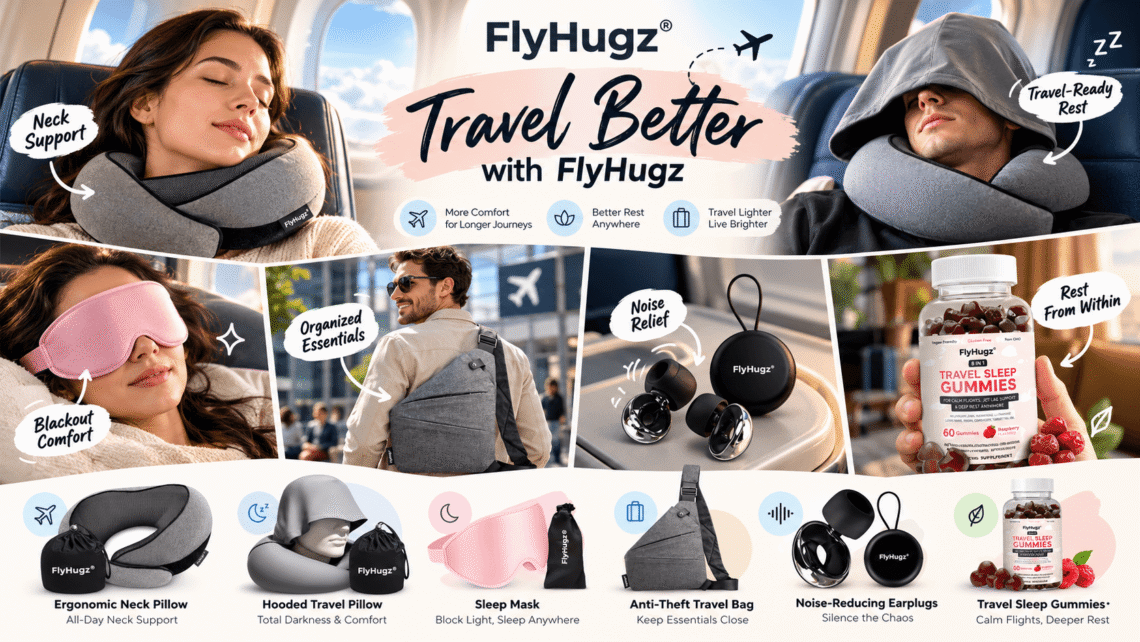
FlyHugz is the brand that looked at exactly that scattered, exhausted shopper and decided there was a better way to do it. Instead of selling you one mediocre U-shaped pillow and leaving you to improvise the rest, FlyHugz built a small, deliberate collection around a single idea: that comfort on the move is a system, not a single product. The neck pillow, the hooded pillow, the sleep mask, the earplugs, the sling bag, and the sleep gummies all share the same design language, the same muted gray palette (with a soft pink accent in the mask), and the same target user—someone who wants to arrive rested, secure, and unflustered. This is a look inside that system, why it exists, and what each piece actually does for the person wearing it.
Meet FlyHugz: A Brand Built by Someone Who Was Fed Up With Bad Travel Sleep
Every travel brand has an origin story, and most of them blur together in the same vague way. What makes FlyHugz’s worth listening to is how ordinary the trigger was. According to the brand’s own story, it started with the founder’s own frustration on a long-haul flight—something almost anyone reading this has felt. Cramped seat, noisy cabin, a pillow that flattened the moment you leaned on it, a mask that let light leak in around the edges, earplugs that either hurt or fell out, and a bag that was either too big to haul around or too small to be useful. The usual market response to that situation is to just… buy a slightly better pillow next time. FlyHugz’s response was to ask why the whole stack of travel comfort gear was sold separately, with each piece designed by a different company that had never spoken to any of the others.
That philosophy shows up in how the brand talks about its own catalog. Rather than positioning each item as a standalone gadget, FlyHugz frames its products as a travel system: a small set of tools that work together to solve the three problems every long-haul traveler actually has. First, physical support—your head, neck, and shoulders need somewhere honest to land. Second, sensory control—light and noise need to be shut out deliberately, not endured. Third, practical security—your passport, phone, and meds need to stay on your body without turning you into a walking backpack. The sleep gummies, the newest addition, quietly add a fourth pillar: getting your body to actually cooperate once the other three are in place.
The brand’s tone is worth noting too. This isn’t rugged, adventure-tactic gear aimed at people who climb mountains between flights. It’s calmer than that. The visual language—soft gray fabrics, natural lighting, real people dozing in airplane seats, cozy living-room photos—suggests a brand that understands its customer isn’t chasing status. She’s a frequent flyer, a visiting family member, a digital nomad between co-working spots, a couple heading somewhere romantic, a business traveler who’s tired of looking wrecked in meetings. FlyHugz is selling, essentially, the feeling of being taken care of in a situation that normally takes everything out of you.
The product line reflects that intent. Rather than sprawling into dozens of SKUs, the brand keeps the collection tight: two neck pillows (one classic memory foam, one upgraded hooded version), one sleep mask, one sling bag, one earplug set, and one gummy. That restraint matters. It means each piece gets designed against the same use case—someone trying to sleep, stay calm, and keep their belongings secure while moving through the world—instead of being pulled in six different marketing directions.
The Core Collection: Six Pieces, One System
The Memory Foam Travel Neck Pillow (Gray) — Your Head Finally Has a Plan
Let’s start with the obvious anchor of the system, because every traveler already knows this category: the travel neck pillow. The problem with most of them is that they fall into two camps. The first camp is the cheap, puffy microbead or polyester job that collapses the moment you lean on it—great for looking prepared at the gate, useless ten minutes into the flight. The second camp is the over-engineered brace that holds your head so rigidly upright you look like you’re about to be questioned, and it never quite fits under the airplane seat.
FlyHugz’s gray Memory Foam Travel Neck Pillow sits in a deliberately different middle. Memory foam is the material choice here, and it’s the reason the pillow behaves differently from those two extremes. Where microbeads squish and shift, memory foam actually remembers your neck’s shape—you sink in, the foam conforms to the angle of your cervical spine, and it slowly pushes back rather than collapsing flat. On a red-eye where you’re nodding forward into the seatback in front of you, that slow pushback is the difference between a restful doze and a neck cramp that you’ll still feel three days later.
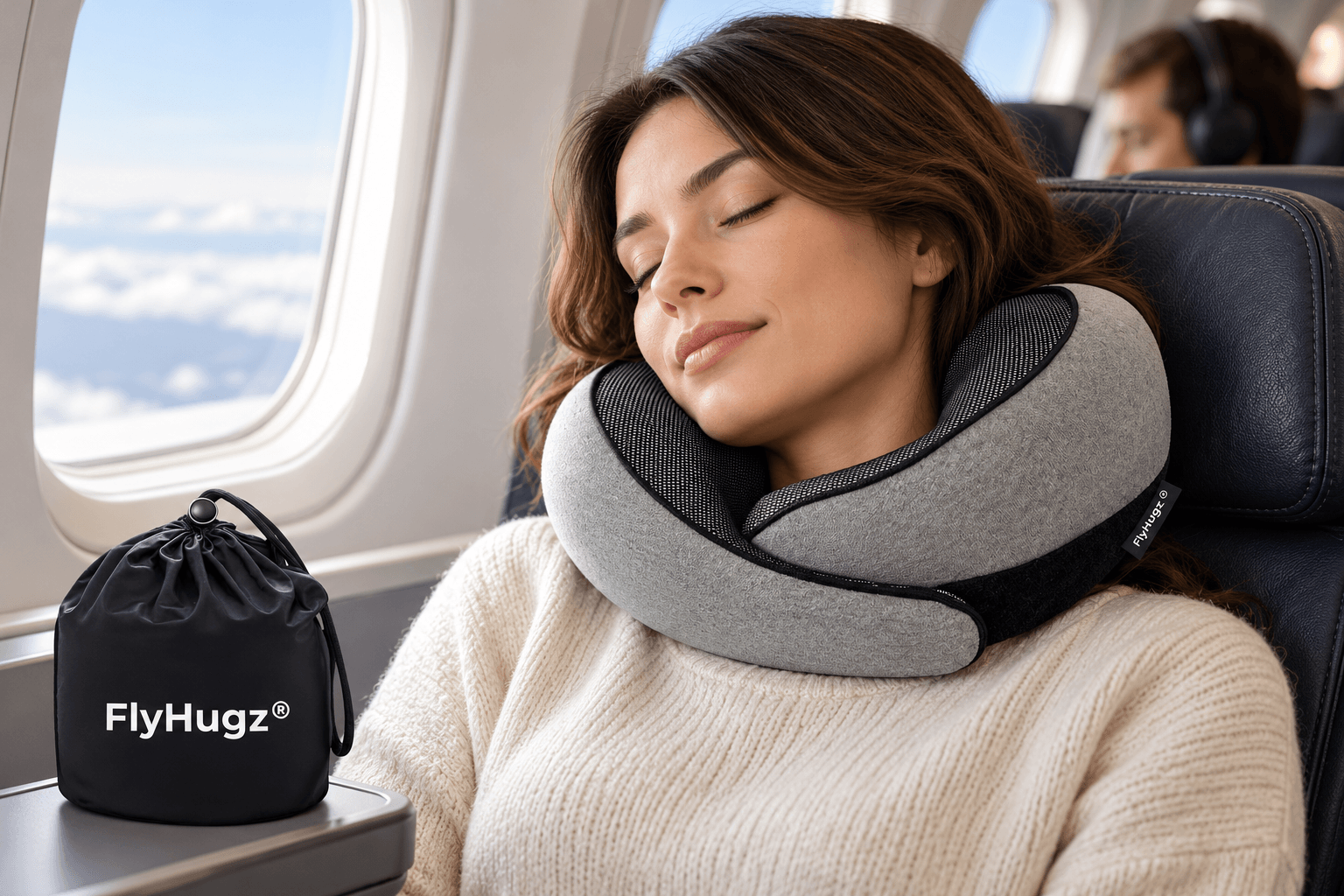
The shape matters as much as the material. The classic U-form wraps under the chin and around the sides of the neck, so your head is supported from the sides rather than from underneath—which is exactly the direction your head actually falls in a reclined seat. The gray fabric cover is soft to the touch, the kind of textile that doesn’t irritate if your cheek is pressed into it for hours, and the brand designs these covers to be removable and washable, which is quietly one of the most important features a travel pillow can have. After a dozen flights, a pillow without a washable cover is just bacteria in a U-shape. The FlyHugz version, like its bigger sibling below, is built to be laundered rather than replaced.
There’s a practical detail that gets overlooked: a good travel pillow also needs to not dominate your bag when you’re not sleeping. Stuffable, compressible foam pillows fold down to a manageable size, clip or stow easily in a carry-on, and sit comfortably around your neck while you walk through the airport rather than bouncing against your chest like a life preserver. This is the baseline piece of the whole FlyHugz system—the one that, on its own, solves the most obvious travel problem. Everything else in the collection builds on it.
The 2.0 Hooded Travel Pillow (Gray, 2026 Original Release) — A Private Booth at 35,000 Feet
If the classic memory foam pillow is the foundation, the 2.0 Hooded Travel Pillow is the brand’s flagship. This is the one FlyHugz puts front and center in its own marketing, and it’s not hard to see why. It takes the memory foam neck pillow you just read about and adds the piece that most travelers improvise badly: a soft, integrated hood that pulls up over your head to create a little private enclosure around your face.
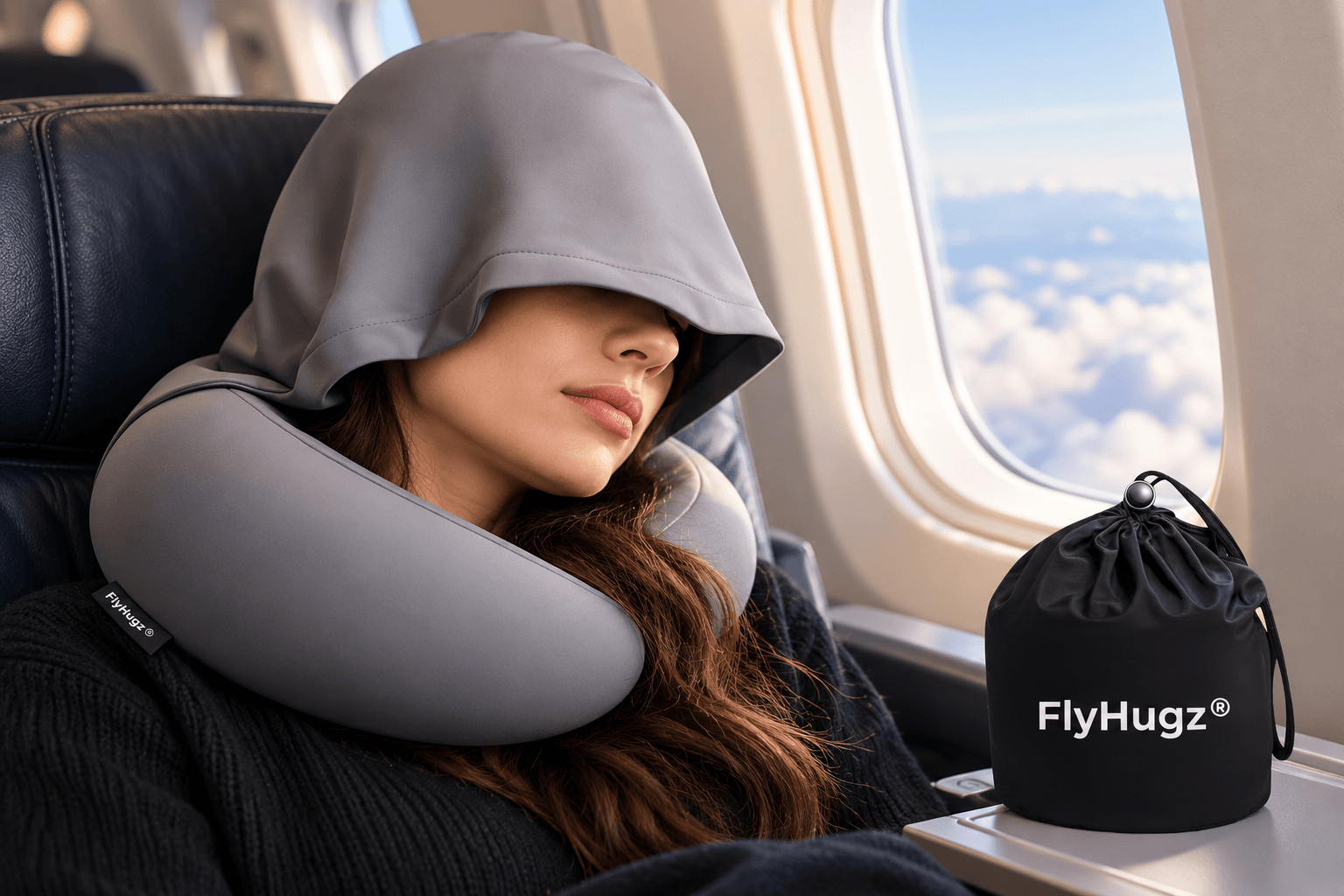
The hood is doing three jobs at once. The first is physical. When you’re trying to sleep upright in an airplane seat, the single most annoying thing is the ambient light—the cabin lamps, the reading light from the seat next to you, the screens, the boarding passes glowing somewhere behind you. Pulling the hood up over your head creates an immediate shade. You don’t need to fumble for an eye mask while half-asleep; the hood is already there, integrated, and it drapes naturally rather than bouncing. The second job is sensory: a hood dampens sound. It’s not noise-canceling, and it doesn’t pretend to be, but the soft fabric barrier around your ears reduces that constant engine hiss and the chatter three rows back by a meaningful amount. The third job is psychological. There’s a reason people pull their hoods up when they’re tired. It’s a small, universal signal to the world please don’t talk to me right now. It turns your seat into a booth.
The 2.0 version—the 2026 original release—represents FlyHugz iterating on that idea. The brand has openly talked about listening to feedback from the first hooded pillow and tightening the fit: better foam density so the neck support holds up over longer flights, a hood that drapes further without sliding off the back of the head, and a gray textile that resists the kind of oily grime that builds up on travel gear. The result is the piece in the collection that a long-haul traveler reaches for first on a ten-plus-hour flight, because it quietly replaces three things they used to carry separately: the neck pillow, the hoodie they didn’t want to wear, and the eye mask they always forgot.
It’s worth being honest about who this is for. If you mostly fly short domestic hops and sleep fine in a normal seat, the 2.0 may be overkill. But if your travel pattern includes overnight or intercontinental legs—where you’re genuinely trying to sleep for four, six, eight hours in a reclined position—the hooded pillow is the kind of single purchase that changes the whole calculus of whether the trip starts well. It’s the piece the rest of the system is built around.
The 3D Travel & Home Sleep Mask (Ultra-Soft, Pink) — Darkness You Can Actually Forget You’re Wearing
Sleep masks are one of those products that sounds like a luxury until you’ve tried a bad one. The bad ones are flat, crinkly, made of stiff nylon that presses on your eyelids, lets light leak in around the nose bridge, and slips off the moment you turn your head. The FlyHugz 3D mask—here in the ultra-soft pink—is the opposite of that design school, and the word “3D” is the important part.
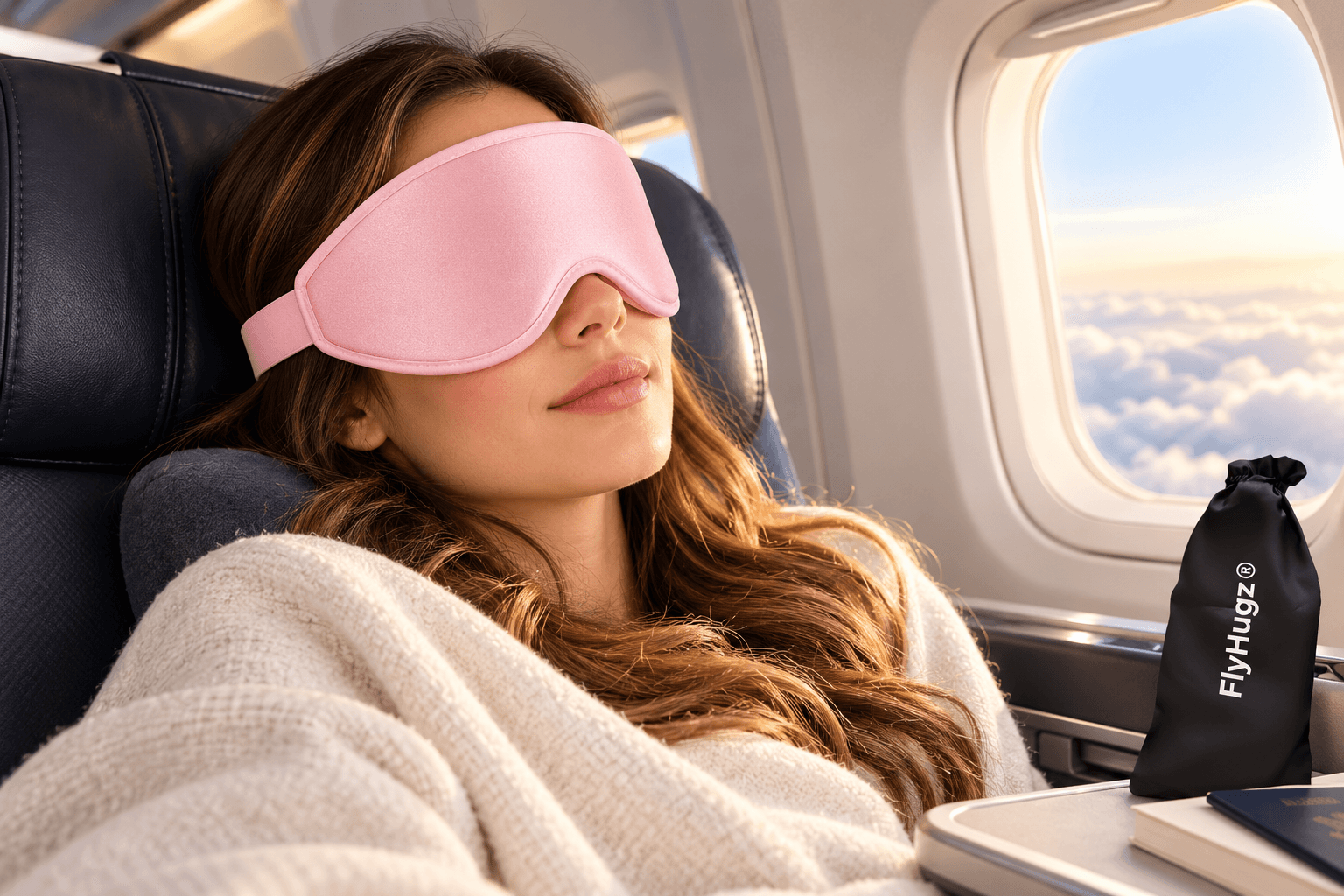
A 3D sleep mask is contoured. It’s molded to have a recessed cup over each eye, so the fabric sits around your eyes rather than on them. That detail changes everything. With a flat mask, you can’t blink, your eyelashes brush the material, and if you wear contacts or have dry eyes, you end up awake and uncomfortable forty minutes in. The 3D shape gives your eyes their own little chamber, which means you can blink normally, keep your lashes off the fabric, and actually close your eyes the way they want to close. For a lot of travelers, that’s the difference between “I tried to sleep” and “I actually slept.”
The pink colorway matters less for function and more for psychology. FlyHugz’s whole palette is calm grays; the pink mask is the one piece in the collection that reads as soft, personal, almost domestic. The marketing around it leans into that: this isn’t just an airplane accessory, it’s a mask you’d use at home, in a hotel room where the curtains are thin, on a train where the compartments never go fully dark, or even in a bright bedroom if you sleep with a partner who reads late. It’s designed to be worn with the same comfort as something you’d keep on a nightstand.
The “ultra-soft” claim refers to the inner fabric—the kind of smooth, skin-friendly textile that doesn’t tug or leave marks when you wake up. Combined with an adjustable strap that fastens behind the head rather than pressing on the temples, it’s the mask version of what the 2.0 hooded pillow is for the neck: a piece that you can genuinely forget you’re wearing. In the system, this mask is the partner piece to the earplugs below—light and noise shut off together, not one at a time.
The Anti-Theft Crossbody Sling Bag — Security Without the Bulky Tactical Look
Here’s the piece in the collection that has nothing to do with sleeping, and everything to do with feeling calm. A crossbody sling bag seems, on paper, unrelated to a neck pillow. But anyone who’s traveled enough knows that a huge amount of travel stress isn’t about the flight—it’s about the luggage anxiety. Where are my keys? Is the passport still in my pocket? Did someone just brush past me on this subway? A sling bag worn across the body, close to the chest, solves that, and FlyHugz’s version is designed to solve it without turning you into a tactical vest.
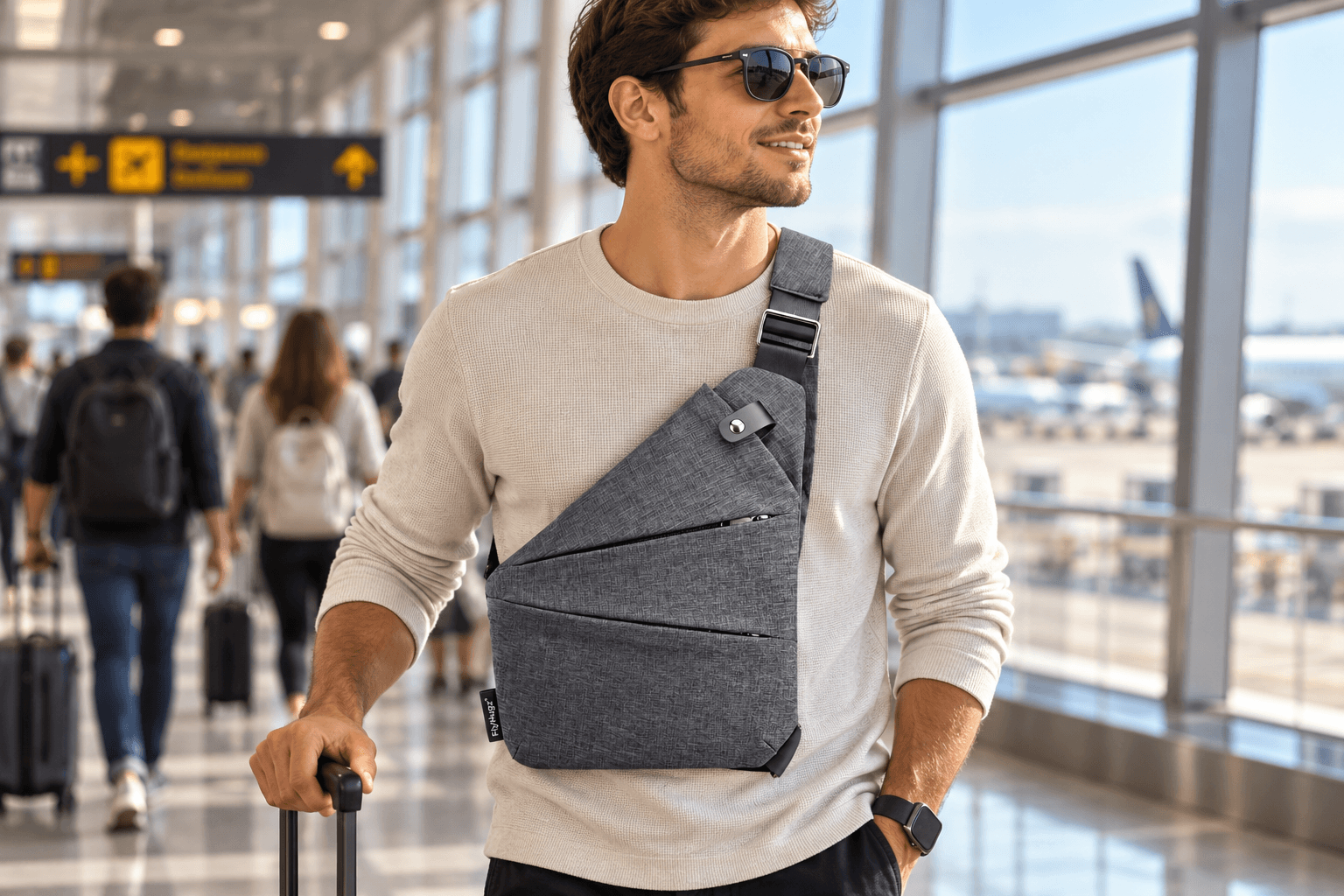
The “anti-theft” label refers to the thoughtful layout of pockets and zippers. The idea is that the bag’s sensitive compartments—passport, phone, wallet—are positioned against your body rather than exposed on the outside where a hand can reach them. Hidden or inward-facing zippers mean a pickpocket can’t simply glide a hand along the bag’s exterior and unzip you. The bag typically also includes a compartment designed for RFID-blocking, which matters because contactless cards and passports can technically be skimmed at close range; a lined pocket keeps that from happening while the card is in your bag. None of this is paranoia if you’ve ever been in a crowded market, a train station, or a tourist district where a fast brush is all it takes.
The sizing is the other important detail. A sling bag is intentionally smaller than a full crossbody, meant for the essentials only: passport, phone, power bank, lip balm, keys, meds, a folded mask. Worn high on the chest or under the arm, it stays out of the way on flights, through security, and while walking through a city. The point isn’t to replace your suitcase or even your daypack—it’s to be the layer that stays on you when the main bag is in the overhead bin or checked in. That separation is what creates the calm: the valuable stuff is never in a place you can’t feel.
In the FlyHugz system, this bag is the “awake” counterpart to the sleep gear. When you’re sleeping, the pillow and mask and earplugs do their job; when you’re up and moving, the sling bag carries the world’s contents you can’t afford to lose. The gray colorway keeps it visually consistent with the rest of the collection, so the whole kit reads as a deliberate set rather than a random pile of travel stuff.
Noise-Canceling Earplugs (Gray, With Carry Case) — Quiet Is the New Window Seat
Let’s be honest about what “noise-canceling” means here, because the word gets stretched across two very different product categories. Active noise-canceling headphones use microphones and electronics to cancel sound; earplugs—even good ones—work by physically blocking it. FlyHugz’s gray earplugs are the physical kind: soft, reusable, silicone plugs that you shape into your ear canal to dampen the cabin’s constant drone. What they’re not is noise-canceling headphones, and that’s actually the selling point.
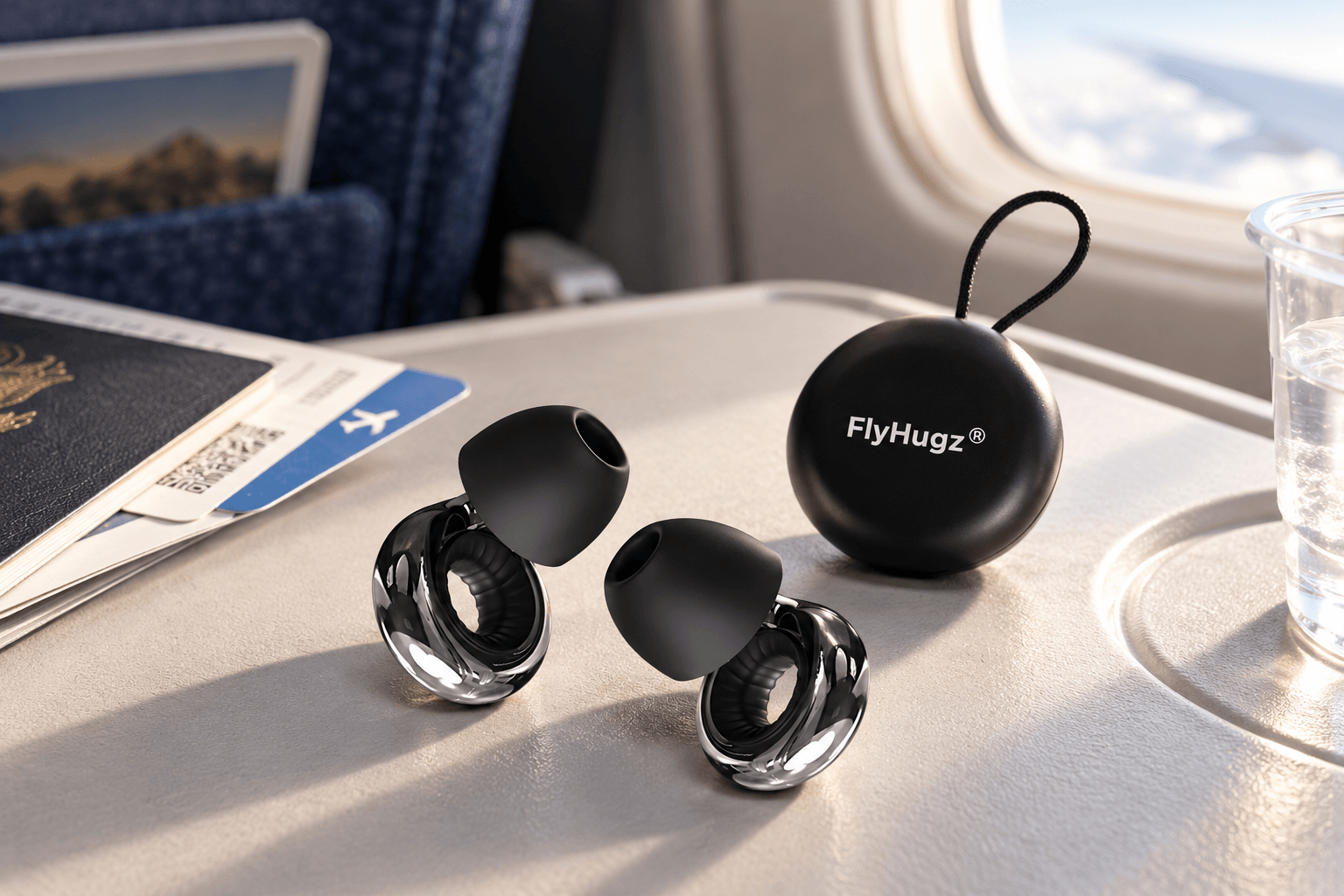
Headphones that cancel noise are great, but they come with a list of compromises: they’re bulky, they need charging, they get hot on a long flight, you can’t hear the safety announcements, and you can’t wear them comfortably on your side while napping. A simple, well-made pair of silicone earplugs sidesteps every one of those problems. They don’t need power. They weigh almost nothing. They stay in even when you turn your head. And crucially, they reduce the constant sounds—the engine hum, the air conditioning whoosh, the muffled conversation three rows back—without isolating you completely, so you still hear the flight attendant if she says your row.
The set comes in a small gray carry case, which sounds trivial until you’ve lost three pairs of earplugs to the bottom of a bag. A hard, labeled case means the earplugs actually survive the trip; without one, they end up somewhere between a charger cable and a granola bar. FlyHugz pairs these with the sleep mask in its marketing for a reason: light and noise are the two sensory inputs that wake you up, and together the mask and plugs shut both down. The earplugs are also useful far beyond the cabin—hostel walls, hotel hallways, loud hotels near a nightlife district, even a snoring partner. They’re the smallest, cheapest piece of the system that has outsized impact.
Travel Sleep Support Gummies for Adults — The Pillar Your Pillow Can’t Give You
The newest piece in the collection, and the one that signals FlyHugz’s ambitions beyond gear, is the Travel Sleep Support Gummies. A brand that makes pillows selling sleep gummies is the kind of move that could feel gimmicky—until you think about the actual problem. You can have the perfect pillow, the darkest mask, the quietest earplugs, the calmest bag on your chest—and still lie there wide awake at 3 a.m. in a foreign bed, because your body clock is confused, your blood is full of airline coffee, and you’ve spent the last twelve hours in seats and queues. The hardware gets you ready to sleep; the gummies are the nudge that helps you actually fall asleep once the environment is set.
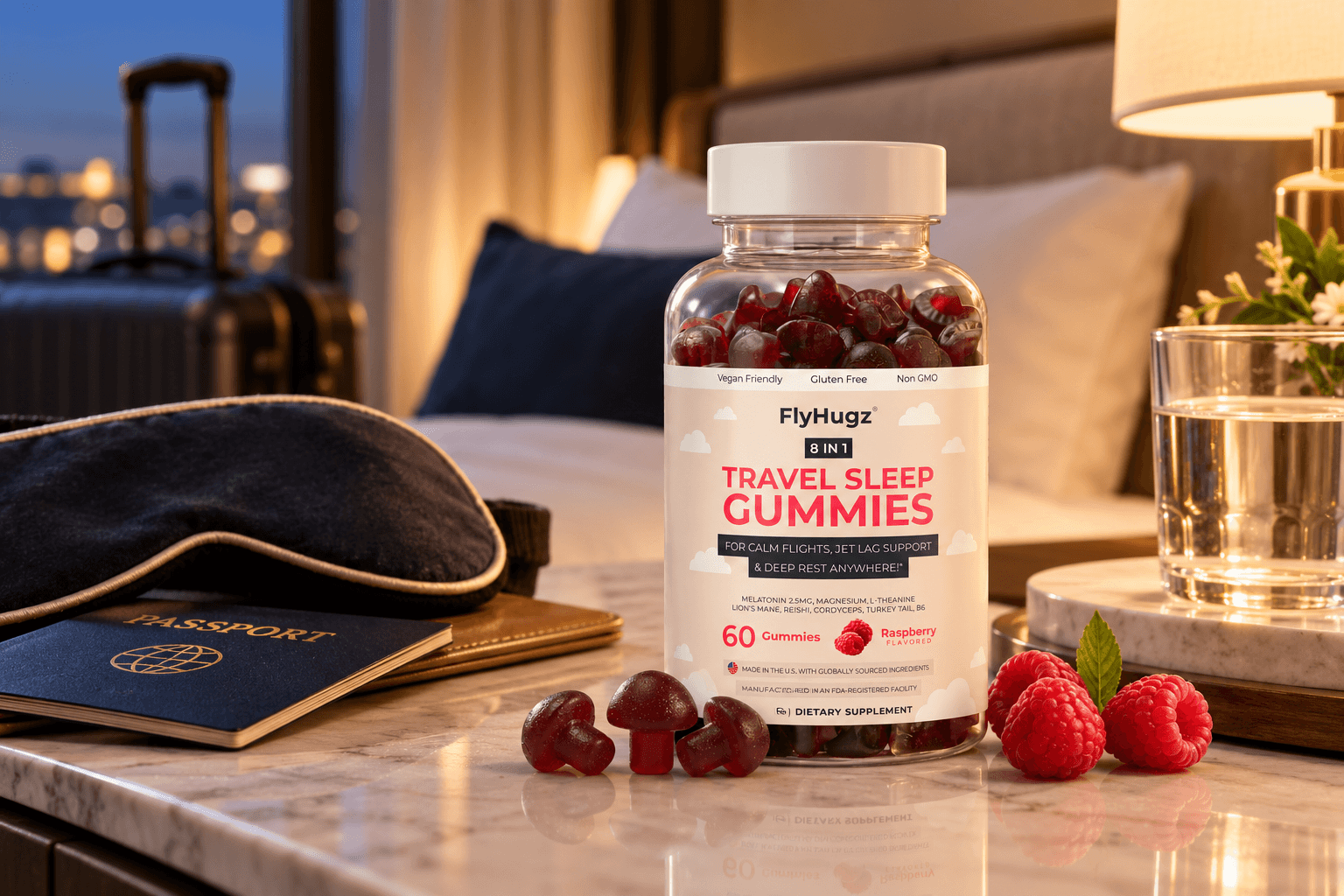
That’s the framing FlyHugz uses: this is the final piece of the system, not a replacement for any of it. A gummy only works if the rest of the setup is doing its job—you need the dark, the quiet, the support. But when everything else is in place, a well-formulated sleep gummy gives your body the signal it’s been missing: that it’s time to switch off, that the travel day is over, that it’s okay to let go. The “for adults” wording is deliberate; this is a formula aimed at grown travelers, not children, and the gummy format (rather than a pill) is chosen because it travels without water, dissolves easily, and avoids the “medicine” feeling that makes some people avoid sleep aids.
The marketing copy on the brand page positions these as the answer to a specific modern travel problem: jet lag plus airport anxiety plus caffeine crashes. You don’t need them on every flight. You need them on the one night where you must sleep, because tomorrow morning’s meeting, tour, or wedding starts early. As part of the FlyHugz system, they’re the safety net—no matter how well-built the pillow is, there’s always one trip where your body simply refuses to cooperate, and this is the piece that has your back.
How the Pieces Fit Together: The FlyHugz Travel System
The reason to talk about all six products in one article is that they’re not really six separate purchases. They’re one stack, and the brand’s own framing—“The FlyHugz Travel System”—is the honest description of what happens when you own more than one of them.
Picture a long-haul flight. You board, stow your main bag, and the sling bag stays on your lap or under the seat with your passport, phone, and meds inside. Once the seatbelt sign turns off and the cabin dims, you pull the hooded pillow around your neck, adjust the foam so it cradles your jaw, pull the hood forward over your head. You slip the pink 3D mask over your eyes under the hood, push the soft gray earplugs into your ears, and—if the flight is the kind that requires an actual reset—you chew one sleep gummy about forty minutes before you want to be asleep. The cabin noise recedes, the light disappears, your neck stops fighting the seat angle, and for the first time all trip, your body has a reason to believe you’re safe enough to rest. That sequence, end to end, is what the collection is designed to enable.
It also works in pieces. A business traveler who only flies domestic might just want the classic memory foam neck pillow plus the earplugs. A honeymoon traveler might prioritize the pink sleep mask and the hooded pillow. A city-hopper who’s nervous about pickpockets might lead with the sling bag and add the rest later. The system doesn’t require you to buy everything at once; it rewards you for adding pieces over time, because each one simply plugs into the same habit of taking your comfort with you.
That’s worth saying out loud: the FlyHugz system isn’t expensive in the way premium luggage is expensive. The individual prices sit in the normal travel-goods range, which is exactly why the collection works as an entry point. Most travelers don’t drop five hundred dollars on a neck pillow. They buy one thoughtful piece, then come back for the next one when they realize the first one actually changed their trips. The brand’s restraint—six SKUs, no sprawl—means there’s no “wrong” way to enter.
Who This Is For (and Who It Isn’t)
To be useful, this post should also be honest about where FlyHugz doesn’t fit. The collection is built for the traveler whose discomfort is mostly about sleeping and staying calm. If your travel life is about hiking, safari gear, or winter expeditions, you’ll need a different category of equipment; this brand isn’t trying to be that. The sling bag is also small—passport, phone, meds, keys—so if you need to carry a camera body, a laptop, or a day’s worth of gear, you’ll want a proper backpack alongside the sling, not instead of it.
But if you’re any of the following, the system was basically designed for you:
- The frequent business flyer who’s tired of looking wrecked in morning meetings after a red-eye.
- The couple who takes one big international trip a year and refuses to arrive exhausted for the first two days.
- The visiting family member flying cross-country to be with kids or parents, who wants the flight itself to feel restful rather than endured.
- The digital nomad or slow traveler who lives out of carry-ons and wants comfort gear that works on planes, trains, and strange hotel rooms.
- The traveler with sensory sensitivity—light or noise—that makes standard economy flights genuinely draining.
The through-line is that you’re not buying travel gear for the status of travel. You’re buying it because travel is already long enough, and the goal is to arrive as yourself.
Final Thoughts: Comfort Is a System, Not a Pillow
There’s a subtle shift happening in the travel-goods market, and FlyHugz sits right at the front of it. For years, the category was dominated by luggage brands selling the outside of travel—suitcases, backpacks, organizers—while the inside of travel (the cabin, the seat, the sleepless night) was left to a scatter of cheap, generic accessories sold at the airport. FlyHugz’s bet is that the inside is where travelers actually spend their pain, and that a brand that treats the cabin experience as seriously as the suitcase experience can build something lasting.
The six pieces in the collection aren’t flashy. None of them will be the thing you Instagram at the airport. But that’s exactly the point. The best travel gear is the stuff you stop noticing—the pillow that supports your neck so well you forget it’s there, the mask that lets you sleep through landing, the earplugs that disappear into your ears, the sling bag that sits on your chest like a second pocket, the gummy that lets you actually switch off. Taken individually, each is a reasonable upgrade to whatever you currently carry. Taken together, they’re the first coherent answer in a long time to the question every traveler has been quietly asking: why do I still arrive this wrecked?
If you’ve ever been that person—face pressed against a cold airplane window, trying to sleep with a neck pillow that gave up an hour ago—FlyHugz is the brand that built itself around fixing exactly that. And in the end, that’s the whole pitch: travel shouldn’t break you before the trip even starts. The system is simply the set of small, well-built things that help it stop.