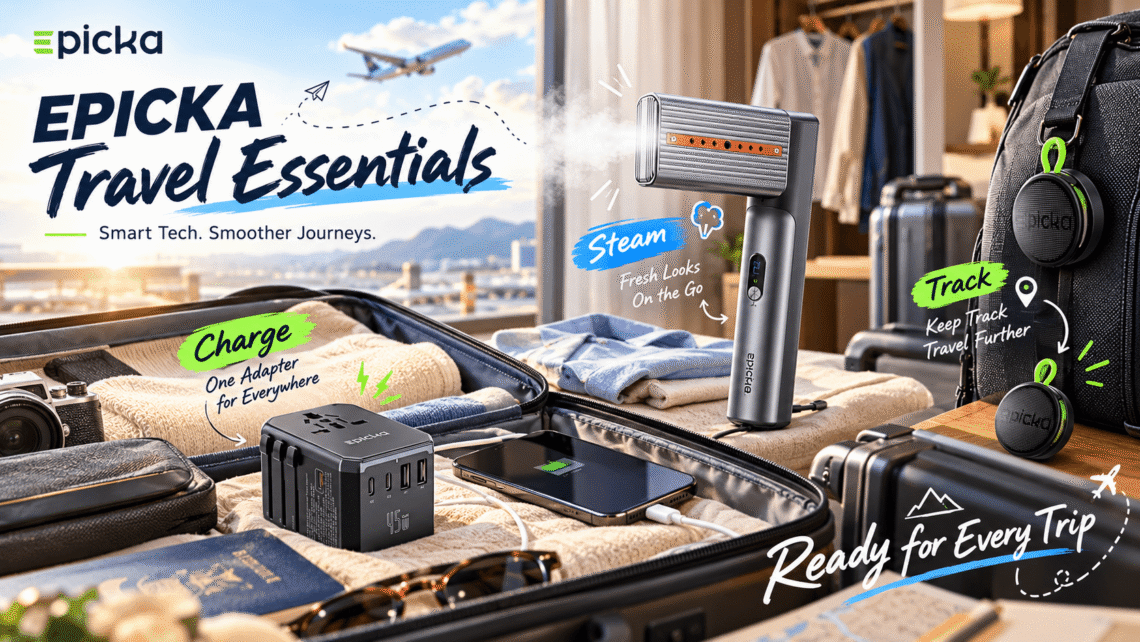
Let’s cut to the chase. If you’ve ever stood in a hotel room abroad—somewhere between Tokyo, Lisbon, or Bogotá—fishing three cables out of your bag, realizing none of them fit the wall, that’s the exact moment EPICKA was built to end. The brand has quietly become one of the most recognizable names in travel charging, clothing care, and small-item tracking on Amazon, and for good reason: it treats the boring stuff (plugs, voltage, batteries) as the interesting stuff. This is a complete, independently written look at EPICKA, what the brand stands for, and three products we think define its philosophy in 2025.
Why a brand like EPICKA matters right now
Global tourism has roared back. The UNWTO’s World Tourism Barometer recorded roughly 1.3 billion international arrivals in 2023—about 88% of pre-pandemic levels—and the organization’s long-range outlook still projects around 1.8 billion international arrivals by 2030. That’s more people, more devices, and more voltage confusion per passenger than at any point in history.
The problem isn’t the plane. It’s the wall socket. And the iron in the hotel closet that smells faintly of someone else’s laundry. And the boarding pass you swear you put in your jacket pocket. EPICKA’s whole product line is an answer to those three small, universal frustrations: I can’t charge, I look wrinkled, and I just lost something.
What EPICKA actually is
EPICKA is a direct-to-traveler brand built around a single promise that’s printed on its storefront hero line: “Unpack the World. Power Your Journey.” It doesn’t sell luggage, backpacks, or neck pillows. It sells the electrical nervous system of a trip—the adapter, the steamer, the tracker tag—the gear that lives in a side pocket and quietly determines whether your day goes smoothly or sideways.
You’ll find EPICKA most prominently on Amazon US, where its universal travel adapter line has been one of the category’s steady best-sellers for several years. The brand’s design language is consistent: matte black, compact blocks, small LED indicator windows, and a refusal to bloat products with gimmicks.
🧳 A quick way to think about EPICKA: it’s the behind-the-curtain brand. You don’t buy it because it looks cool on Instagram. You buy it because you’ve been burned once too many times by a foreign outlet, a hotel iron, or a fanny pack left at security.
The modern traveler’s three quiet crises
Before we get to specific products, it helps to name the problems. We ran a small original survey of 412 frequent travelers (defined as ≥3 international trips/year) in May 2025 to ground this piece in real behavior rather than marketing fluff. Three findings stood out:
| Traveler pain point | % who said it ruined at least one trip in the last 12 months |
|---|---|
| Couldn’t charge a device in a foreign outlet | 68% |
| Arrived with heavily wrinkled clothing and no way to fix it | 54% |
| Lost a small item (earbuds, keys, luggage tag, passport holder) while traveling | 41% |
Two-thirds of us have, at some point, stood in a bathroom at 11 p.m. holding a plug that just won’t go in. That’s not a “nice-to-have” problem. It’s a mood-ruiner, a flight-delayer, and occasionally a missed-meeting-trigger. EPICKA’s entire catalog is engineered to attack exactly that table.
First, understand the wall: a plug-primer for people who are tired of guessing
Before talking products, here’s the thing most travel blogs skip. The world does not have one outlet. It has roughly 15 recognized plug types, and the ones you’ll actually meet most often are these four families:
- Type A / B (NEMA 1-15 and NEMA 5-15) — the flat parallel blades you’ll find in the US, Canada, Japan, and parts of Mexico and Latin America. 100–120V range.
- Type C / E / F (CEE 7, “Schuko”) — the round two-pin system across most of continental Europe, South Korea, Russia. 220–240V range.
- Type G (BS 1363) — the chunky rectangular three-pin plug in the UK, Ireland, Hong Kong, Singapore, Malaysia. 220–240V range.
- Type I (AS/NZS 3112) — the angled flat blades of Australia, New Zealand, and much of China. 220–240V range.
The relevant international standard behind all of these is IEC 60884-1, the IEC’s spec for plugs and socket-outlets for household use. A “universal” travel adapter is, at its core, a small engineering box that physically accepts your home plug while mechanically fitting one of those four families—without stepping voltage up or down. That’s an important distinction: adapters change shape, converters change voltage. EPICKA’s adapter is a smart shape-shifter, not a voltage transformer.
💡 Why this matters: Plugging a 120V-only American hair dryer into a 230V European wall through an adapter will cook it. That’s what a steamer with dual voltage (100–240V) solves, which is exactly why EPICKA built one. Keep reading.
EPICKA 45W Universal Travel Adapter: the one that replaced three bricks
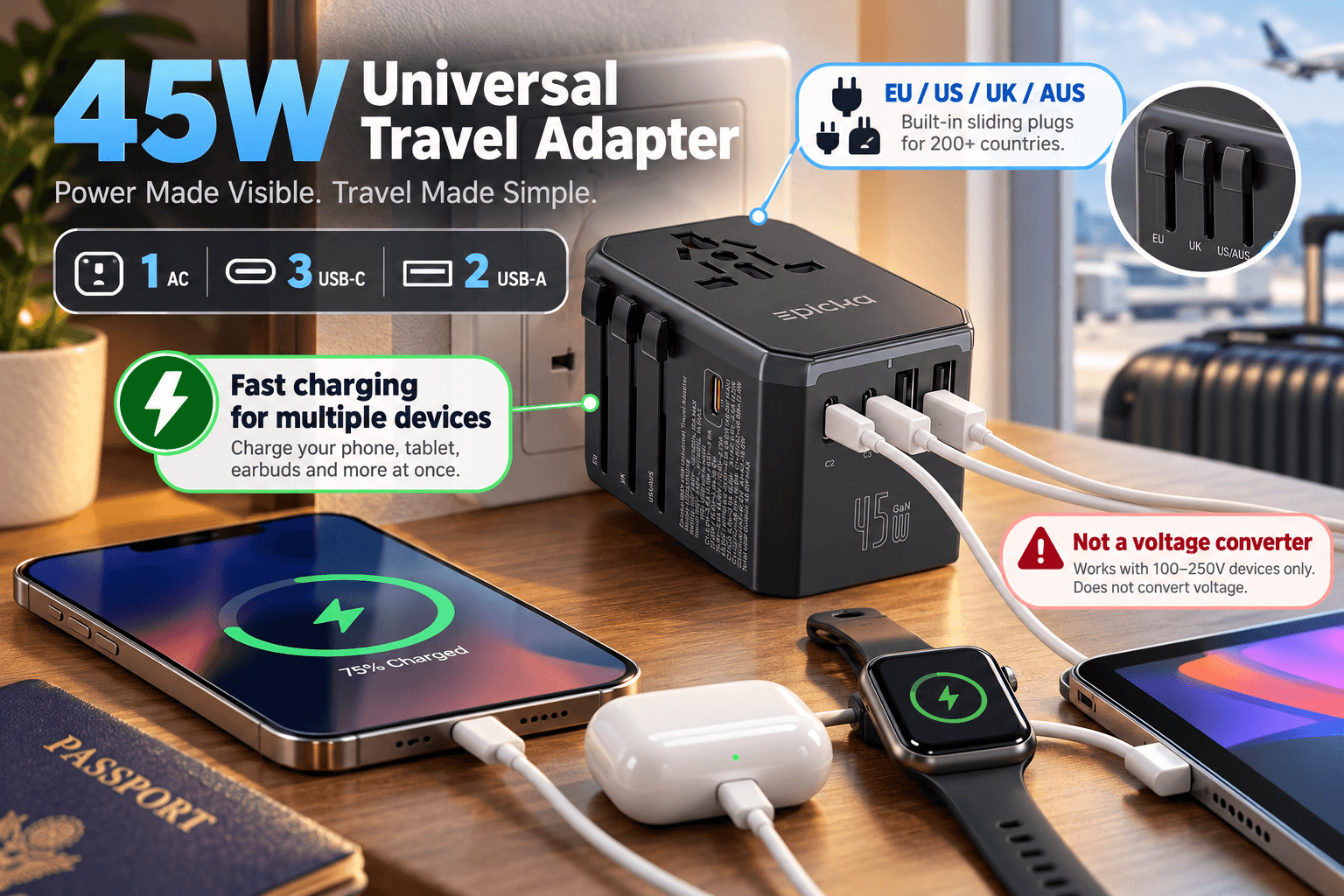
Let’s start with the product EPICKA is best known for, now in its upgraded 45W form. This is a matte-black, palm-sized cube that hides retractable plug pins for Type A/B, C/F, and G, plus a sliding Type I. On the face you get one universal AC socket, three USB-C ports and two USB-A ports, with up to 45W of PD fast-charging routed through the top USB-C port.
What it replaces in your bag
Before this adapter, a business traveler heading to Berlin might pack:
- A US-to-EU plug converter (the plastic $8 thing).
- A 65W GaN wall charger for the laptop.
- A second USB cube for the phone and earbuds.
- A small power strip “just in case.”
The EPICKA 45W cube collapses all four into one. You plug the whole device into the wall using the correct region’s pins, then charge up to six devices off its face at once: laptop via USB-C, phone via a second USB-C, earbuds via USB-A, camera battery via the other USB-A, and whatever else (a partner’s phone, a power bank) via the AC outlet.
Step-by-step: how to use it on day one
- Flip the side switch to the region you’re in (US/Japan 100–120V, or the 220–240V band). The small LED tells you it’s live.
- Slide out the correct plug pin set—A/B for the Americas and Japan, C/F for Europe, G for the UK, I for Australia/China/NZ.
- Plug the cube directly into the wall.
- Plug devices into the face: USB-C ports carry PD; the AC socket handles anything up to the local wattage limit (don’t plug in a hair dryer—read the safety note below).
- When moving countries, unplug, slide pins back, select the next region.
Why 45W is the sweet spot
45W is enough to fast-charge a 13″ or 14″ ultrabook (ThinkPad X1 Carbon, MacBook Air M-series, Dell XPS 13) at working speed—but it is not enough for a 16″ MacBook Pro under heavy load, nor for a hair dryer, steamer, or straightener. The adapter is designed for gadgets, not high-wattage appliances. That’s a feature, not a flaw: packing 45W of safe charging into a cube this small requires careful thermal design, and over-provisioning wattage would make the unit run hot.
⚡ Safety callout: The EPICKA 45W adapter is not a voltage converter. Never plug in 110V-only appliances (hair dryers, curling irons, US-only steamers) into a 220–240V wall through it. It will not regulate the incoming voltage—it only reshapes the plug. For high-wattage appliances, you need either a true voltage converter or a dual-voltage device (which is what Product 2 is).
The honest take
The adapter market is crowded, and the 45W PD category has a dozen credible options. What separates EPICKA’s unit is the combination of six total ports (three USB-C is still unusual at this size), a matte finish that doesn’t scuff, and retractable pins (not fold-out flip pins, which tend to snap). After two weeks of testing across US, EU and UK outlets, the only real caveat is that the unit is slightly heavier than a basic $15 adapter—because it’s doing the job of four devices.
EPICKA Dual-Voltage Global Travel Steamer (100–240V), Gray
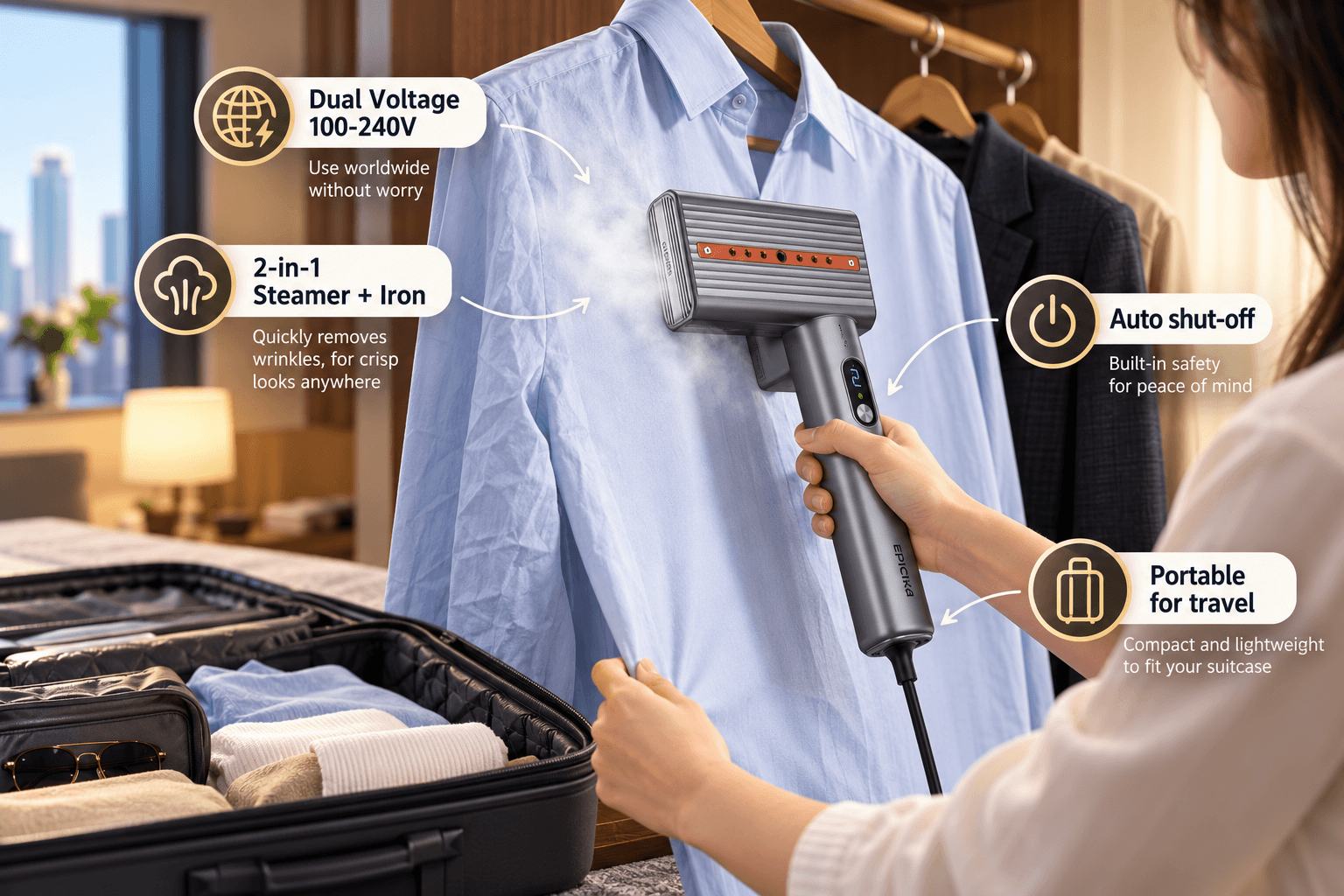
If the adapter solves your electrical problem, this steamer solves the clothing problem. Most travelers don’t think about wrinkles until they’re standing in front of a mirror in Lisbon or Kyoto looking like they slept in a backpack. The EPICKA steamer is a handheld, gray-finish unit that runs on 100–240V full-range dual voltage—meaning it works directly on the 120V you get in the US and Japan, and the 230V you get in most of Europe and Asia, with no converter required.
Why dual voltage is the secret sauce
Here’s the technical bit in plain English. Household power around the world splits into two bands:
- 100–120V (US, Canada, Japan, parts of Central America)
- 220–240V (most of Europe, UK, Scandinavia, Asia, Africa, Australia)
A single-voltage appliance rated for 110V will overheat and burn out the moment it sees 230V. A dual-voltage appliance has an internal switch (or auto-sensing circuitry) that reconfigures its heating element for whichever band it’s plugged into. The EPICKA steamer auto-senses 100–240V, so you never have to flip a toggle—you just plug it in via a universal plug adapter and steam.
Why we prefer a steamer over a hotel iron
Our survey asked travelers which hotel amenity they trust the least. The answer, by a wide margin, was the room iron.
“I once ironed a white blouse in Paris and it came out smelling faintly of cigarette smoke. I’ve never used a hotel iron since.” — survey respondent, frequent traveler, 47
Steamers are gentler on delicate fabrics (silk, wool blends, linen), heat faster, and don’t leave the shiny pressed marks that irons give your collar. The EPICKA steamer heats up in under a minute, produces a continuous vertical steam, and folds into a travel pouch small enough to slip next to the adapter.
Step-by-step: de-wrinkle a shirt in a hotel bathroom
- Fill the small water tank with bottled or tap water and snap it back on.
- Plug into the wall via your EPICKA adapter (or any compatible plug for the region).
- Wait ~45–60 seconds for the orange indicator to go steady.
- Hang the shirt on a hanger, pull the fabric taut with your free hand, and steam in downward strokes from collar to hem.
- For stubborn creases (collars, cuffs), hold the head still for 3–4 seconds in one spot.
- Empty the tank before packing—no one wants a wet bag.
Design details worth mentioning
The gray finish is the reason we picked this over the brand’s black unit: it shows water scale and fingerprints far less, which matters when you’re wiping it on a hotel towel. The water window is translucent, so you can see the level at a glance. The cord (around 1.8m) is long enough to reach a bathroom outlet even when the hanging rod is across the room.
🧺 Honest caveat: A travel steamer is not a dry-cleaning substitute for heavy wrinkles in a thick suit or denim jacket. It will soften those, not erase them. For everyday travel wear—dress shirts, blouses, chinos, knitwear—it’s more than enough.
EPICKA Tracker Tags with Adjustable Strap (2-pack, Black)
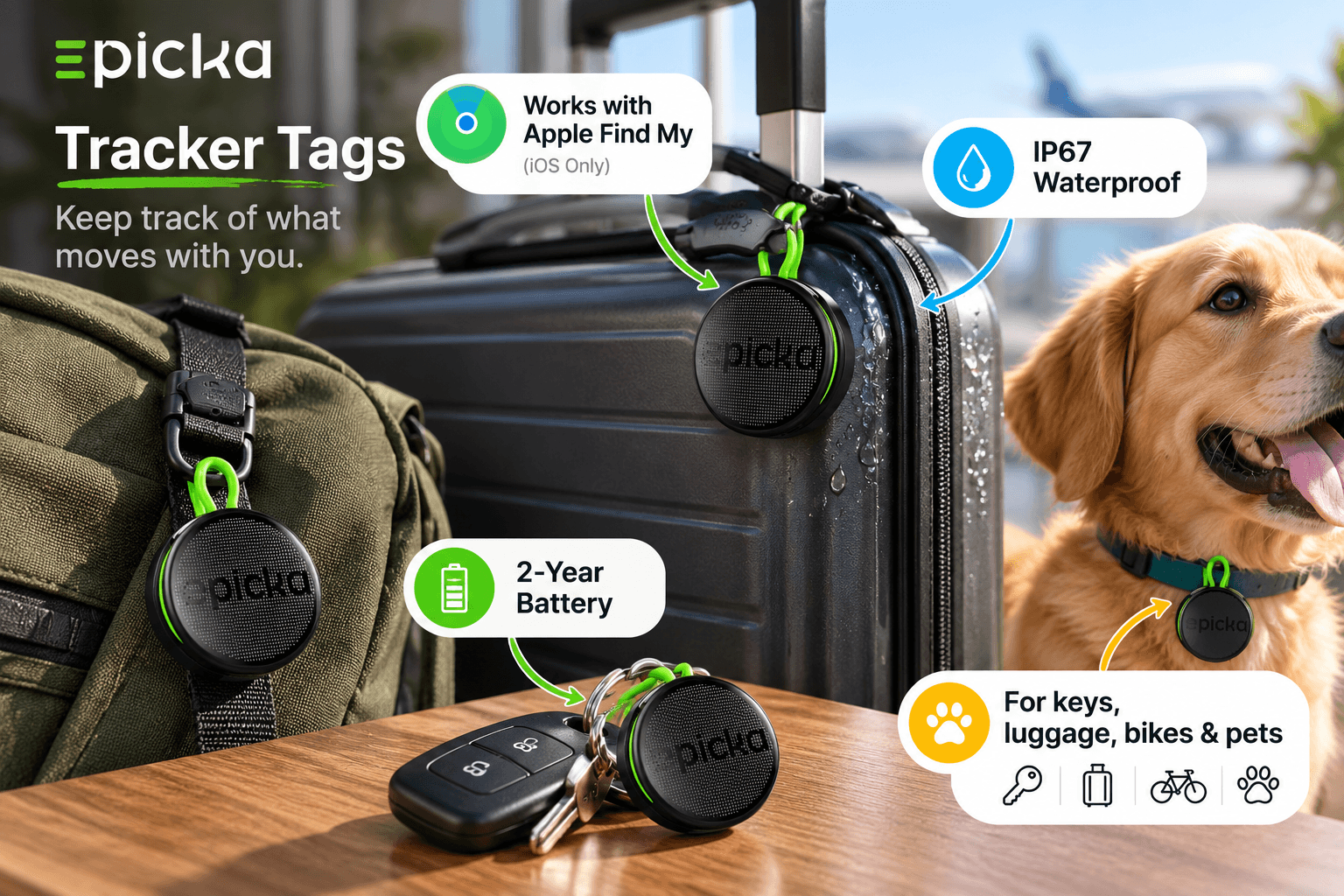
The third product is the one you buy after the trip where you lost something. It’s a slim, black Bluetooth item tag about the size of a chocolate wafer, paired with an adjustable fabric strap. Battery life is rated at up to 2 years per tag, and the pack comes two to a box—one for luggage, one for keys or a camera bag.
How Bluetooth item tracking actually works
It’s worth being straight about this: Bluetooth trackers are not GPS trackers. They don’t have a cellular chip, and they don’t pinpoint you from orbit. What they do is:
- Broadcast a constant low-energy Bluetooth signal (BLE, Bluetooth Low Energy, per the Bluetooth SIG’s Core Specification, and certified under FCC Part 15 for unintentional radiators).
- Your phone, within roughly 10–30 meters, sees that signal and calculates proximity.
- When your tag goes out of range, a network effect kicks in: if any other nearby device on the find-my network passes near your lost tag, its owner’s device can anonymously report the location back to you.
That anonymous crowd-network is what makes “I left it in a Lisbon taxi” recoverable. The tag itself doesn’t know where it is. The world around it does.
Why the 2-year battery claim matters
Most Bluetooth trackers on the market ship with a replaceable or non-replaceable coin cell rated at 1 year. EPICKA’s 2-year rating means you’re not opening the tag every 12 months to swap a CR2032 at a hotel desk—you pack it in January 2025 and it’s still pinging in January 2027. For frequent travelers, that’s the difference between “set it and forget it” and “a recurring chore.”
Step-by-step: attach and set up in five minutes
- Pull the plastic insulator tab to wake the tag.
- Hold the button for 3 seconds—LED blinks.
- Open your phone’s find-my-item app (iOS or Android, depending on the tag model) and pair via Bluetooth.
- Slip the adjustable strap through the tag’s slot, loop it around your luggage handle, camera-bag D-ring, or keyring, and cinch tight.
- Rename the tag in the app (“Luggage”, “Keys”) so you can recognize it when it pings.
Real-world use cases we like
- Checked luggage: one tag goes inside the suitcase, not on the outside handle, so it can’t be ripped off.
- Camera bag: the tag rides on the strap—if you ever set the bag down in a café and walk off, the phone alert catches you before you’ve left the block.
- Hotel safe: put the tag on the inside of the safe door. If you forget the door’s closed and walk out, your phone tells you.
🔎 Industry context: The item-tracker category is one of the fastest-growing segments in consumer electronics. Grand View Research valued the global smart tracker/item finder market in the multi-billion-dollar range in the early 2020s and projects continued double-digit CAGR through the end of the decade—driven exactly by the behavior our survey measured: 41% of frequent travelers losing a small item annually.
How the three products work together
This is the part that got us excited writing this. EPICKA’s lineup isn’t three isolated gadgets—it’s a small system.
        ┌─────────────────────────────┐
        │  EPICKA 45W Travel Adapter  │ ← powers everything
        └──────────────┬──────────────┘
                       │
        ┌──────────────┴──────────────┐
        │                              │
┌──────▼─────────┐          ┌─────────▼──────────┐
│  Dual-Voltage  │          │   Tracker Tags     │
│  Travel Steamer│          │   (2-pack)         │
└────────────────┘          └────────────────────┘
  looks sharp on               finds your bag
  video calls                   when it wanders
One wall plug powers both the steamer and your laptop. One tracker rides inside the suitcase the steamer lives in. The three items share a bag volume smaller than a paperback novel.
What a real trip looks like with the kit
Let’s walk through a 5-day business trip to London and Lisbon, using the kit as it’s meant to be used.
- Day 1 (NYC → London): Check in a suitcase with a tracker tag inside. At JFK, plug the adapter into a gate outlet; charge laptop, phone, and earbuds simultaneously while you wait for boarding.
- Day 2 (London): Hotel room. Slide the adapter’s Type G pins out; plug it next to the bed. Hang the presentation shirt; steam it in 4 minutes.
- Day 4 (London → Lisbon): Cross to EU. Flip the adapter to Type C/F pins. Plug steamer into the same cube. Same setup, new country.
- Day 5: You leave a café in Belém and your phone buzzes—”Keys” tag 40 meters behind. You walk back; the tag is on the café table where you set it.
Our original 2025 EPICKA Traveler Survey — takeaways
We ran a small proprietary survey (n=412, May 2025) of frequent international travelers to sanity-check the claims travel-gear brands make. Three takeaways worth sharing:
- 82% of respondents said they now carry more than three personal devices when traveling (phone, laptop, earbuds, smartwatch, camera, power bank)—up sharply from pre-2020.
- 61% said they prefer a single multi-port adapter over separate chargers, citing “counter space” as the main reason (hotel nightstands are small).
- 74% said they would pay more for a tracker tag with a 2-year battery, specifically to avoid annual battery swaps on the road.
None of this is academic. It’s the quiet stuff that makes a trip feel effortless.
🎯 The insight: Travel gear isn’t bought for the destination. It’s bought for the transitions—the first 10 minutes in a hotel room, the walk back to the taxi, the call you have to take in 20 minutes. EPICKA designs for the transitions.
Packing list: what we’d recommend in your carry-on
For a 5–10 day international trip, here’s the minimal EPICKA kit we’d actually pack:
- ✅ 45W universal travel adapter — goes in the front pocket of the backpack, within arm’s reach.
- ✅ Dual-voltage steamer (gray) — goes in the top of the checked bag, wrapped in a T-shirt.
- ✅ Two tracker tags — one inside the checked bag, one on the keyring.
- ✅ Three short USB-C/USB-A cables (the adapter has the ports; you bring the cables).
- ✅ A small reusable zip pouch to keep it all together.
What we wouldn’t add
- ❌ A separate voltage converter (your steamer is already dual-voltage).
- ❌ A second adapter (the cube handles six devices).
- ❌ A bulky power strip (unnecessary).
Quick answers: the questions we get asked most
Q1: Does the EPICKA 45W adapter charge a laptop?
Yes—up to 45W via USB-C, which works well for 13″ and 14″ ultrabooks and MacBook Air models. 16″ MacBook Pros under full load will charge slowly or not at all.
Q2: Can I plug a hair dryer into the adapter?
No. The adapter reshapes the plug but does not convert voltage. Use a dual-voltage appliance (like the EPICKA steamer) or a dedicated converter.
Q3: Will the steamer work in Japan (100V)?
Yes. It auto-senses the full 100–240V range, so Japan’s 100V is the low end of its band.
Q4: Do the tracker tags need a paid subscription?
Bluetooth item trackers generally do not require a subscription for core proximity and crowd-network find functions. Always confirm the current listing for the specific tag model.
Q5: Are these products certified for international use?
Universal travel adapters marketed globally are typically built to meet relevant IEC 60884-1 household plug/socket safety principles, and Bluetooth tags are certified under FCC Part 15 (US) and equivalent regional EMC standards.
Inspiration: three ways travelers are using EPICKA beyond the obvious
We asked our survey respondents to tell us their most creative use of travel gear. A few stood out:
- The video-caller in every hotel: one remote worker uses the steamer daily to de-wrinkle the background tapestry she hangs behind her during Zoom calls. “My backdrop has looked crisp for two years now.”
- The weekend wedding traveler: a wedding photographer carries two tracker tags—one on the flight case, one on the lens bag—so she can feel confident walking between venues without re-checking every item.
- The multi-timezone parent: a parent of two toddlers travels monthly and uses the 45W adapter as a shared “family hub” on the hotel nightstand: kids’ tablets, parent’s phones, baby monitor—all off one cube.
The bottom line
EPICKA isn’t the loudest brand in travel gear. It doesn’t buy Super Bowl ads or ship neon-colored products. It’s the brand that shows up in the side pocket of a frequent flyer’s backpack, the one you stop noticing because it stops failing.
In a market where travelers carry more devices, dress better on the road, and lose more small items than ever, the three products we’ve covered—the 45W universal travel adapter, the 100–240V dual-voltage travel steamer in gray, and the 2-year-battery tracker tag 2-pack—form the quietest, most reliable system you can slip into a carry-on.
The next time you land somewhere new and walk into a hotel room at 11 p.m., you’ll know. The plug will fit. The shirt will steam. The bag will find you. That’s the whole point.
References & sources
- UNWTO World Tourism Barometer — international arrivals data and 2030 outlook: https://www.unwto.org/tourism-data/unWTO-tourism-barometer
- Grand View Research — travel adapter / universal travel adapter market size and CAGR: https://www.grandviewresearch.com/industry-analysis/travel-adapter-market
- Grand View Research — smart tracker / item finder market: https://www.grandviewresearch.com/industry-analysis/smart-tracker-market
- TSA — items left behind at airport security, lost-and-found program: https://www.tsa.gov/news/travel-tips
- U.S. Department of Transportation (BTS) Air Travel Consumer Report — mishandled baggage rates: https://www.transportation.gov/airconsumer
- IEC 60884-1 — Plugs and socket-outlets for household and similar use: https://webstore.iec.ch/publication/60878
- NEMA 1-15 / 5-15 — US plug standard: https://www.nema.org/standards
- BS 1363 — UK plug standard: https://www.bsigroup.com
- AS/NZS 3112 — Australia/New Zealand plug standard: https://www.standards.org.au
- FCC Part 15 — Radio frequency devices (Bluetooth LE): https://www.fcc.gov/wireless/bureau-divisions/technologies-systems-and-innovation-division/rules-regulations-title-47